Imagery Evidence Platform for Physical Asset Histories
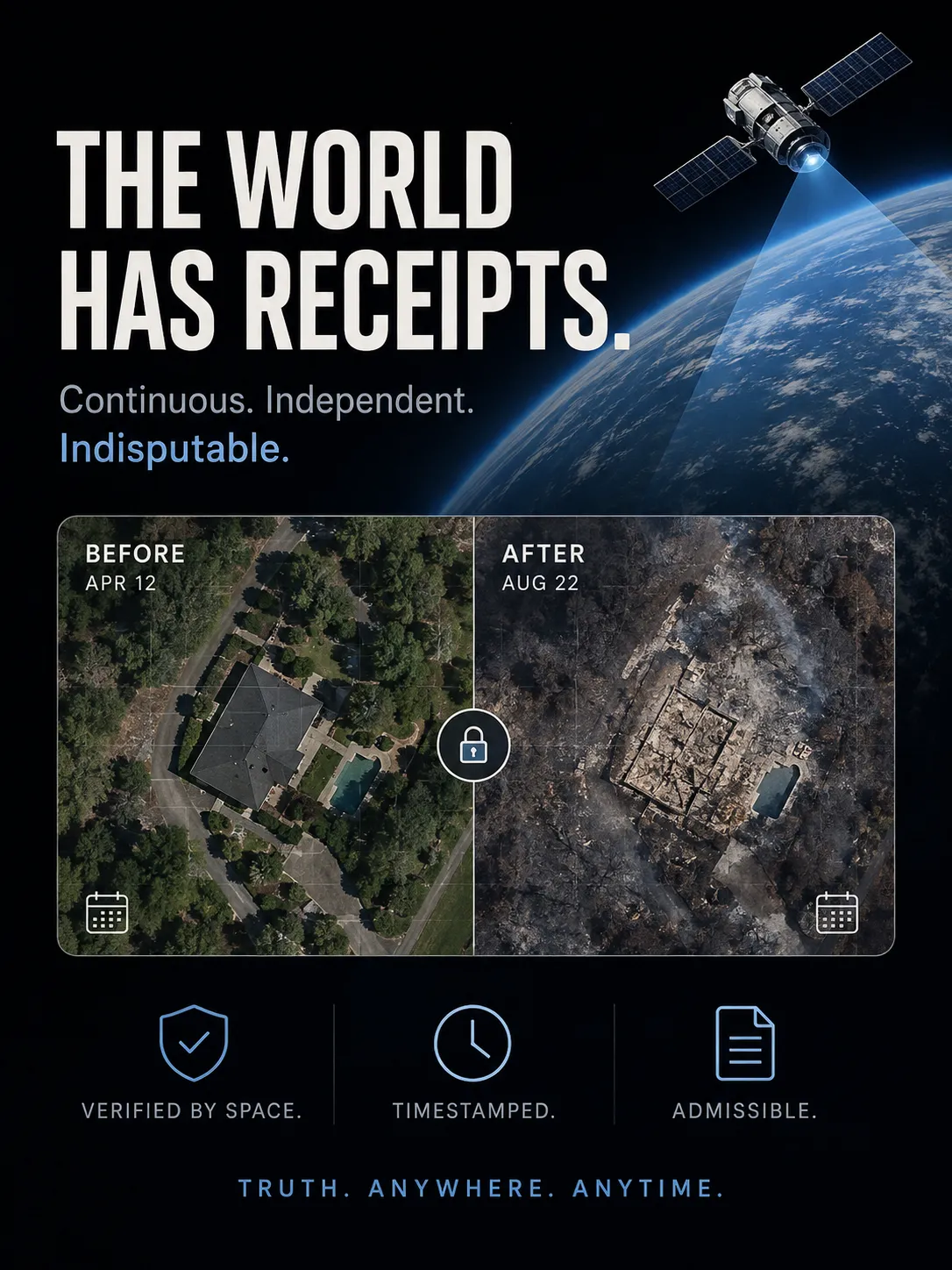
Nobody can reliably answer what a physical place looked like on a specific day six months ago. That becomes a major problem when insurers, utilities, property owners and governments disagree about when damage occurred or who should have noticed a dangerous condition. Build an evidence layer that continuously converts satellite and aerial imagery into legally defensible histories of physical assets, preserving what changed, when it changed and which party was responsible. This becomes possible as observation frequency rises and AI can interpret imagery rather than requiring humans to inspect it. After a wildfire destroys a neighborhood, an insurer could ask whether vegetation was touching a utility corridor three months earlier and receive the imagery, timestamps and change history packaged as evidence.
Description
No additional description provided.
The Pitch
Turn time itself into infrastructure. Many industries already depend on records of physical reality, but those records are strangely accidental: a site inspection, a dated photo, a maintenance note, a neighbor’s complaint. The world is full of disputes where the decisive fact is not hidden, exactly; it simply was never captured in a form that anyone can trust later. A persistent evidence layer would make the past queryable, and that is a different category from analytics. It is not predicting what might happen, but establishing what did happen.
The most valuable wedge is that liability often turns on timing. A cracked roof after a storm, a tree leaning over a power line, an unpermitted structure, a flooded access road, an uncleared drainage channel: the economic question is usually not just “what is the condition?” but “when did this condition become visible, and who had the duty to act?” That makes historical change detection unusually powerful. It converts ambiguous blame into dated evidence, which is exactly the kind of artifact large institutions will pay for because uncertainty itself is expensive.
The business would also benefit from being neutral in a way that individual parties cannot be. An insurer’s photo, a utility’s inspection log, or a property owner’s statement all arrive with suspicion attached. A third-party archive with consistent methods, provenance, timestamps and repeatable interpretation could become more trusted precisely because it is boring: the same process applied everywhere, before anyone knew which facts would later matter. In legal and regulatory contexts, evidence collected before a dispute is often more persuasive than evidence assembled after one.
There is a compounding effect hiding in the archive. Each new image is useful, but the real asset is the longitudinal memory of places: the normal condition of a corridor, roof, parcel, coastline or road before the event. Most visual AI businesses sell detection in the present; this one would sell the delta against a known past. The longer it exists, the harder it becomes to replace, because the product is not just software but accumulated custody of yesterday.
The deeper reason this should exist is that the physical world is becoming too costly to manage through episodic inspection. Climate volatility, aging infrastructure and dense regulation all increase the number of moments when someone asks, “Who knew, and when?” A company that can answer that question with credible visual history would sit at the intersection of money, responsibility and memory.