Identity Layer for AI Agent Payments
AI agents will soon pay bills, move money, negotiate balances, and manage subscriptions on behalf of consumers, but payment systems have no way to identify the agent behind a transaction or prove what it was authorized to do. An Agent Payment Passport would become the identity and authorization layer for autonomous payments. Every agent receives a verified identity and attaches a machine-readable credential to each transaction showing who owns the agent, what it was authorized to pay, its spending limit, the reason for the payment, and how disputes or reversals should be handled. A consumer could tell their financial agent to manage every household bill under $1,000, and when it pays the electric company, the utility receives both the money and cryptographic proof that the agent was authorized to send it. As agents gain the ability to execute rather than recommend financial actions, businesses will need a way to distinguish legitimate delegated transactions from mistakes, compromised agents, and unauthorized automation. Agent Payment Passport could become the trust layer between autonomous agents and the financial systems they increasingly transact with.
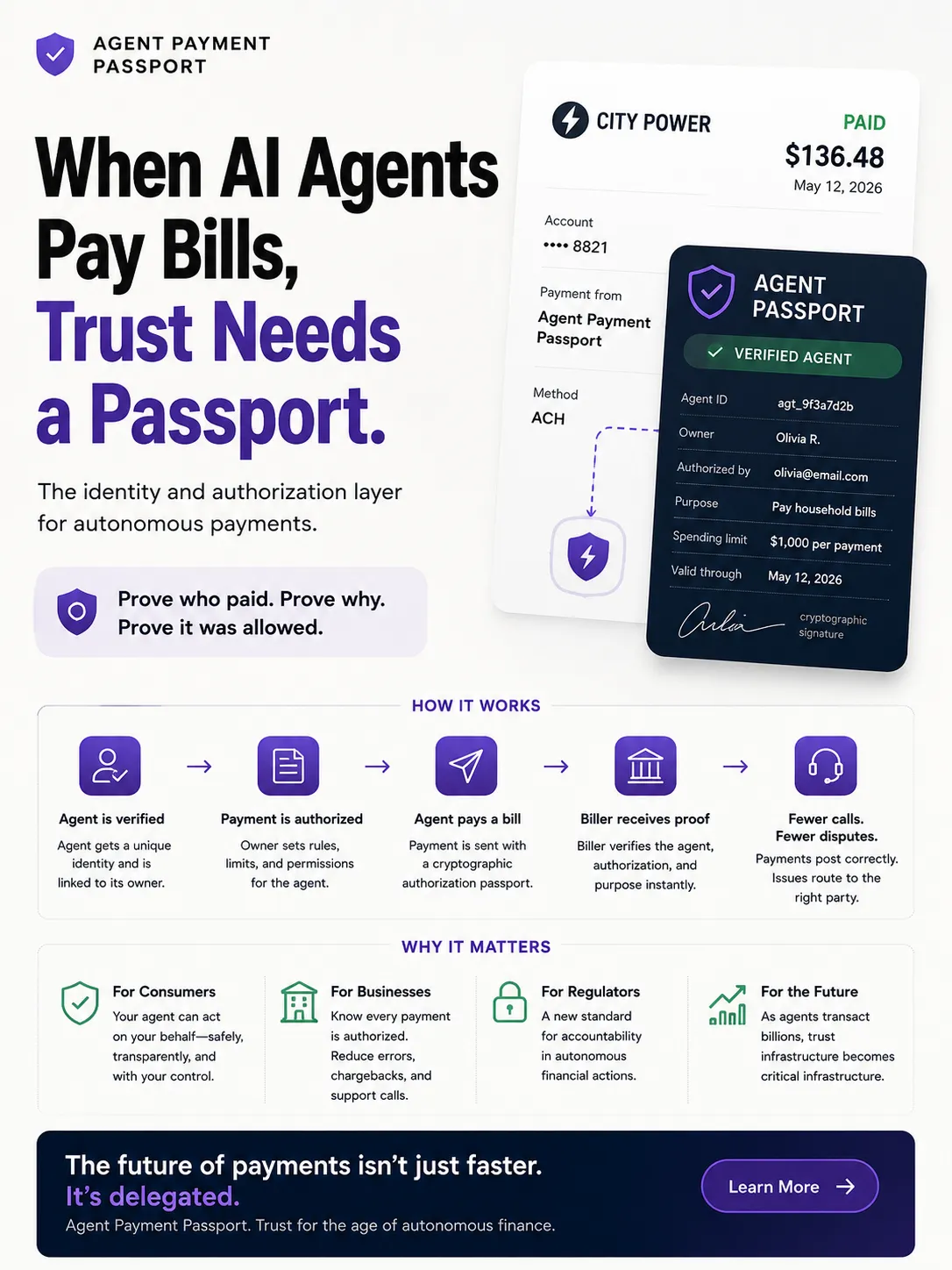
Description
No additional description provided.
The Pitch
Agent Payment Passport isolves a coordination problem before it becomes visible to most consumers. Today, payments assume the actor is either a person or a merchant system. Agents create a third category: software that is acting for a person but is not the person. That distinction sounds semantic until something goes wrong. The moment an agent overpays a bill, accepts a bad subscription renewal, or moves funds after being manipulated, every participant will ask the same question: was this authorized, and by whom?
The most valuable layer in payments is often not the movement of money itself, but the shared understanding around the movement. Card networks are powerful partly because they standardized trust: authorization, fraud rules, chargebacks, merchant identity, and liability. Autonomous agents will need an equivalent grammar. Without it, every bank, biller, wallet, agent developer, and consumer platform will invent its own proof format and risk policy, which would make agent-driven commerce brittle and slow. A common passport turns agent behavior from an opaque automation event into something institutions can reason about.
This is especially compelling because the buyer’s pain is defensive before it is aspirational. Businesses may not initially want agent traffic, but they will have to accept it once consumers delegate more financial tasks. Refusing agents will feel like refusing online payments once customers expect them; accepting them blindly will create fraud, disputes, and compliance exposure. The passport sits in the narrow but powerful gap between “block the future” and “trust anything that looks automated.”
The business also benefits from an unusual accumulation of context. Each transaction credential creates a record not just of payment, but of delegated intent: what the consumer allowed, what the agent decided, and what the counterparty accepted. Over time, that becomes a reputation system for agents, issuers, merchants, and permission templates. The company that authenticates the transaction can become the place where financial institutions learn which agents are safe, which permissions are normal, and which patterns indicate abuse.
The deeper insight is that autonomy does not remove the need for institutions; it increases the need for legible delegation. As software begins to act independently, the scarce resource is not intelligence but acceptable authority. A company that makes machine decisions understandable to payment systems would occupy a small-looking but foundational position: the notary for a world where consumers no longer click every button themselves.