Human Verification API for AI Agent Actions
AI agents are gaining permission to move money, modify infrastructure, sign agreements and execute actions where a single mistake could cause enormous damage. Human Required is an API companies place in front of consequential actions that forces an authorized person to complete a physical verification the agent cannot perform itself. As autonomous agents move from answering questions to controlling real systems, companies will need a way to guarantee that certain decisions cannot happen entirely machine-to-machine. A corporate treasury agent could prepare a $20 million wire, but releasing the money requires the CFO to tap a registered hardware device sitting on their desk.
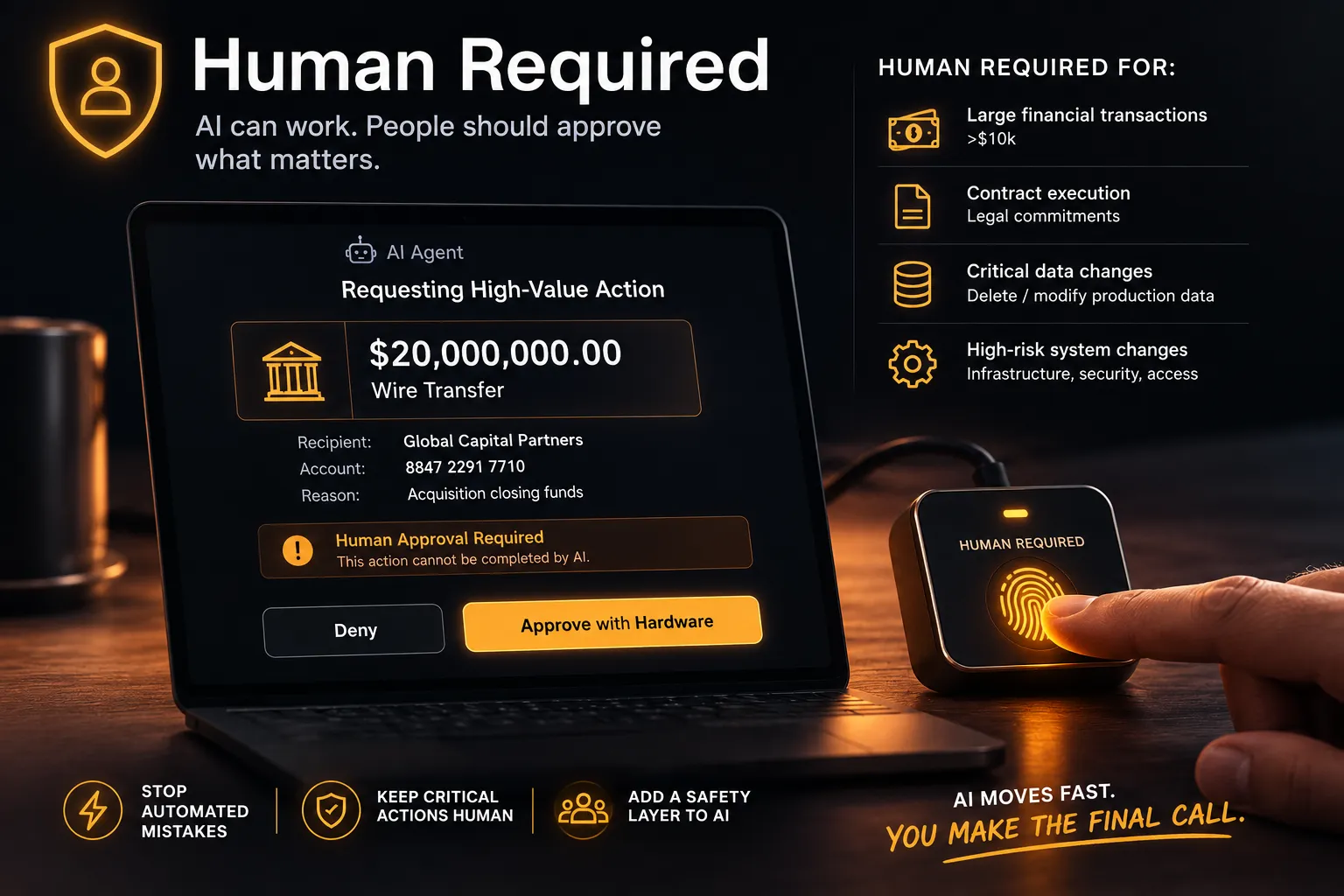
Description
No additional description provided.
The Pitch
Autonomy does not eliminate the need for authority; it makes authority harder to prove. As more work is delegated to agents, the question stops being “did the software follow policy?” and becomes “was there ever a real human moment of consent?” That distinction will matter most in places where after-the-fact audit logs are too late: money moved, servers deleted, contracts signed, credentials rotated. A company that can create a durable, machine-resistant proof of human presence becomes part of the control surface for the agent economy.
The business works because the highest-value AI actions will be concentrated behind a small number of irreversible gates. Most agent behavior should remain fast and automated, but a tiny fraction of actions will carry disproportionate risk. That creates an elegant wedge: the product does not need to supervise everything an agent does. It only needs to become the required checkpoint before the dangerous moments. The more capable agents become, the more valuable the checkpoint becomes, because the gap between routine automation and catastrophic automation widens.
There is also a subtle trust problem inside companies that ordinary identity tools do not solve. Passwords, SSO, device certificates, and approval workflows can all be mediated by software, copied into sessions, socially engineered, or delegated away. What companies will increasingly need is not just authentication, but friction with a purpose: a physical act that proves an accountable person was actually present and aware at the moment of consequence. In a world of synthetic emails, cloned voices, remote sessions, and autonomous execution, “the CFO touched the thing on their desk” may become a surprisingly powerful primitive.
This could become valuable infrastructure because every serious company will want its own policy about where humans must remain in the loop, but none will want to build and defend that mechanism themselves. The hard part is not the button; it is making the button acceptable to auditors, insurers, boards, regulators, banks, and security teams as evidence that a boundary was real. Once that trust exists, the API becomes less like a feature and more like a shared ritual for high-stakes automation.
The deeper thesis is that the future will not be fully autonomous or fully manual. It will be mostly autonomous, with deliberately preserved human bottlenecks at the points where responsibility cannot be delegated. Human Required would sell the bottleneck.