Human Review API for AI Workflows
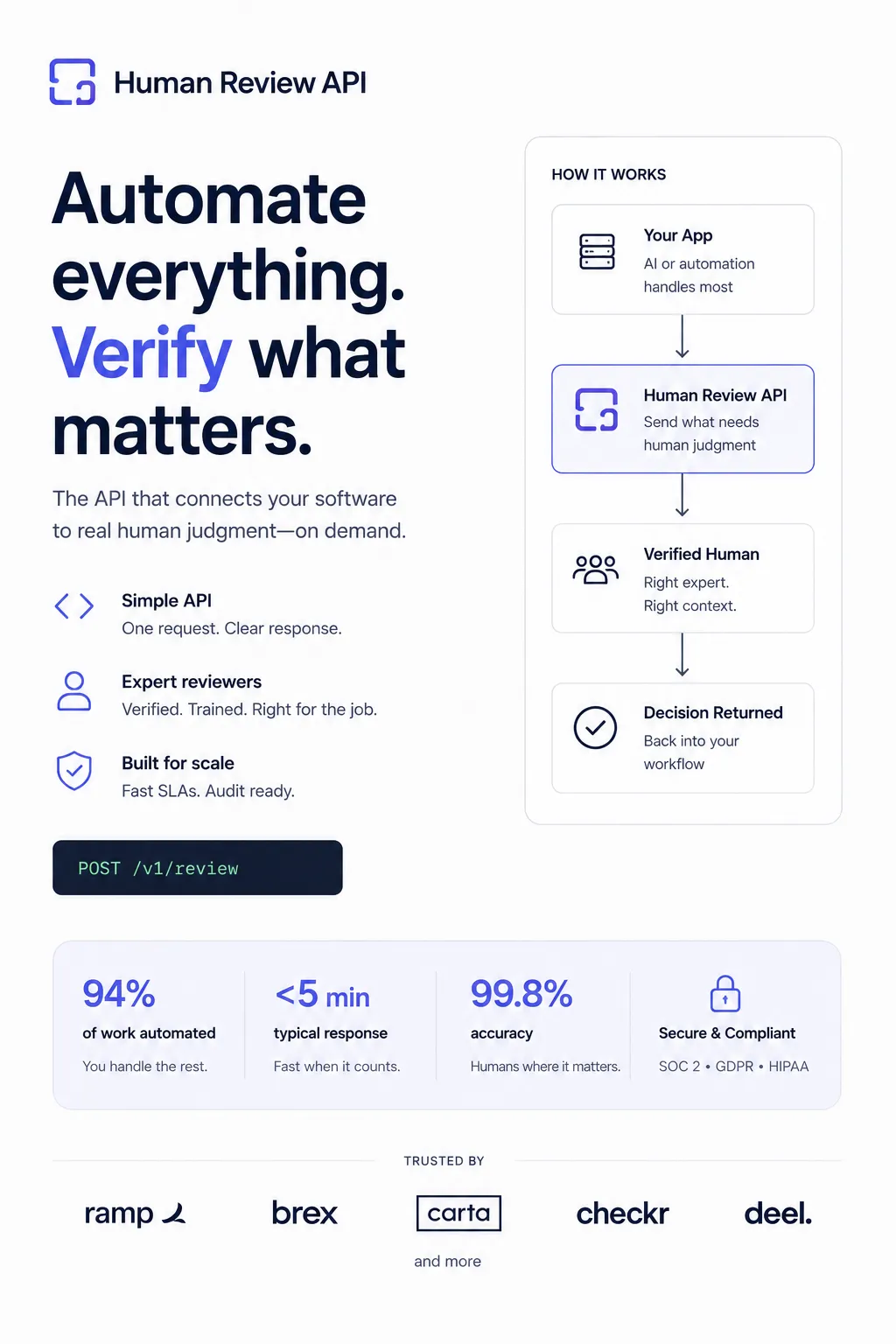
AI products increasingly automate 90% or 95% of a workflow, but the remaining cases still require a human with the right judgment, credentials or context. Human Review API gives software a programmable way to send those exceptions to verified reviewers with defined expertise, price and SLA, then returns the decision directly into the workflow. Why now: AI is creating more partially automated products where the last mile cannot safely be handled by the model, but companies still staff that layer manually. Example: an insurance platform automatically processes 94% of applications and sends the remaining 6% through an API to qualified reviewers instead of maintaining enough internal staff for peak volume.
Description
No additional description provided.
The Pitch
The interesting shift is that “human in the loop” stops being a custom operations function and becomes infrastructure. Today, every company that needs expert judgment at the edge of automation rebuilds the same messy layer: recruiting reviewers, checking qualifications, scheduling coverage, managing quality, and wiring decisions back into software. A common API would turn that from an internal department into a callable resource, much like payments or identity verification became standardized components rather than bespoke back-office work.
The strongest businesses here would not just sell labor. They would sell confidence in the boundary between automation and accountability. As AI handles more routine work, the remaining cases become more valuable, ambiguous, and risky. Those are precisely the cases where companies need an auditable answer from someone who is allowed to make it. The reviewer’s credential, reasoning, timestamp, and decision trail may matter as much as the decision itself, especially in regulated or high-stakes workflows where “the model said so” is not an acceptable explanation.
The market could also be pulled forward by a counterintuitive dynamic: better automation may increase demand for specialized human review rather than reduce it. When software can process most cases instantly, companies become less willing to build permanent teams sized for rare exceptions. The residual work becomes spiky, specialized, and fragmented across many products. That shape is poorly suited to traditional hiring but well suited to a networked review layer that can aggregate exception volume across customers.
The defensibility would come from trust density. A generic marketplace of freelancers is not enough; the valuable asset is knowing which reviewers are qualified for which decisions, how their judgments compare over time, and where their work is accepted by customers, auditors, insurers, or regulators. Over time, the system could become the place where expertise is measured, routed, and reused across software environments. That creates a richer form of reputation than ratings: a record of decisions made under real constraints.
The broader thesis is that AI does not eliminate human judgment; it changes where that judgment lives. Instead of sitting inside every company as a fixed cost, it can become an external, programmable layer attached only to the moments that need it. If software is going to keep expanding into consequential work, the companies that make the human fallback fast, reliable, and legible may become as important as the models themselves.