Human Judgment Automation for AI Quality Review
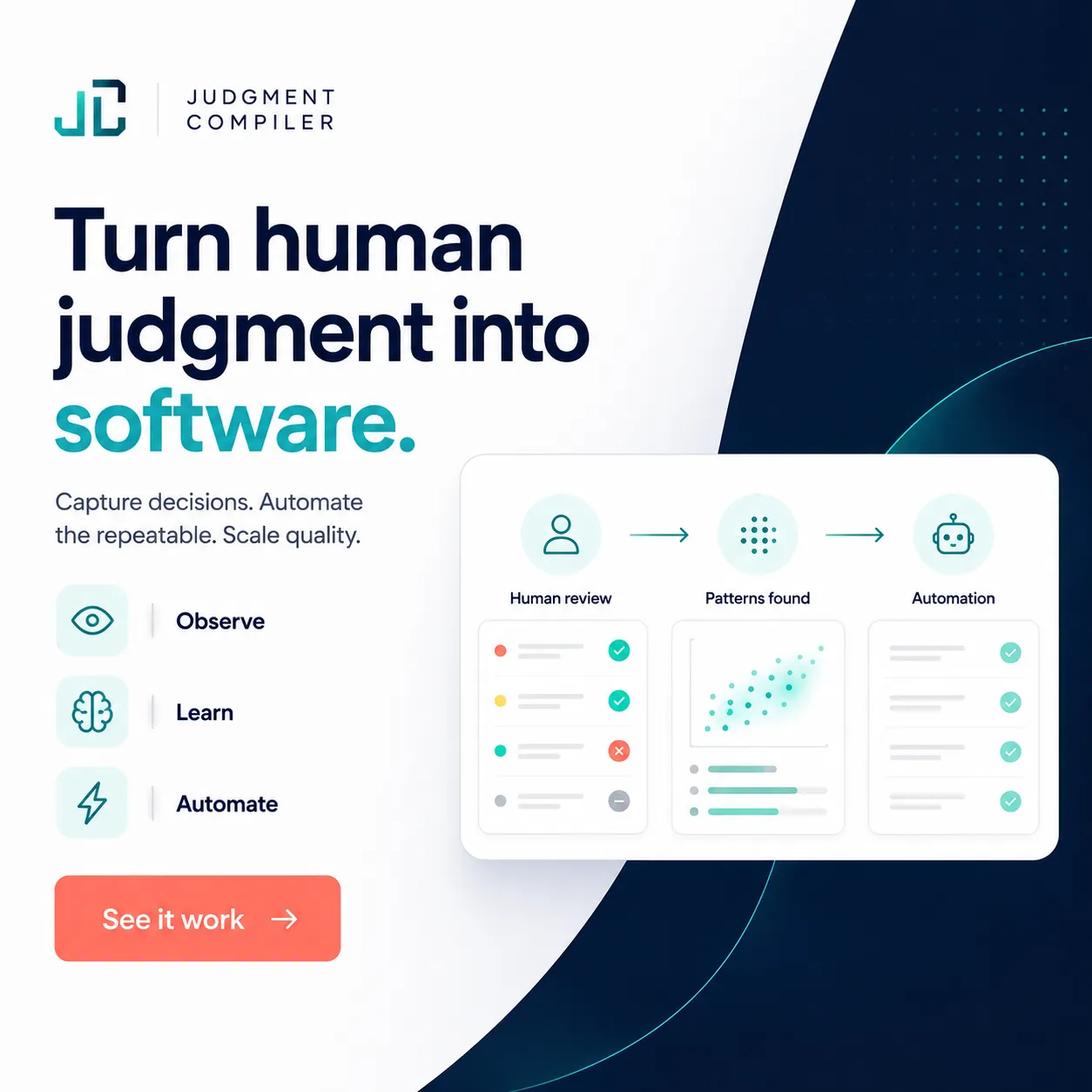
Companies often have a few people who know how to fix model failures, review edge cases, interpret weird inputs or keep quality acceptable, but that judgment lives in their heads. Judgment Compiler would watch those humans work, capture the decision context, learn the recurring rules and progressively turn their judgment into executable logic, tests and agent behavior. Why now: AI systems increasingly depend on human review, and that review already produces the feedback needed to improve models and routing logic. Example: three editors manually fix 800 model outputs each weekend. The system observes what they change and why, automates the recurring 70%, and sends only genuinely novel cases back to humans.
Description
No additional description provided.
The Pitch
Human judgment is not as labor to be replaced, but as a scarce operational asset that is currently leaking out of companies every day. Most organizations do not know their own decision rules as well as they think they do. The real rules live in exceptions, workarounds, Slack explanations, reviewer comments, and the hands of the person everyone asks when the system gets something strange. A company that can turn that invisible expertise into durable software would be capturing one of the least formalized but most valuable layers of modern operations.
The important shift is that many AI failures are not “model problems” in the abstract; they are translation problems between messy reality and institutional taste. Two companies can use the same underlying model and want different answers because their standards, risk tolerance, brand voice, legal posture, and customer promises are different. That local judgment is hard to buy off the shelf. If it can be learned from repeated human corrections, the resulting system becomes more valuable over time precisely because it is shaped by the company’s own edge cases.
This also creates an unusually strong loop between doing work and improving the work. In most process automation, someone has to stop and document rules before software can be built. Here, the documentation is a byproduct of expert review. Every correction is both an operational act and a training signal. That matters because the people with the best judgment are usually too busy applying it to formalize it. The business works if it makes expertise compound without asking experts to become process designers.
A subtle advantage is that it gives companies a way to preserve accountability while reducing dependence on individual reviewers. Full automation often feels dangerous because nobody can explain why the system behaved a certain way. Pure human review is expensive and inconsistent. Compiled judgment sits between the two: it can expose the patterns behind decisions, create tests from past mistakes, and route only the truly unfamiliar cases back to people. That makes automation feel less like a black box and more like institutional memory becoming operational.
The deeper opportunity is that AI adoption will make judgment bottlenecks more visible, not less. As models generate more work, the constraint becomes the few humans trusted to say what is acceptable. The company that learns from those people fastest becomes the system of record for how an organization thinks when the answer is not obvious.