Human Intent Verification for High-Value Transactions
Deepfakes are making it increasingly easy to impersonate someone’s voice or face, which means proving identity alone may no longer be enough for high-stakes transactions. Intent Ceremony would create a short, transaction-specific proof that a real person was present, understood the exact action, and authorized it, using randomized live challenges tied to the amount, recipient, contract, or decision being approved. As AI-powered impersonation attacks become cheaper and more convincing, banks and enterprises will need evidence of human intent rather than just authentication. A CFO sending a $4 million wire would have to demonstrate awareness of the recipient, amount, and purpose before the bank accepts it, producing a cryptographic receipt that a stolen voice or video could not generate.
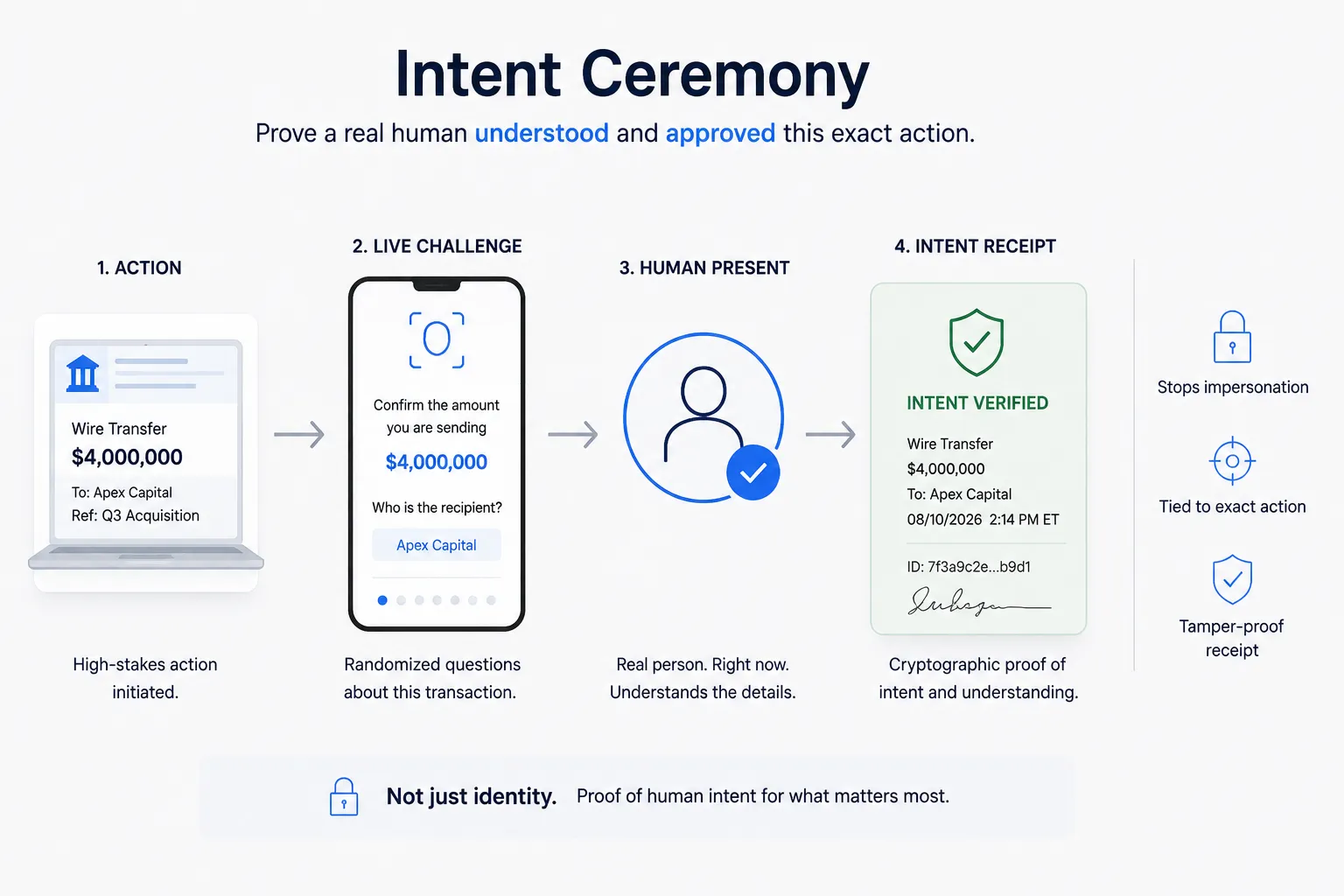
Description
No additional description provided.
The Pitch
Identity is becoming too weak a primitive for serious authorization. For years, security systems asked, “Is this the right person?” Deepfakes turn that into the wrong question. The more valuable question is, “Did the right person consciously mean to do this exact thing?” A business built around that distinction would sit at the moment where trust actually matters: not login, but irreversible action.
The most interesting part is that intent is naturally contextual. A face scan may be reusable, a password may be stolen, and a voice may be cloned, but a person demonstrating comprehension of a particular transaction at a particular moment is harder to fake in advance. The ceremony creates evidence that is bound to meaning, not merely to biology. That makes it closer to a digital notarization of judgment than another authentication factor.
This would matter because the cost of false authorization is asymmetric. A bank, insurer, board, law firm, or enterprise does not need this for every click; it needs it for the rare actions where being wrong is catastrophic. That creates a narrow but valuable wedge: large wires, signing authority, privileged access, legal approvals, major configuration changes, and consent events where “our system verified the user” will no longer satisfy auditors, counterparties, or courts.
There is also a subtle institutional benefit: it gives organizations a defensible record of human awareness without forcing them to become investigators of synthetic media. Instead of trying to determine whether every audio clip, video call, or executive instruction is real, they can require a structured proof at the point of action. The business becomes valuable not because it detects every fake, but because it changes the rules of acceptance.
If this existed, it could become part of the trust layer for high-consequence digital decisions. The enduring company would not be the one with the cleverest liveness test, but the one whose receipts become accepted as evidence that a person understood and authorized an action. In a world where likeness is abundant and cheap, proof of situated intent becomes scarce, and scarce trust primitives tend to become infrastructure.