Home Recycling Factory for DIY Materials
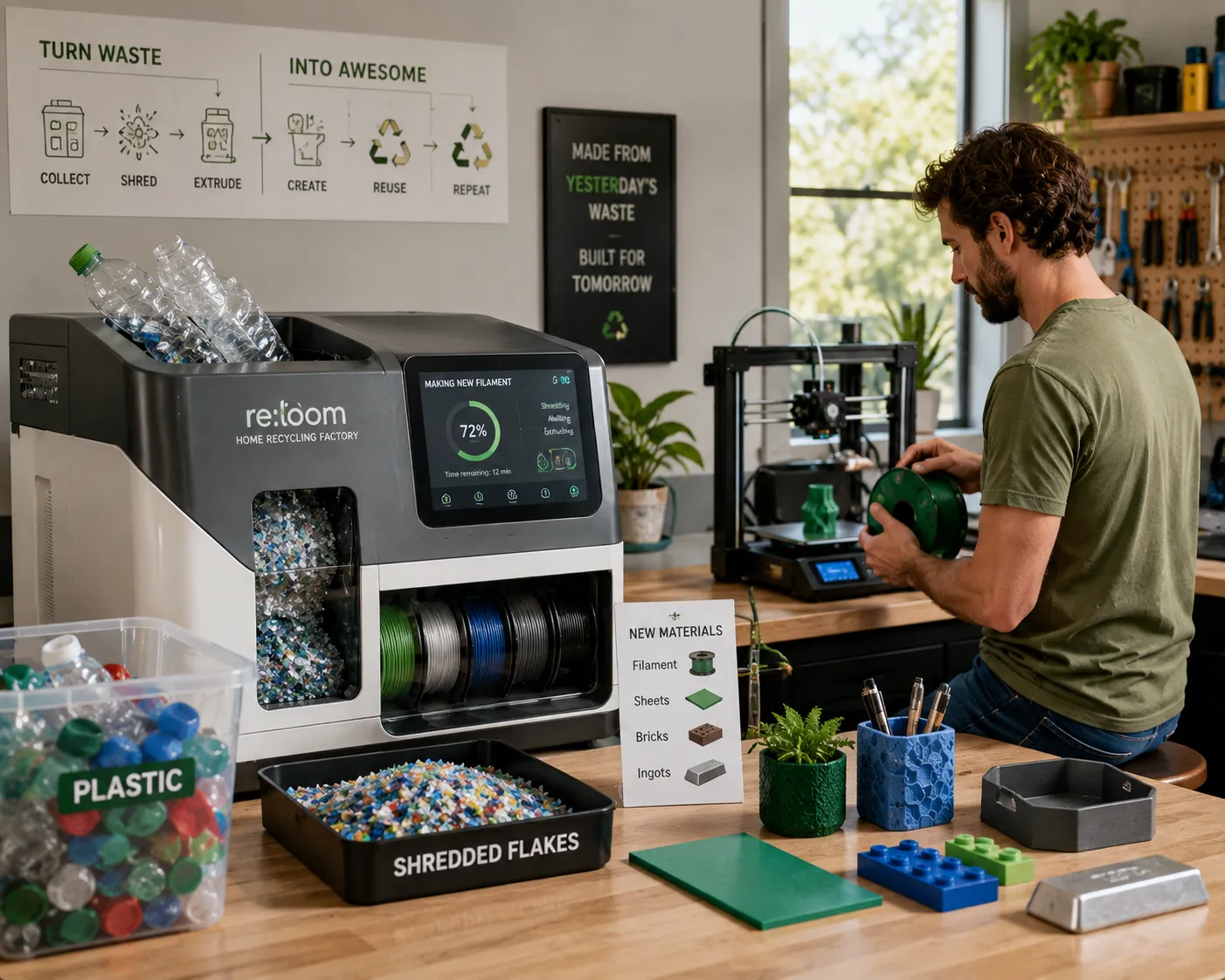
Most household recycling disappears into a black box, leaving consumers with little visibility into what actually happens to their waste. Meanwhile, makers, hobbyists, and homeowners continue buying raw materials for 3D printers and DIY projects despite throwing away valuable plastic and aluminum every day. A Home Recycling Factory closes that loop by converting household waste into usable materials like 3D printer filament, construction bricks, plastic sheets, aluminum ingots, or other raw components that can immediately be reused around the home. Instead of shipping recyclable materials across the country, homeowners transform yesterday's trash into tomorrow's projects. As 3D printing becomes mainstream and consumers become increasingly interested in sustainability and self-sufficiency, the technology is approaching a point where small-scale manufacturing can move into the home. Imagine finishing a case of bottled water, feeding the empty bottles into a countertop recycler, and printing replacement hooks, planters, storage bins, or toys from the same plastic the next morning.
Description
No additional description provided.
The Pitch
A home recycling factory would be compelling because it changes recycling from a moral act into a material advantage. Most sustainability products ask people to pay more, tolerate inconvenience, or accept a worse version of what they already use. This flips the emotional equation: waste becomes inventory. The household stops seeing plastic and aluminum as guilt and starts seeing them as feedstock, which is a much stronger habit loop than environmental obligation.
The business also sits at the intersection of two behaviors that have historically been separate: disposal and making. Recycling is usually an endpoint, while DIY is a starting point. Connecting them creates a strange but powerful continuity inside the home. The more someone makes, repairs, prints, builds, or experiments, the more valuable their waste stream becomes. That makes the product more than an appliance; it becomes a domestic materials system, where the home slowly learns to metabolize its own excess.
Its most interesting advantage is that it could make raw material feel personal. A roll of filament bought online is anonymous and replaceable; a spool made from your own packaging has a story, a cost basis near zero, and an oddly satisfying provenance. People already pay premiums for tools that make them feel capable—espresso machines, sewing machines, laser cutters, workshop equipment—even when the economics are imperfect. This would belong to that same category: not merely saving money, but giving the owner a new kind of agency.
There is also a trust gap in municipal recycling that a home system could exploit without needing to solve the entire waste problem. Consumers have learned that the blue bin is often symbolic, contaminated, or dependent on distant commodity markets. A machine that visibly turns waste into something useful offers proof at the exact point where the current system is most opaque. The value is not just the output material; it is the disappearance of doubt.
The broader thesis is that homes are becoming smaller factories again. Cooking returned from packaged food into appliances and countertop rituals; energy is shifting from grid-only consumption toward batteries and solar; manufacturing may follow the same pattern at a household scale. If fabrication tools keep spreading, the missing piece is not imagination but material supply. A home recycling factory would make the house less like the end of a supply chain and more like a tiny circular economy.