Healthcare Subscription Comparison Marketplace
Healthcare is rapidly becoming subscription-based: concierge doctors, lab testing, fertility care, GLP-1 management, physical therapy, mental health, dermatology, longevity clinics, and more. Consumers have no easy way to compare these offerings or optimize what they’re paying for. This company becomes the “Kayak” for healthcare subscriptions, helping users assemble the best combination based on budget, conditions, and goals while continuously optimizing as better options emerge.
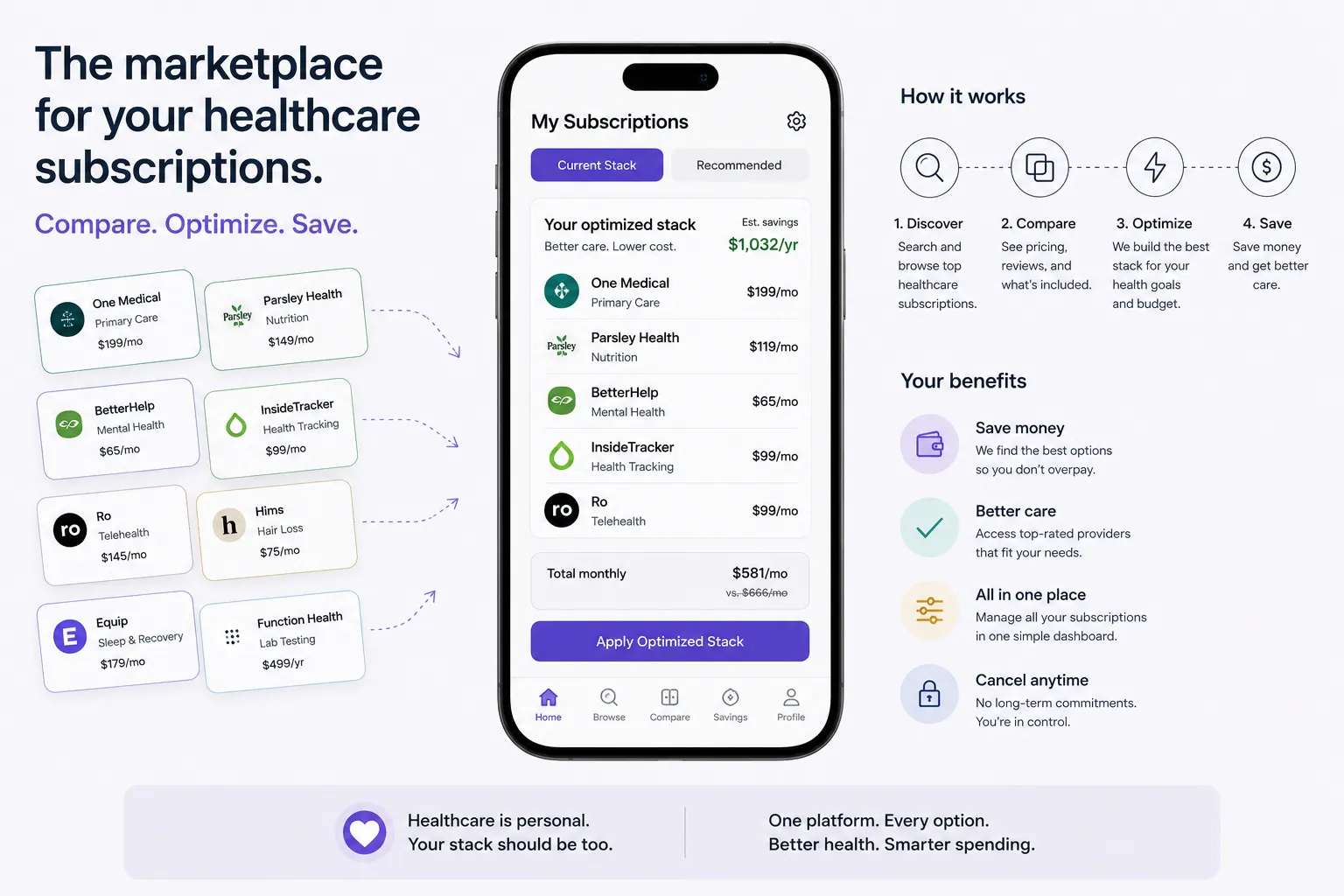
Description
No additional description provided.
The Pitch
Healthcare subscriptions is that they are sold like consumer products but behave like infrastructure. A person does not experience them as isolated purchases; they experience them as an overlapping stack of access, tests, prescriptions, visits, refills, and exclusions. The waste is not just paying too much for one service. It is paying for three services that each solve 40% of the same problem while leaving the crucial 20% uncovered.
A comparison layer becomes valuable because healthcare choice is increasingly shifting from “which doctor takes my insurance?” to “which bundle of care actually fits my life?” That is a much harder question than price comparison. The right answer depends on medication history, location, risk tolerance, family plans, frequency of labs, preferred communication style, and whether a customer needs diagnosis, maintenance, or escalation. The business works if it can translate messy personal needs into practical purchasing decisions better than either a marketplace or a doctor’s office can.
The non-obvious opportunity is that optimization does not end at checkout. Healthcare subscriptions decay. Introductory prices expire, formularies change, clinicians leave networks, protocols improve, and a person’s needs shift after a diagnosis, pregnancy, weight-loss plateau, injury, or new medication. A static directory captures attention once; a living advisor earns trust by noticing when the stack no longer makes sense. In a market where churn is usually a provider’s problem, this company could make churn a consumer benefit.
There is also a power imbalance waiting to be corrected. Subscription healthcare companies know exactly where their offering is strong, vague, or economically engineered; consumers mostly see polished landing pages and testimonials. A neutral layer that compares what is actually included, what happens when something goes wrong, how escalation works, and where hidden costs appear would make the category more legible. In healthcare, legibility itself is a product.
If this company existed at scale, it would sit in a rare position: close enough to the consumer to understand intent, but broad enough across providers to see market truth. It would know which services are quietly effective, which are mostly branding, and which combinations produce unnecessary duplication. That knowledge compounds. The business is compelling because the more fragmented subscription healthcare becomes, the more valuable it is to have someone whose only job is to make the fragments add up.