Health Benefits Payment API
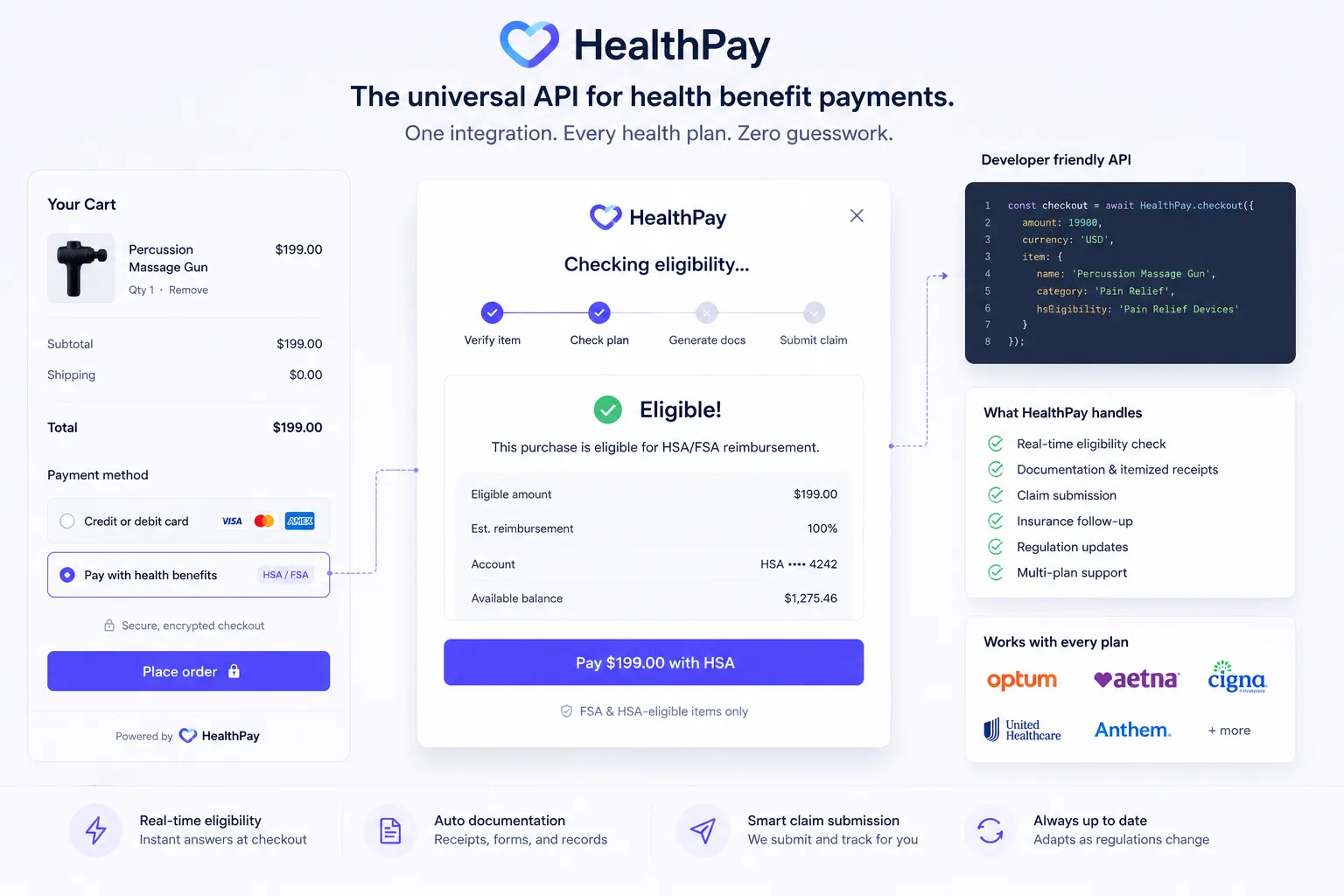
Americans have billions of dollars sitting in HSA and FSA accounts, yet most health purchases still require customers to guess whether they'll qualify for reimbursement. Imagine a universal API that sits behind every health and wellness checkout, instantly determining eligibility, generating the required documentation, submitting claims, and adapting as regulations change. Instead of every brand building its own healthcare compliance system, developers simply add a "Pay with Health Benefits" button and let the infrastructure handle the rest. As consumers spend more on preventative health and telehealth becomes mainstream, healthcare payments should be as seamless as online payments.
Description
No additional description provided.
The Pitch
HSA and FSA dollars behave less like money than permissioned money. They are nominally owned by consumers, but every transaction carries a hidden question: will this count? That uncertainty turns a pre-tax benefit into a source of friction, breakage, and customer support. A company that can reliably translate “is this allowed?” into a real-time checkout decision would not just move payments; it would make restricted healthcare dollars feel liquid.
The most interesting wedge is that eligibility is not purely a payments problem or purely a compliance problem. It sits in the messy middle between merchant category codes, product-level details, letters of medical necessity, plan rules, IRS guidance, and documentation standards. That middle is exactly where individual merchants are weakest. A mattress company, supplement brand, telehealth provider, or fertility startup may know its product, but it does not want to become an expert in benefits substantiation. Shared infrastructure becomes more valuable than bespoke internal work because the same regulatory interpretation can be reused across thousands of checkouts.
There is also a subtle demand-side advantage: consumers do not need to be convinced to spend new money. The money is already there, often mentally set aside for health, and in many cases at risk of being underused or awkward to access. Reducing uncertainty at the moment of purchase can change behavior more than a discount, because it converts a questionable out-of-pocket expense into an obvious use of allocated funds. The product would expand merchants’ effective purchasing power without asking consumers to stretch their budgets.
The business could also benefit from the fact that healthcare commerce is becoming more retail-like while healthcare payment rules remain institution-like. Consumers now buy diagnostics, virtual care, recovery tools, women’s health products, metabolic programs, and therapeutic devices through modern digital storefronts, but the reimbursement layer still feels built for fax machines and benefits administrators. The gap between how health products are discovered and how they are paid for is widening, which creates room for a neutral layer that normalizes the transaction.
The strongest version of this company would become a kind of eligibility memory for the healthcare internet. Each transaction, denial, documentation pattern, and rule change would make the system better for the next merchant and the next consumer. That compounding knowledge is hard for any single brand to match, and it turns a dull administrative burden into a defensible network of interpretations, evidence, and workflows.