Guaranteed Capacity Marketplace for API Partners
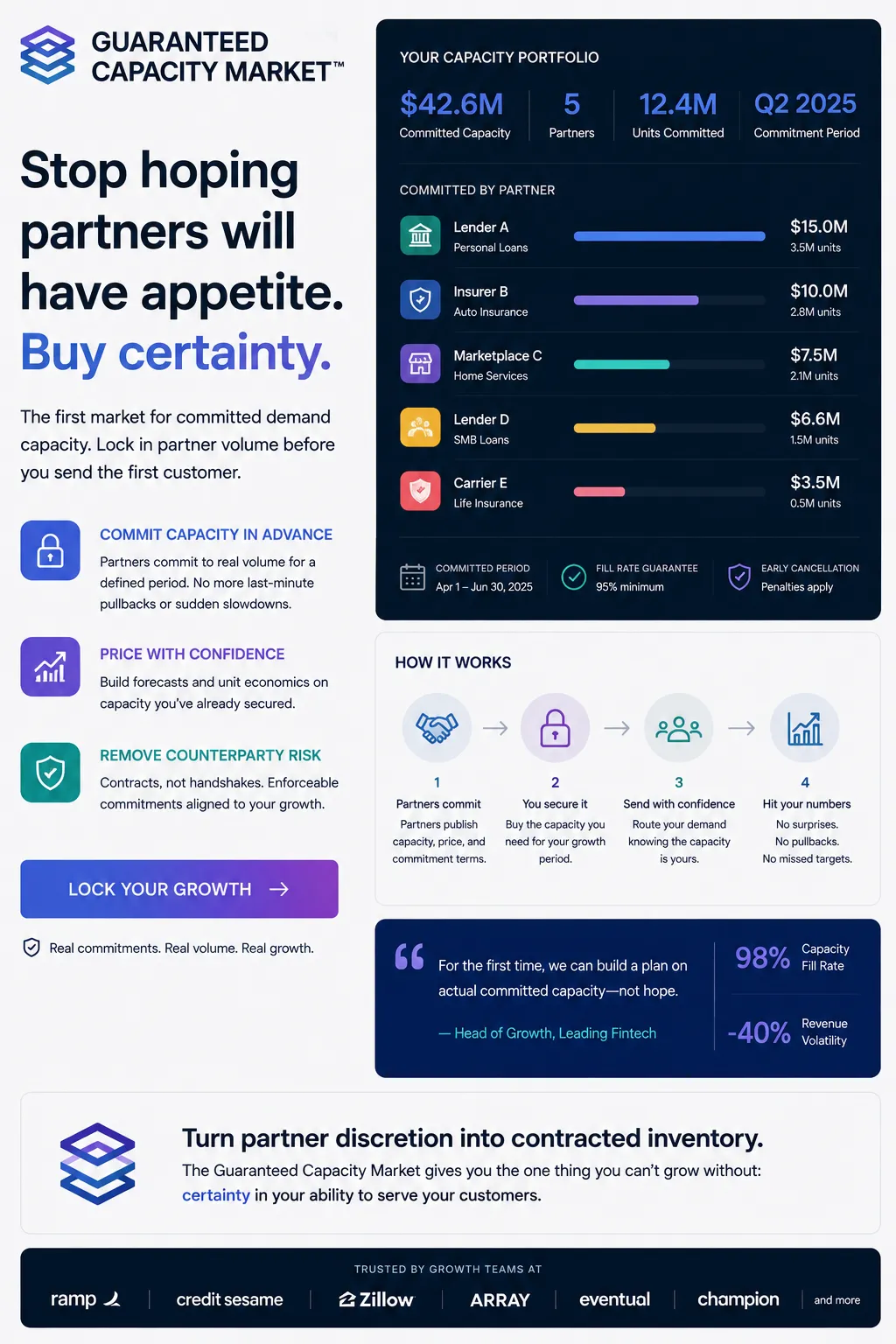
Partner agreements usually promise access but not actual capacity. A Guaranteed Capacity Market would let distributors purchase committed demand capacity in advance. Lenders might commit to fund $20M of a borrower segment next quarter, insurers commit to quote a defined volume, or marketplaces guarantee a minimum level of inventory or placement. Why now: companies increasingly depend on API-based partners but still contract them using relationship-era agreements with almost no enforceable volume commitment. Example: a fintech expecting 40,000 qualified applications buys guaranteed capacity from five lenders rather than hoping their appetite remains available. The innovation is turning discretionary partner appetite into contracted inventory.
Description
No additional description provided.
The Pitch
Capacity is the hidden input in many digital businesses, yet it is treated as if it were infinite until the moment it disappears. A company can spend heavily to acquire borrowers, sellers, patients, merchants, or policyholders, only to discover that the partner who completes the transaction has quietly reduced appetite, changed criteria, or hit an internal limit. The business opportunity sits in that mismatch: modern demand generation is measurable and scalable, but partner willingness remains opaque, informal, and revocable.
The most interesting part is that this turns “partner risk” from a relationship problem into a tradable operational asset. Many companies already forecast demand with increasing precision, but they cannot reserve the downstream capacity needed to monetize it. If capacity can be defined, committed, and monitored, it becomes closer to cloud computing or freight space than a handshake. That shift creates a new kind of market: not for leads, clicks, or introductions, but for the right to convert qualified demand into completed transactions.
It also changes behavior on both sides. Buyers of capacity get confidence that their growth does not depend on a partner’s shifting mood. Sellers of capacity get a way to monetize underused balance sheet, underwriting bandwidth, quote volume, inventory, or fulfillment slots before demand arrives. The non-obvious insight is that unused capacity is not just waste; it is perishable inventory. Once a quarter passes, the lender who could have funded more loans, or the insurer who could have quoted more policies, cannot recover that lost opportunity.
A market like this would become more valuable as partner ecosystems become more automated. APIs make it easy to route demand instantly, but they also make partner relationships easier to switch and harder to trust. The missing layer is not connectivity; it is commitment. The company that records, prices, and enforces capacity would occupy a powerful position because it would see both sides of the market’s true constraints: who has demand they can prove, and who has capacity they are willing to stand behind.
The enduring business is not merely selling certainty. It is creating a new primitive for commerce between companies: reserved economic willingness. Once that exists, planning changes. Growth teams stop guessing whether supply will be there. Capacity providers stop waiting passively for volume. And entire categories that currently run on soft promises begin to operate with something closer to inventory discipline.