Financial Title Registry for AI Compute
Hundreds of billions of dollars may soon be lent against AI infrastructure, but there is no universal system for establishing the financial identity of a piece of compute: who owns it, what debt sits against it, where it has been, how hard it has been used, and whether someone else has already pledged it as collateral. Compute Title Registry would create a persistent financial title for GPUs and clusters, combining ownership, liens, utilization history, repairs, location, benchmark degradation and residual value into a record that follows the hardware for life. As AI infrastructure shifts toward private credit, leases and asset-backed financing, lenders will need more than a spreadsheet saying "10,000 H100s." A lender financing a 20,000-GPU cluster could check its titles before funding, then transfer those titles when the machines are eventually sold. Carfax meets UCC filings for compute.
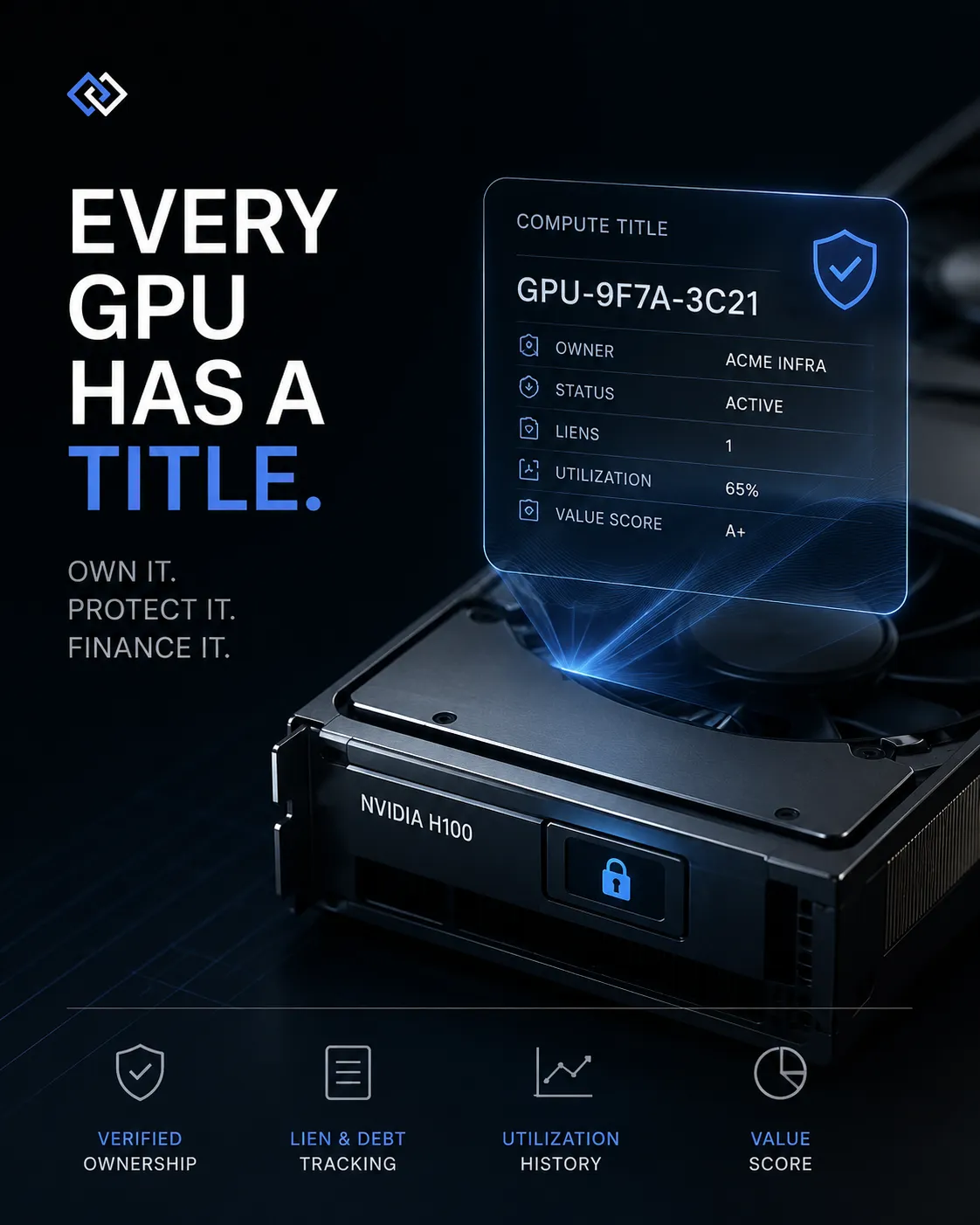
Description
No additional description provided.
The Pitch
AI compute is starting to behave less like IT equipment and more like rolling stock, aircraft engines, or commercial real estate: expensive, financed, mobile, reused, and dangerous to misunderstand. A GPU is not just a chip once it becomes collateral. It becomes a financial object whose value depends on provenance, encumbrances, location, operating history, and trust in the seller. Markets develop registries when the cost of not knowing becomes larger than the cost of recording.
The strange thing about compute is that its financial value can deteriorate invisibly. Two identical GPUs on paper may have lived radically different lives: one operated in a well-cooled facility under normal workloads, another ran hot in a poorly managed cluster, was moved across borders, repaired twice, and pledged into multiple credit facilities. Today those differences are often compressed into a line item in an asset schedule. That works while the market is small and relationship-driven. It breaks when the same hardware starts circulating through lenders, lessors, brokers, cloud operators, distressed sales, and secondary buyers.
A title layer would be especially powerful because the parties who need it do not fully trust one another but all benefit from a shared source of truth. Borrowers want cheaper capital, lenders want lower fraud and recovery risk, insurers want evidence, buyers want clean ownership, and auditors want records that are not reconstructed after the fact. The registry becomes more valuable as more institutions refuse to finance or buy machines without checking it. In that sense, the business is less about data collection than about turning a messy asset class into something institutions can safely transact.
The timing matters because AI infrastructure is being financed faster than the market’s control systems are maturing. When capital floods into a new physical asset class, the first wave often relies on optimism and PDFs; the second wave demands standards. If even a small number of high-profile defaults, double pledges, counterfeit inventories, or disputed repossessions occur, the need for title discipline will stop feeling administrative and start feeling existential.
The deeper opportunity is that compute may become one of the first major asset classes whose title includes a live history of performance. Unlike a building deed or vehicle registration, the record could reflect how the asset actually behaved while earning revenue. That makes the registry not merely a fraud-prevention tool, but a pricing mechanism for residual value, credit risk, and secondary-market liquidity. In a world where chips are the factories, whoever defines their financial identity sits at a very important junction.