Financial Performance Tracking for AI Agents
Companies are rapidly adding AI agents, but finance teams still see the cost as a pile of model bills and software subscriptions rather than a workforce with measurable economics. Agent P&L would give every autonomous agent its own income statement: compute spend, tools used, human review time, errors created, revenue influenced, and output produced. As companies deploy hundreds of agents, the question will stop being “how much are we spending on AI?” and become “which machine workers are actually worth keeping?” A sales research agent might cost $18,000 a month and generate $90,000 in pipeline, while another burns $11,000 to save 20 hours, triggering an automatic downgrade to a cheaper model or shutdown.
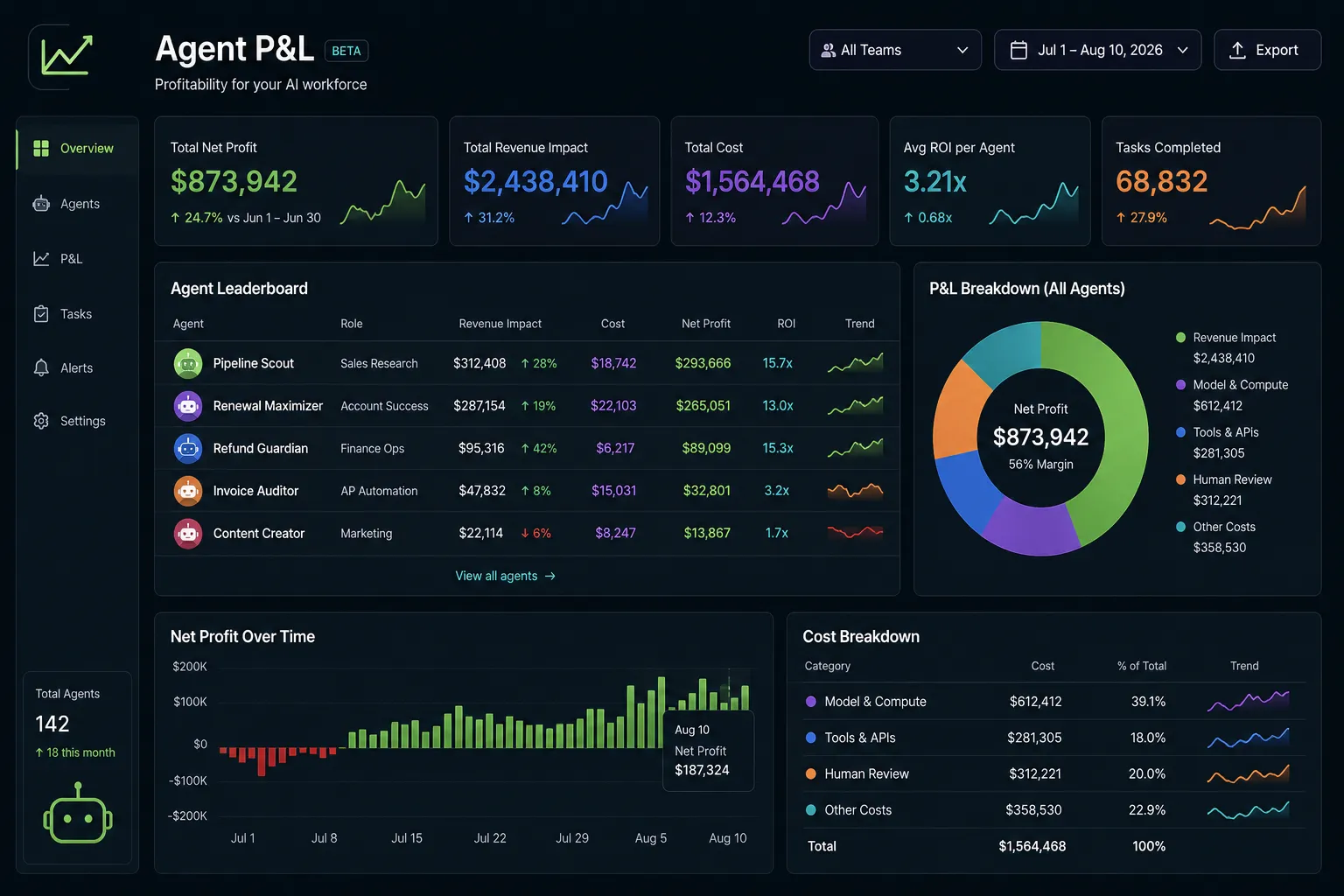
Description
No additional description provided.
The Pitch
AI agents will not be managed like software for very long. Software is usually judged by adoption, uptime, and license cost; workers are judged by output, error rate, supervision burden, and contribution to the business. Agents sit uncomfortably between the two. They consume metered resources, make decisions, create downstream work, and sometimes generate value far from where their cost appears. A company that turns agents into accountable economic units would become the accounting layer for a new kind of labor.
The category becomes more interesting as soon as agents stop being rare experiments and become operationally abundant. A company can tolerate vague economics when it has five automations. It cannot do that when every department has dozens of semi-autonomous systems touching customers, contracts, code, campaigns, invoices, and internal workflows. The hidden cost will not just be model spend; it will be review queues, rework, exception handling, duplicated effort, and expensive agents doing cheap tasks. The business works because complexity compounds faster than the bill, and finance will need a way to see the whole organism rather than isolated API charges.
There is also a governance truth buried inside the economics: the agent that looks productive in a workflow dashboard may be unprofitable once its mistakes are priced. A human employee’s poor judgment eventually shows up in management attention, customer complaints, or missed targets. An agent’s poor judgment can be scattered across logs, tickets, refunds, and quiet human correction. Capturing those costs makes the product more than analytics; it becomes the mechanism by which companies decide how much autonomy a machine deserves.
The strongest businesses often appear when a new asset class needs a native ledger. Cloud computing produced cost management because servers became variable and invisible. Digital advertising produced attribution because spend became granular and continuous. AI agents are likely to create a similar need because labor itself becomes programmable, metered, and swappable. Once companies can compare agents by marginal cost and marginal contribution, they will not want to go back to treating AI as a single budget line.
If this existed, its power would come from becoming the financial memory of the machine workforce. Models will change, tools will change, and individual agents may be rebuilt constantly, but the question of whether a task deserves autonomy will remain. The company that owns that answer becomes hard to remove, because it is not merely reporting spend; it is defining what productive machine labor means.