Failure Knowledge Asset Tracking Platform
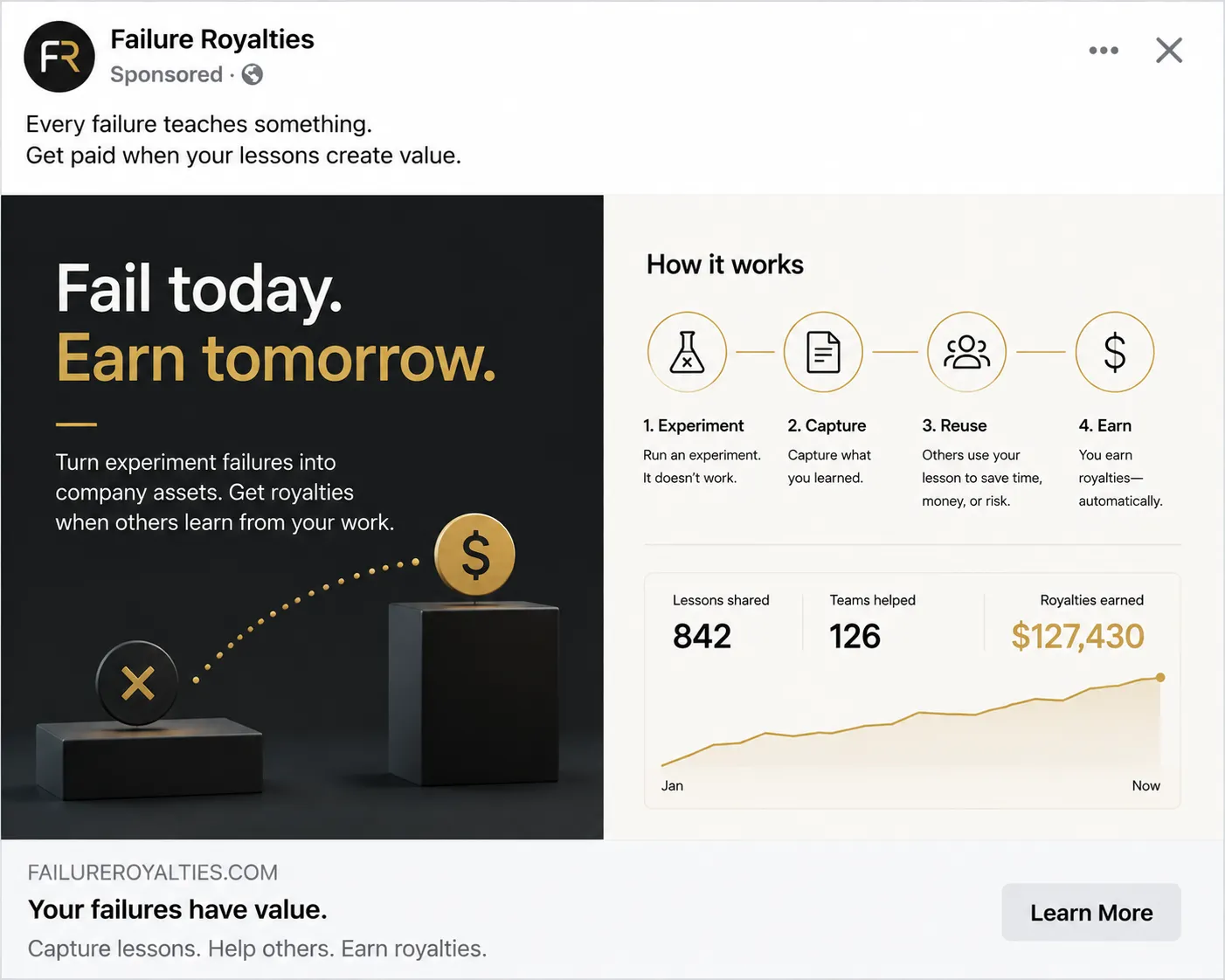
Companies spend millions learning what doesn't work, then bury most of that knowledge in old decks, Slack threads and former employees' heads. Failure Royalties turns failed experiments into trackable intellectual assets. Every experiment receives an ID, its lessons become machine-readable, and whenever another team uses those findings to avoid a mistake or improve a decision, value flows back to the original experiment's ledger. A failed $100,000 campaign that prevents ten other teams from wasting $100,000 each could become one of the company's highest-return experiments. AI makes organizational learning reusable at scale. Accounting systems should start recognizing the value of being wrong first.
Description
No additional description provided.
The Pitch
Companies already pay for failure, but they rarely preserve its resale value. A failed experiment is treated as sunk cost because its output is not a product, a customer, or a metric that fits neatly into existing systems. But the real asset is often a boundary condition: this message fails with this buyer, this integration breaks under this workflow, this segment looks attractive until procurement appears. Those are expensive facts. Today they decay almost immediately.
The reason this becomes more valuable now is that AI changes the unit economics of memory. Historically, capturing lessons required people to write clean postmortems, tag them correctly, and search for them later at exactly the right moment. That almost never happened. But if messy evidence can be translated into structured, retrievable decision context, then “what we already learned” can start appearing inside planning, budgeting, product review, and sales strategy. The knowledge does not need to be remembered by humans to be useful.
The deepest insight is that organizations misprice originality. Teams often repeat bad ideas not because they are careless, but because they are rewarded for forward motion and punished for looking backward. A system that attributes value to avoided waste would make reuse visible in a way culture alone cannot. It gives status to the team that ran the painful experiment first, not just the team that later succeeds after quietly inheriting the lesson.
This could become a new internal accounting layer for judgment. Companies already track software usage, sales attribution, cloud costs, patent filings, and employee performance with obsessive precision, yet they treat decision quality as vapor. If lessons from failed work can be connected to later choices, the firm gains a map of which negative knowledge is actually compounding. That map would be hard to fake, because the most valuable insights would reveal themselves through repeated reuse.
The business is interesting because it reframes failure from an emotional category into an information asset. Not all failure is noble, and much of it is worthless. But some failures are equivalent to paid reconnaissance. The company that can distinguish reusable scar tissue from ordinary mistakes would give large organizations a way to keep the upside of experimentation without forcing every team to bleed for the same lesson.