External Observability for AI Product Impacts
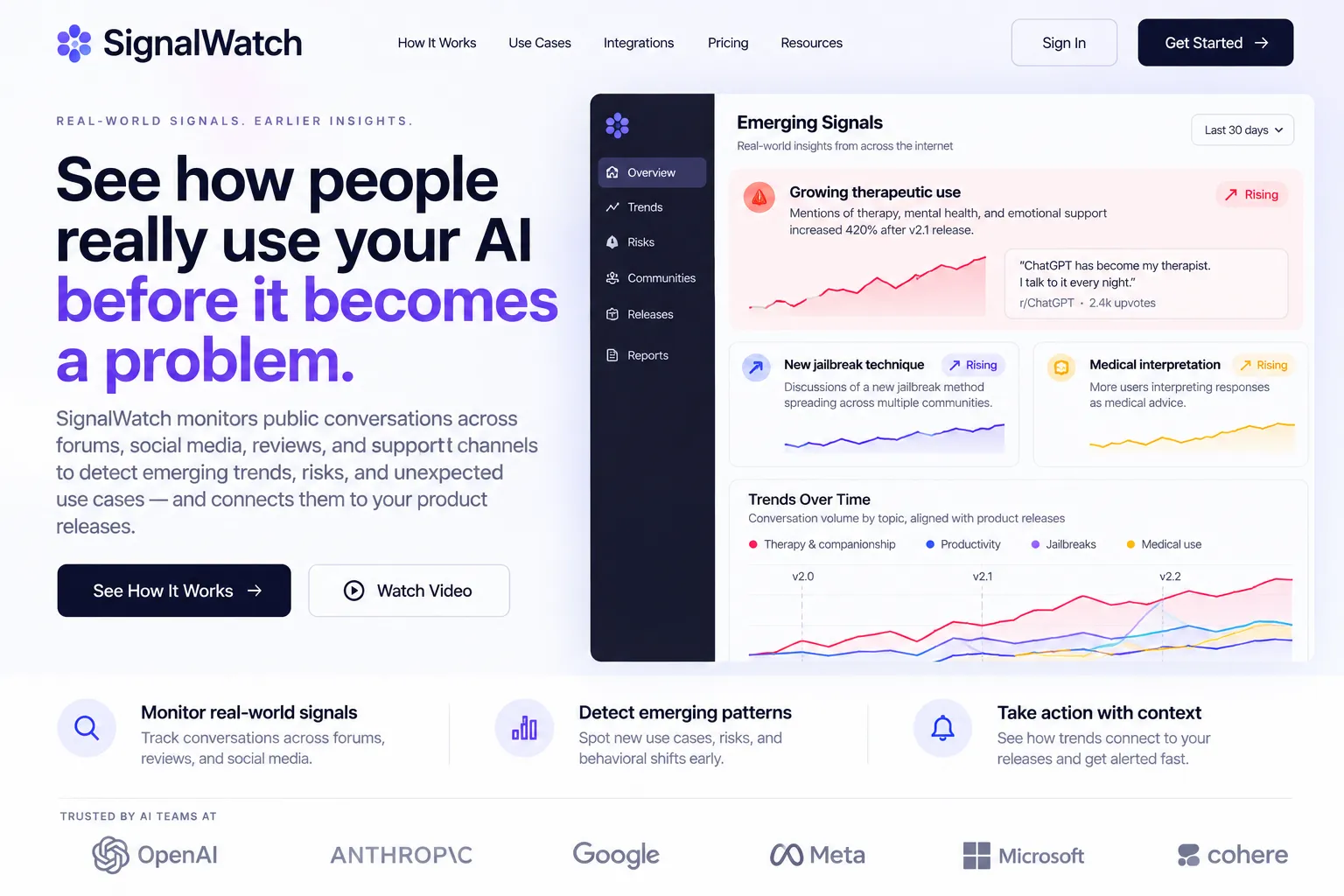
AI companies can monitor what their models do inside the product, but they often cannot see what those systems are becoming in people’s lives until a behavior is already widespread. Build an external observability layer that continuously monitors public communities, forums, reviews, support channels, and other real-world signals for emerging patterns around an AI product, then connects those changes back to specific model releases or product updates. This matters now because AI products increasingly influence behavior in ways traditional telemetry cannot measure, from emotional dependence and medical interpretation to new jailbreaks or unintended use cases. Imagine a company learning within weeks that users are increasingly treating its assistant like a therapist, long before internal metrics or a public controversy make the shift obvious.
Description
No additional description provided.
The Pitch
Most important effects of an AI product often happen outside the product. A model can look safe, useful, and well-behaved in logs while quietly changing how people make decisions, describe symptoms, seek companionship, cheat on work, or pressure-test boundaries in public. Internal analytics measure interaction; they rarely measure interpretation. The business exists in that gap between what a system outputs and what a society starts doing with it.
AI companies will need a new kind of radar because model launches are no longer discrete software updates. A small change in tone, refusal behavior, memory, or capability can alter the social role a product occupies. Users notice these changes collectively before companies do, but their signals are scattered across Reddit threads, Discord servers, app reviews, TikToks, GitHub issues, patient forums, teacher groups, and customer complaints. The valuable unit is not any single mention; it is the early shape of a pattern that has not yet become obvious enough to be a crisis.
This becomes more important as AI products turn into quasi-institutions. A search engine could ship a bad answer and move on; an AI companion, tutor, coding assistant, or health explainer accumulates trust over time. The risk is not only that it says something wrong, but that users assign it a role the company did not intend and may not be prepared to govern. A business that can detect those role shifts early is not merely doing reputation monitoring; it is helping companies understand what their product has become in the wild.
The strongest version would create a memory of external consequences across releases. Most companies know which version improved retention or reduced latency, but far fewer can say which release coincided with teenagers describing attachment, clinicians reporting misuse, developers sharing new exploit patterns, or customers adopting the tool for regulated decisions. That causal stitching is where the defensibility lies: over time, the system becomes a map of how model behavior translates into human behavior.
The deeper thesis is that AI governance cannot be confined to pre-release testing. The world is now part of the test environment. Any company making widely used AI will need a way to see around corners, not because it is altruistic, but because the first credible warning often appears as a weird forum thread long before it appears as a metric, lawsuit, regulator letter, or headline.