Expert Bounty Network for AI Agent Failures
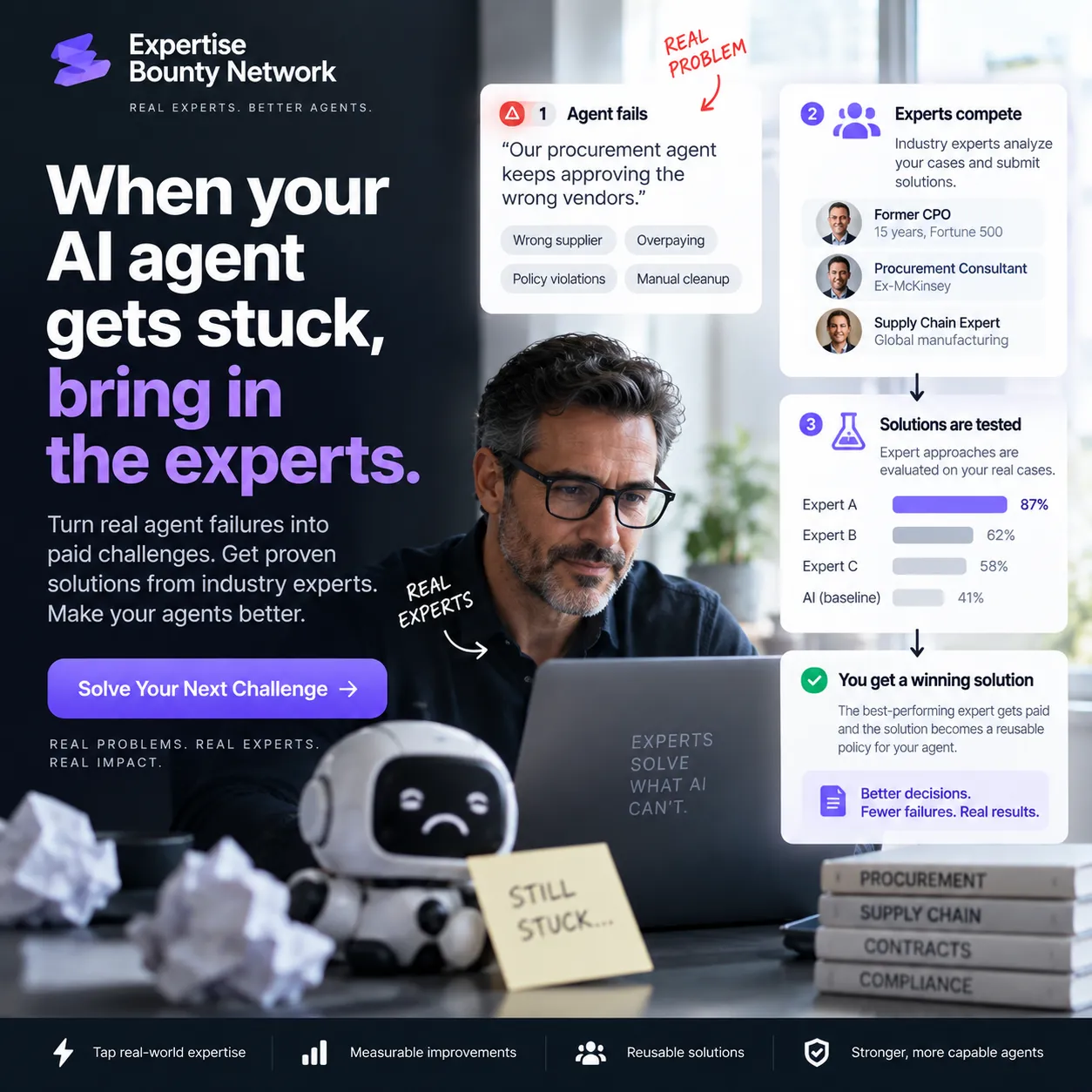
As companies deploy more AI agents, they're going to discover thousands of situations their agents repeatedly handle poorly. Today those failures usually get sent back to engineers to tweak prompts, research the problem or bring in an internal expert. Expertise Bounty Network would turn those failures into paid challenges for people who actually know how to solve them. A company could submit 100 cases its procurement agent keeps getting wrong, offer a bounty, and let experienced procurement executives compete to produce a better decision system. Their approaches would be tested against the real cases, the best-performing expert gets paid, and the winning judgment becomes a reusable policy the agent can use going forward. Instead of asking experts what knowledge they want to sell, start with what machines can't do and pay humans who can teach them.
Description
No additional description provided.
The Pitch
AI adoption turns expert judgment from a scarce internal service into a measurable input. In the past, companies often could not tell which outside expert was actually useful until after a long engagement. Agent failures create a different kind of market: the company already has the test set. If ten experts claim they understand customs classification, supplier risk, or insurance exceptions, their answers can be compared against the exact situations where the machine failed. That makes expertise unusually verifiable.
The most interesting shift is that demand would be generated by failure, not by content creation. Most expert marketplaces ask people to package what they know in advance, which produces generic courses, advisory calls, and vague credentials. Here, the buyer brings a concrete gap: “our system cannot reliably decide this class of cases.” That makes the work narrower, higher-value, and less performative. The expert is not being paid to sound smart; they are being paid to leave behind a decision artifact that improves a machine.
The business also benefits from an odd asymmetry: many of the most valuable experts are not famous. A retired logistics manager, a former claims adjuster, or a procurement lead from a niche industry may possess judgment that is extremely expensive for a company to rediscover but impossible to monetize at scale on their own. AI systems make that judgment portable. Once captured as policies, examples, edge-case rules, or evaluation logic, it can be reused every time the agent encounters a similar situation.
This creates a natural compounding advantage. Each solved failure becomes part of a growing library of human judgment attached to real operational problems, not abstract knowledge. Over time, the network would know which experts improve which kinds of agents, which errors are common across companies, and which decision patterns transfer between industries. The asset is not just a marketplace of experts; it is a map of where AI judgment breaks and who can repair it.
The deeper reason this should exist is that companies will not want fully autonomous systems that are merely “pretty good” in domains where exceptions carry real costs. The missing layer is not more model capability in the abstract, but a repeatable way to inject accountable human judgment at the exact points where automation becomes brittle. A business that owns that correction loop could become essential infrastructure for serious AI deployment.