Executable Business Startup Seed Packages
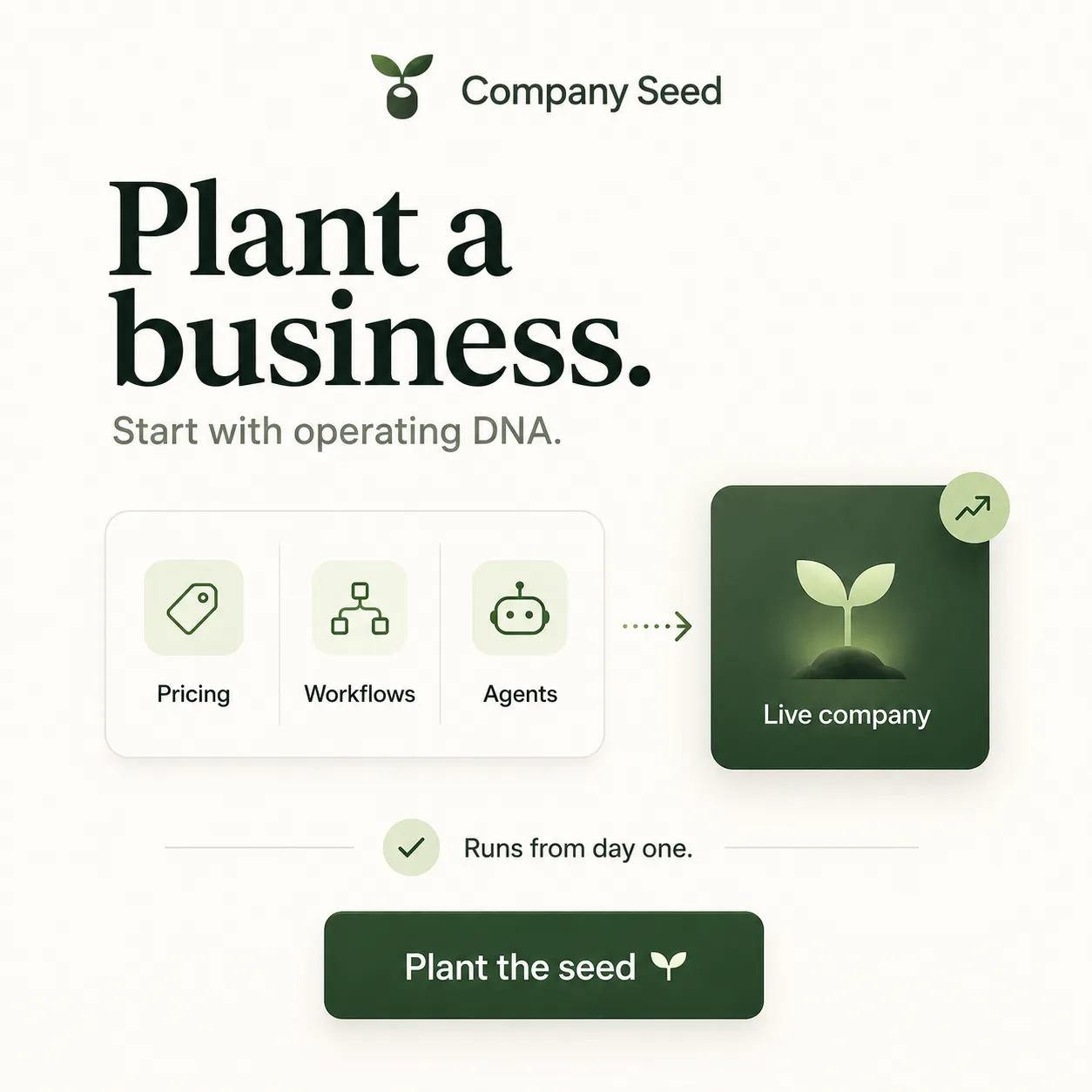
Starting a company currently means assembling software, people, processes and knowledge over years. Company Seed would package the smallest possible executable version of an entire business: agents, operating procedures, supplier relationships, pricing logic, customer-acquisition loops and financial rules. Give it capital and a market, and the seed begins operating, hiring additional agents, testing acquisition channels and adapting until it becomes a functioning company. SaaS lets people buy software instead of building it. The next abstraction may let people buy the starting DNA of a business instead of assembling the company itself.
Description
No additional description provided.
The Pitch
A Company Seed would be compelling because many businesses are less unique than their founders believe. The hard part is not inventing the first version of the operating model; it is finding, connecting, and continuously adjusting the dozens of small decisions that make the model run. Most new companies spend their earliest years rediscovering mundane knowledge: which vendors matter, what emails convert, what margins are acceptable, what tasks must happen daily, what metrics indicate danger. Turning that accumulated pattern into an executable object would make entrepreneurship less like folklore and more like replication with variation.
The interesting shift is that the unit of software would no longer be a tool used by a company, but a company-shaped system that uses tools itself. A CRM improved sales teams by organizing their work; a Company Seed would already contain a primitive sales motion. Accounting software records financial reality; a Company Seed would encode financial behavior before the business has a bookkeeper. This changes the buyer’s question from “what software should I adopt?” to “what kind of business should I instantiate?” That is a much larger and stranger market than SaaS, because the product is not productivity but organizational capacity.
Its strongest advantage would come from feedback across many attempts. One founder learning from one company has narrow experience; a seed provider watching hundreds of similar seeds operate would see patterns no individual operator could see. It would know which acquisition loops decay, which supplier terms predict failure, which roles should be automated longer than expected, and which human hires reliably change the slope. The more seeds that run, the better the next seeds become, making the product closer to a living playbook than a static template.
The business would also appeal because it sits between two inefficient extremes: starting from scratch and buying an existing company. Starting from scratch is cheap but blind; acquiring a company is proven but expensive and full of inherited mess. A seed would offer a third category: not a guarantee of success, but a pre-compressed operating theory with enough agency to test itself. That is valuable because many capable people have capital, taste, or distribution, but not the patience or institutional memory to assemble a company molecule by molecule.
The deeper insight is that “company formation” may become a product category in its own right. Once agents can execute procedures, negotiate with software, monitor economics, and revise workflows, the scarce asset becomes not code or labor alone, but encoded judgment about how a business should behave when reality pushes back. A company that can package that judgment into repeatable seeds would sell something unusually powerful: not advice about what to do, but a small organization already inclined to do it.