Exchange for Hedging Digital Infrastructure Costs
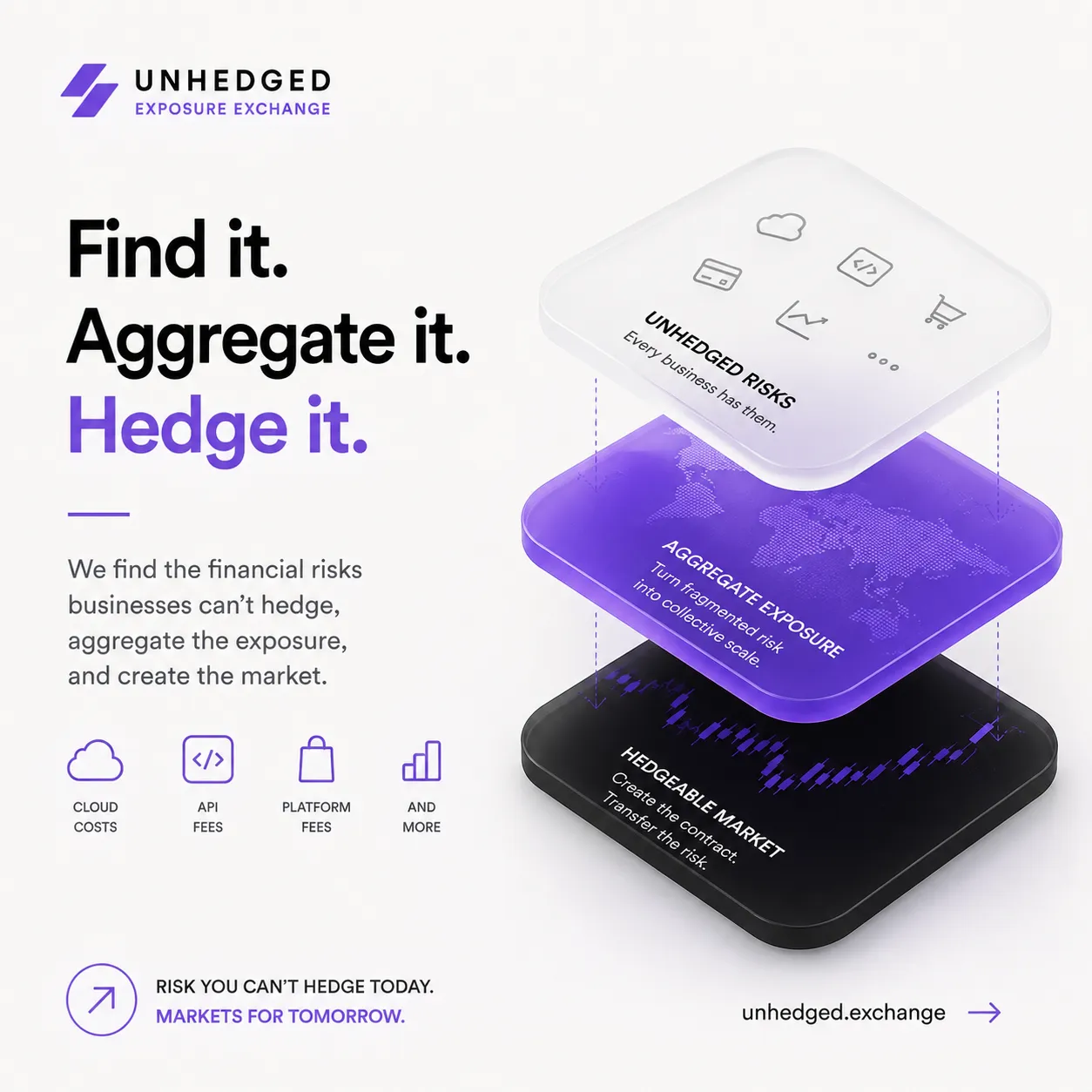
Companies have thousands of financial exposures they simply accept because no hedge exists: cloud pricing, AI inference costs, API fees, app-store commissions, creator CPMs, payment fees. Unhedged Exposure Exchange would find identical exposures across businesses, aggregate them, and create a financial contract once enough demand exists. Instead of an exchange inventing a derivative and hoping traders appear, software discovers $500M of companies exposed to the same risk and manufactures the hedge around them. As businesses become increasingly dependent on variable-priced digital infrastructure, entirely new classes of corporate risk are becoming large enough to financialize.
Description
No additional description provided.
The Pitch
Exposures are not speculative abstractions; they are buried operating costs that already determine margins. A company spending millions on cloud compute or AI inference is effectively long a commodity whose price it does not control, yet that commodity is not oil, gas, or wheat. It is a line item created by a platform. As more of the economy becomes rented through APIs, usage-based software, marketplaces, and take rates, corporate risk migrates from the physical world into private digital tollbooths.
The unusual insight is that the missing ingredient is not financial engineering, but discovery. Traditional derivatives markets begin with a standardized contract and then try to attract liquidity. But many modern exposures are too specific, too fragmented, or too new for that approach. The business works if it can see across enough companies to notice that what looks idiosyncratic to one CFO is actually shared by hundreds of others. Risk becomes hedgeable the moment it is recognized as collective.
This creates a powerful data advantage because the most valuable information is not public price history, but private demand for protection. Knowing that a large group of AI startups wants to cap inference costs, or that commerce companies want protection against payment fee changes, is itself the basis for a market. The company that aggregates this intent is not merely matching buyers and sellers; it is defining the category of risk before the financial world has named it.
There is also a structural reason this could expand over time: platform-dependent businesses tend to dislike admitting how exposed they are. They may negotiate privately with vendors, optimize usage, or absorb margin volatility, but none of those responses changes the underlying dependency. A hedge offers something different: it turns a strategic vulnerability into a manageable financial input. That is especially valuable when the exposure sits outside the company’s core competence.
The deepest business truth is that the economy keeps inventing new toll roads faster than finance invents guardrails. Every time a platform becomes essential infrastructure and prices dynamically, a new class of involuntary risk is born. A company that can detect those risks early, gather the natural buyers, and translate their pain into tradable contracts would sit at the point where software dependency becomes financial infrastructure.