Exchange for Guaranteed AI Workloads
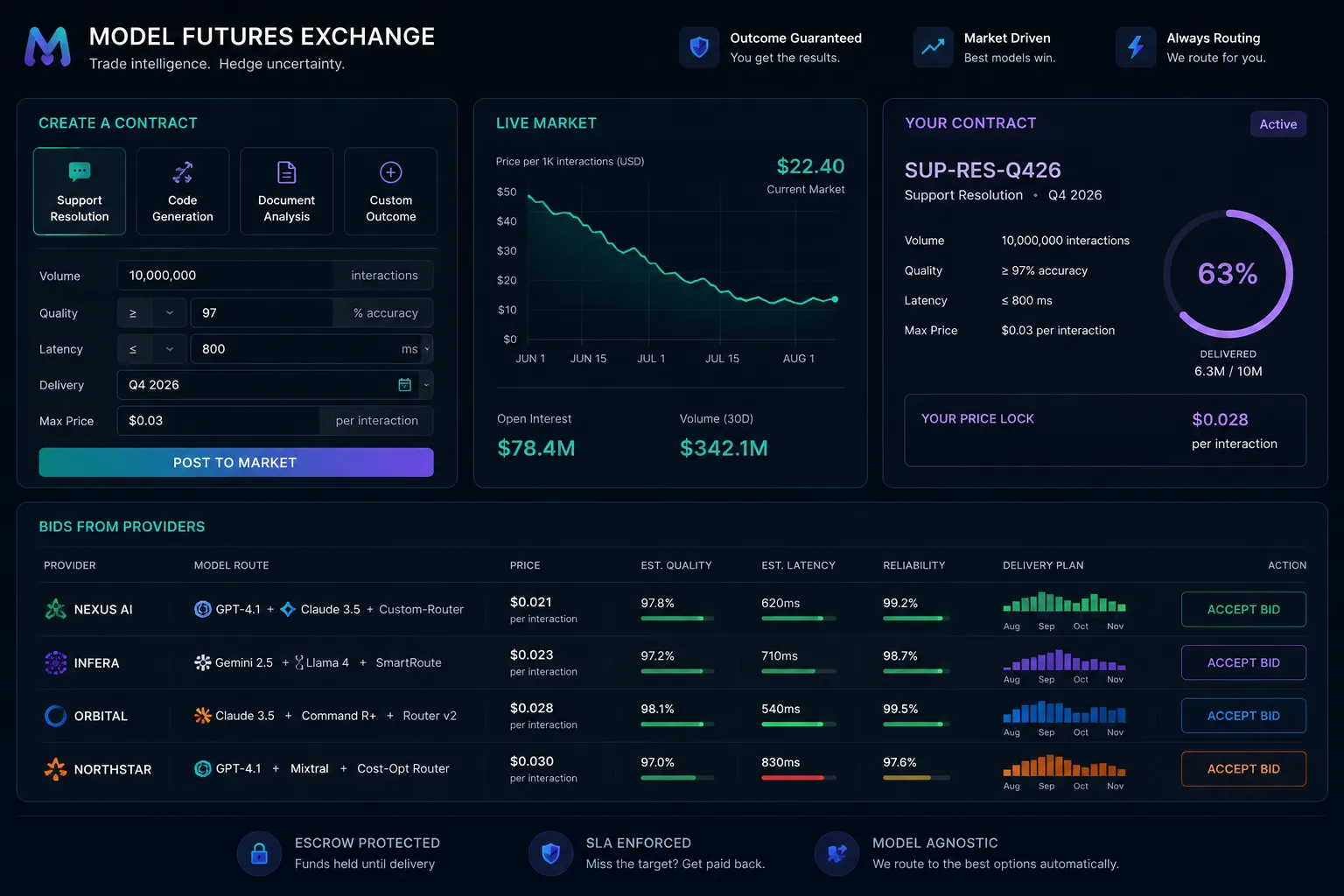
Enterprises buy access to specific AI models today even though price and performance can change dramatically within months. Model Futures Exchange would let companies buy guaranteed units of intelligence instead: contracts specifying an outcome, accuracy level, latency, volume, and maximum price, with providers competing to fulfill the workload using whatever models perform best at the time. As models commoditize and routing improves, customers may care less about which model performs the work than whether the promised outcome is delivered. A retailer could lock in the processing of 10 million support interactions next quarter at 97% accuracy and under three cents each while the exchange continuously routes the work across competing models.
Description
No additional description provided.
The Pitch
AI demand is starting to look less like software procurement and more like energy procurement. A company does not really want “GPT-5 access” any more than a factory wants “Turbine 7 electricity.” It wants a predictable amount of useful work at a known cost. Once intelligence becomes a variable input to operations, volatility itself becomes the pain. A market that converts shifting model capabilities into contracted, reliable output would sit at the point where AI becomes infrastructure rather than experimentation.
The deepest truth is that model identity may become less valuable as model abundance increases. Today, brand names matter because performance gaps are obvious and workflows are immature. But as models converge, specialize, and get wrapped in evaluators, memory, tools, and routing layers, the unit of value moves from the model to the guarantee. The buyer’s real question becomes: “Will this task be completed to my tolerance, on time, at budget?” Whoever can answer that question credibly owns the customer relationship, while the underlying model providers become suppliers competing inside the system.
This business would also benefit from a strange asymmetry: enterprises hate uncertainty more than providers do. A model company, GPU cloud, or inference shop may be willing to accept variable margins if it helps fill capacity, benchmark real workloads, or monetize models outside its direct sales motion. Enterprises, meanwhile, will pay for budget certainty because AI costs can otherwise leak into every department invisibly. The exchange could turn unused or underutilized intelligence capacity into something financially useful, much as cloud spot markets turned idle compute into an asset.
The most interesting defensibility would come from evaluation data, not transaction volume alone. To write a contract for “97% accuracy,” someone must define, measure, audit, and enforce what that means across thousands of task types. Over time, the exchange would accumulate a private map of which models actually perform which business tasks at which cost and failure rate. That map would be more valuable than any single model benchmark because it would be grounded in paid work, not demos.
If this existed, it could become the abstraction layer between buyers of outcomes and sellers of intelligence. The winning company would not need to build the best model. It would need to make AI performance legible, comparable, and financially dependable. In a market obsessed with capability, the overlooked prize may be reliability.