Escrow Wallets for Autonomous AI Agents
AI agents are starting to spend money, but today's payment systems were built around a human approving a card, account, or transaction—not software autonomously deciding what to buy. Agent Escrow Wallet would create temporary wallets for individual agent tasks, each funded with a fixed budget and encoded with rules around approved merchants, categories, time limits, refund handling, and the exact outcome the agent is authorized to pursue. The agent can negotiate and transact freely inside that box but cannot touch anything outside it, and unused funds automatically return when the task ends. As agents move from recommending purchases to actually making them, companies will need a safer primitive than handing software a corporate card. A travel agent could receive $2,500 to book a four-night trip under a defined set of constraints, spend autonomously across airlines and hotels, and lose access the second the itinerary is completed.
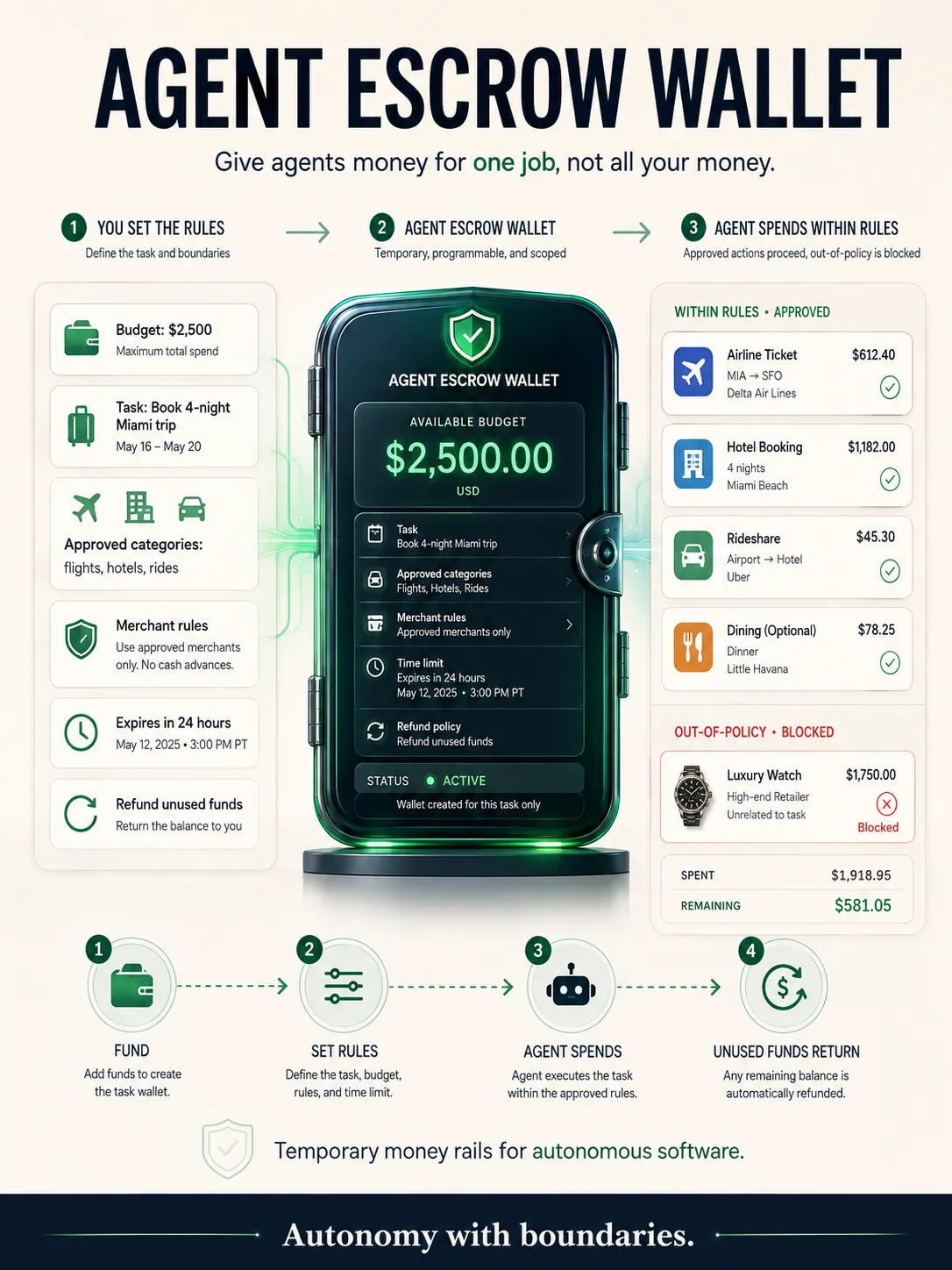
Description
No additional description provided.
The Pitch
Agent commerce will not fail first because agents are too dumb; it will fail because the financial permissions around them are too blunt. A corporate card is an identity and trust instrument built for an employee, not a bounded machine process. The interesting business is not “payments for AI,” but a new authorization layer that treats every delegated task as its own financial container, with money, rules, evidence, and expiry fused together.
The non-obvious insight is that autonomy becomes more acceptable when it is made financially small. Companies already tolerate mistakes by people because responsibility, budgets, and approvals are legible. Agents need the same legibility, but at machine speed and far higher granularity. A wallet created for one trip, one procurement request, or one customer resolution turns a frightening open-ended capability into a controlled experiment. That makes adoption less about trusting AI in the abstract and more about limiting the blast radius of each decision.
This could also become a system of record for intent, not just spend. Traditional payments know that money moved; they do not know what outcome the payer was trying to achieve. An escrow wallet tied to a task can preserve the mandate: buy this, under these conditions, by this deadline, with these fallback rules. That context is valuable because disputes, refunds, audits, and compliance all become easier when the payment rail understands the job rather than merely the transaction.
The business becomes stronger as agents multiply. If every company eventually uses many agents across travel, procurement, software, customer support, logistics, and operations, then the scarce resource is not access to payment networks but controlled delegation. Whoever sits at that boundary can become the default place where companies define what software is allowed to do with money. That is a more durable position than being another wallet, because it lives at the moment where policy turns into action.
The elegant part is that this product would make both sides of a transaction more comfortable. Buyers get containment; merchants get cleaner authorization that an agent is allowed to purchase; platforms get an audit trail instead of a mystery charge from an automated workflow. As commerce becomes less human-clicked and more software-executed, the winning infrastructure will likely be the one that makes automated spending feel boring, reversible, and accountable.