ERP Transition Readiness for Private Equity Portfolios
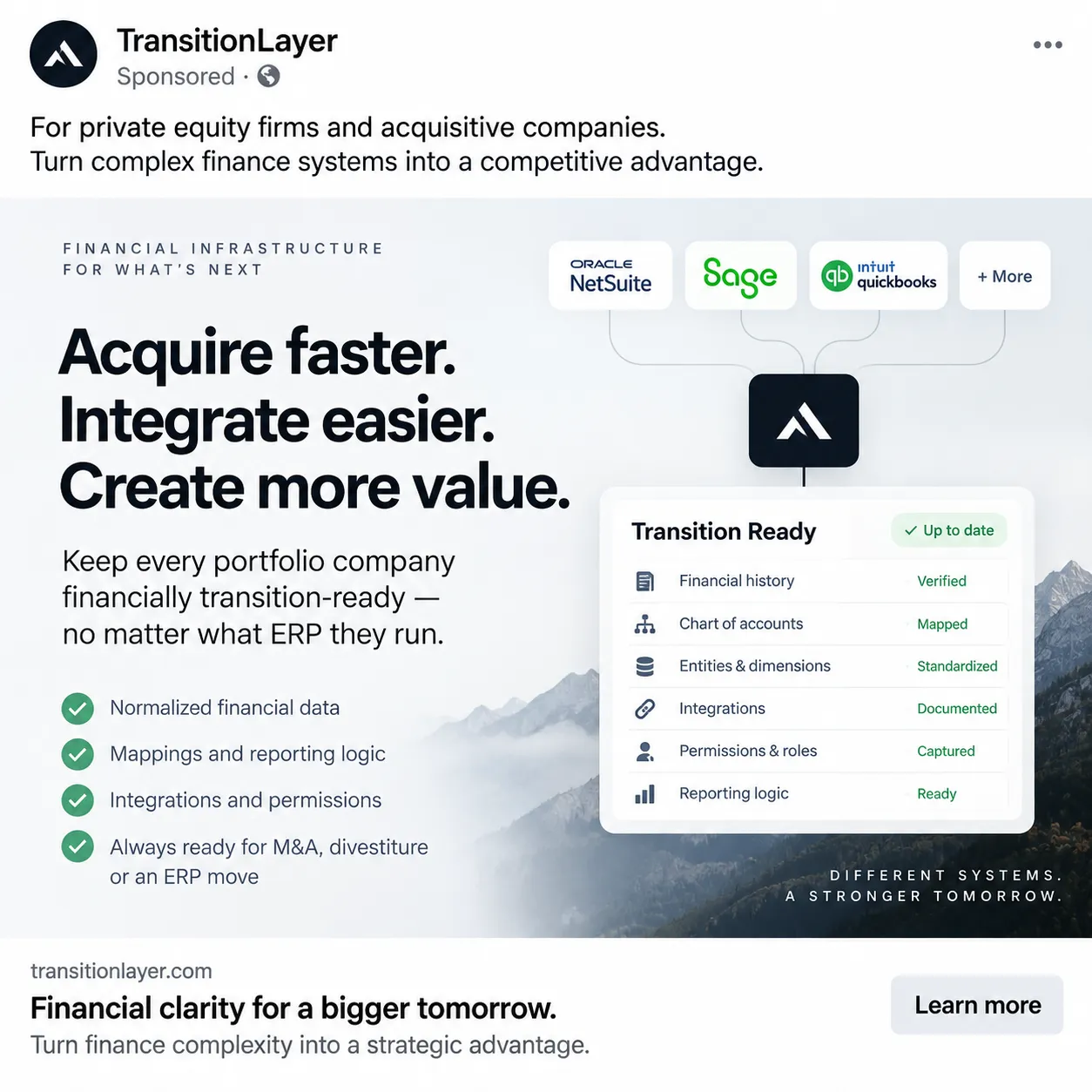
Private equity firms keep buying companies with different finance systems, different charts of accounts, different reporting logic, and years of history trapped inside each ERP. Every acquisition creates the same expensive cleanup: figure out how the books work, map everything into the new structure, rebuild integrations, and decide what needs to move. A better approach would keep each portfolio company continuously “transition-ready.” Connect the ERP once, maintain a verified financial model outside the system, and keep the mappings, entities, permissions, integrations, and reporting logic current over time. Then when a company is acquired, sold, consolidated, or moved to a new ERP, the finance team starts with a clean transition package instead of months of discovery work.
Description
No additional description provided.
The Pitch
Private equity has turned finance-system disorder into a recurring operating tax, but the market still treats each transition as a one-off project. The same questions are answered again and again: what does this account mean, which entity owns this transaction, which reports are trusted, which integrations matter, which historical data must survive? A company that preserves those answers over time would convert institutional memory into portable infrastructure. The value is not simply cleaner data; it is avoiding the moment when a deadline exposes that nobody actually knows how the financial plumbing works.
The non-obvious wedge is that the buyer is not only the company changing systems. The real beneficiary may be the future owner, lender, auditor, or operating partner who needs confidence before or after a transaction. Today, financial systems are treated as internal tools, but in an acquisition they become part of the asset being evaluated. A business that makes a company’s finance stack legible and transferable could change how operational readiness is perceived: not as back-office hygiene, but as a quality of the asset itself.
The timing is attractive because holding periods, add-ons, carveouts, and rollups all increase the number of times financial data has to be reinterpreted. The pain compounds with every acquisition: one messy chart of accounts is annoying, ten become a permanent drag on decision-making. PE-backed companies often live in a state between independence and integration, where fully standardizing every system is too disruptive, but leaving everything untouched creates future cost. A neutral financial model outside the ERP fits that in-between reality better than forcing premature migration.
There is also a strong trust advantage if the system becomes the record of how finance logic changes over time. Most migrations fail not because data cannot be exported, but because meaning gets lost: exceptions, local practices, manual workarounds, and report definitions disappear into spreadsheets and Slack threads. Capturing this context continuously makes the transition package more than a data map; it becomes a living explanation of the business. That is hard to replace with a generic integration tool or a consulting project that starts after the damage is already visible.
The deeper business is that financial portability could become a standard expectation for professionally owned companies. Just as clean legal documents and audited statements reduce friction in a sale, clean finance-system metadata could reduce operational uncertainty. If that expectation takes hold, the company is not selling software for migrations; it is selling preparedness for any ownership event.