ERP Financial Data Portability Platform
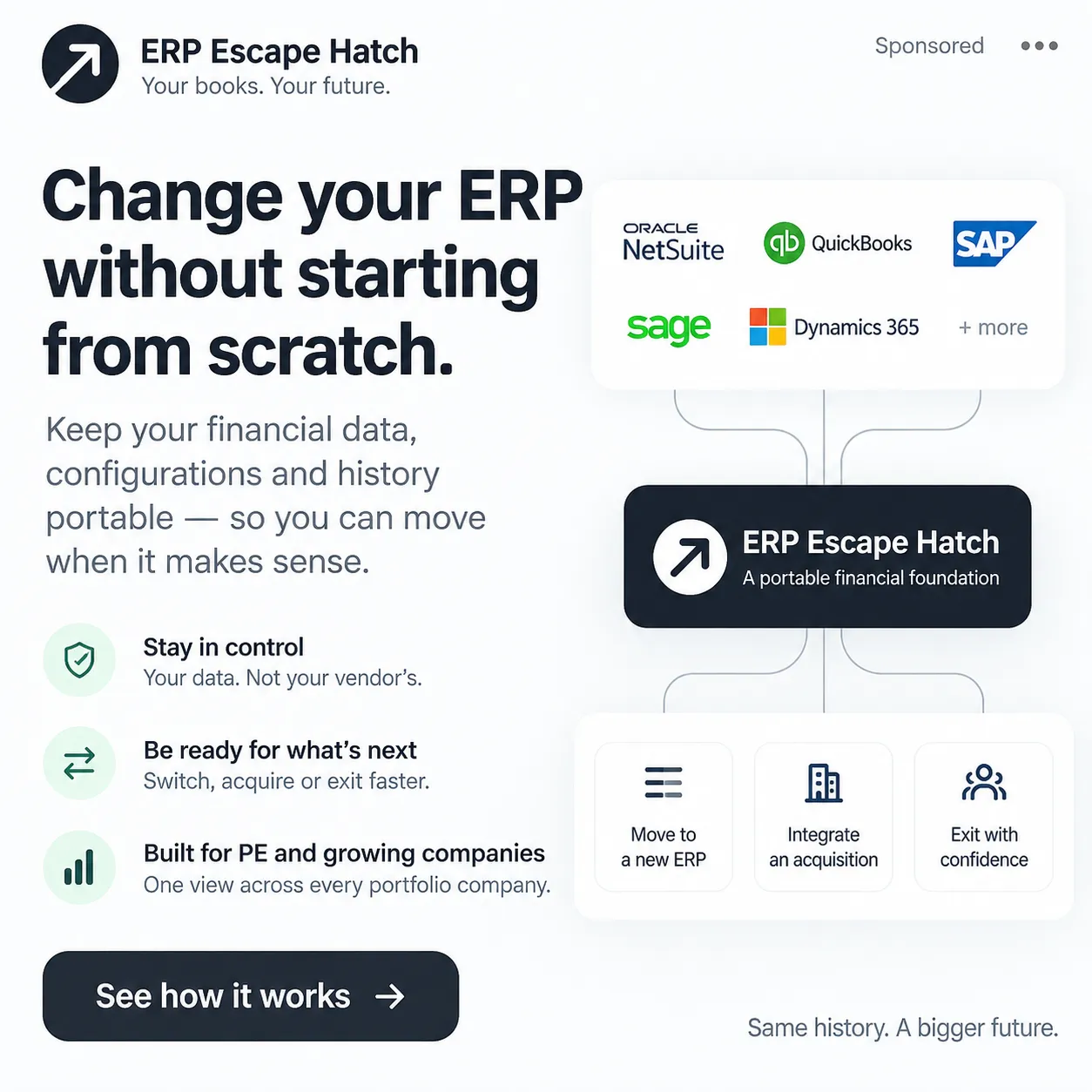
Companies rarely stay on the same ERP forever, but leaving one is still treated like a major transformation project. Years of transactions, account structures, permissions, integrations and reporting logic get trapped inside the system that happens to store them. The idea is to build a vendor-neutral portability layer that continuously keeps a company’s financial data and configuration switch-ready. Connect NetSuite, Sage, QuickBooks or another ERP once, map everything into a canonical financial model, and maintain it over time. When the company wants to move, sell, acquire another business or standardize a portfolio, the financial history is already portable. The wedge could be private equity firms and serial acquirers that face this problem repeatedly across portfolio companies. Every ERP vendor has an incentive to make it easy to enter. Almost none have the same incentive to make it easy to leave.
Description
No additional description provided.
The Pitch
ERP lock-in is not mainly contractual; it is sedimentary. The cost of leaving accumulates quietly through custom fields, forgotten workflows, reporting shortcuts, subsidiary quirks, and one-off integrations that nobody would design twice but everyone depends on. By the time a company wants optionality, the map of how its finance function actually works lives inside the incumbent system. A portability layer turns that hidden dependency into an asset that can be inspected, maintained, and moved.
The strongest version of the business is not a migration tool used once during a painful switch. It is an ongoing system of record for ERP independence. That distinction matters because financial data decays as soon as it is extracted: accounts change, departments merge, permissions drift, vendors are reclassified, new revenue lines appear. A static export is a photograph. The valuable product is a living translation layer that stays current enough that leaving remains a real choice rather than a theoretical one.
The buyer most likely to understand the value is one that sees ERP fragmentation as a portfolio problem, not an IT inconvenience. A private equity firm may own twenty companies whose financial systems each encode the history of prior owners, local accountants, and industry-specific habits. Standardizing them after acquisition is expensive, but forcing everyone onto one ERP too early can destroy useful local context. A neutral financial model creates a middle path: portfolio-level comparability without immediate system replacement. That is a subtle but powerful form of control.
This also works because the company would sit in a place vendors cannot credibly occupy. An ERP provider can promise easy onboarding, but a customer will always doubt its neutrality around exit. Accountants and consultants can perform migrations, but their knowledge usually disappears into spreadsheets and project folders when the engagement ends. A persistent, vendor-neutral portability layer becomes trusted precisely because it is not the destination system and not a one-time services artifact.
The deeper insight is that financial history is becoming part of corporate mobility. Companies are bought, merged, carved out, refinanced, audited, and replatformed more often than their core systems were designed for. In that world, the ability to preserve continuity while changing infrastructure becomes strategically valuable. The company that owns the clean, current, vendor-agnostic representation of finance may become more important than the software where the transactions originally happened.