Enterprise Budget Mapping for Software Sales
Companies know who likes the product, but often do not know which budget can actually buy it. Budget Router would map a product’s value to the existing budget lines, owners, approval thresholds and adjacent spend already inside the customer, then package the purchase against the most natural source of funds. Why now: enterprise buying is getting more committee-driven while AI can increasingly infer budget ownership from org structure, procurement patterns and existing software spend. Example: a customer-success tool has no standalone budget, so the system identifies that its measurable effect is expansion revenue, ties the business case to the CRO’s retention budget and generates the internal purchase path around that line instead of creating a new category.
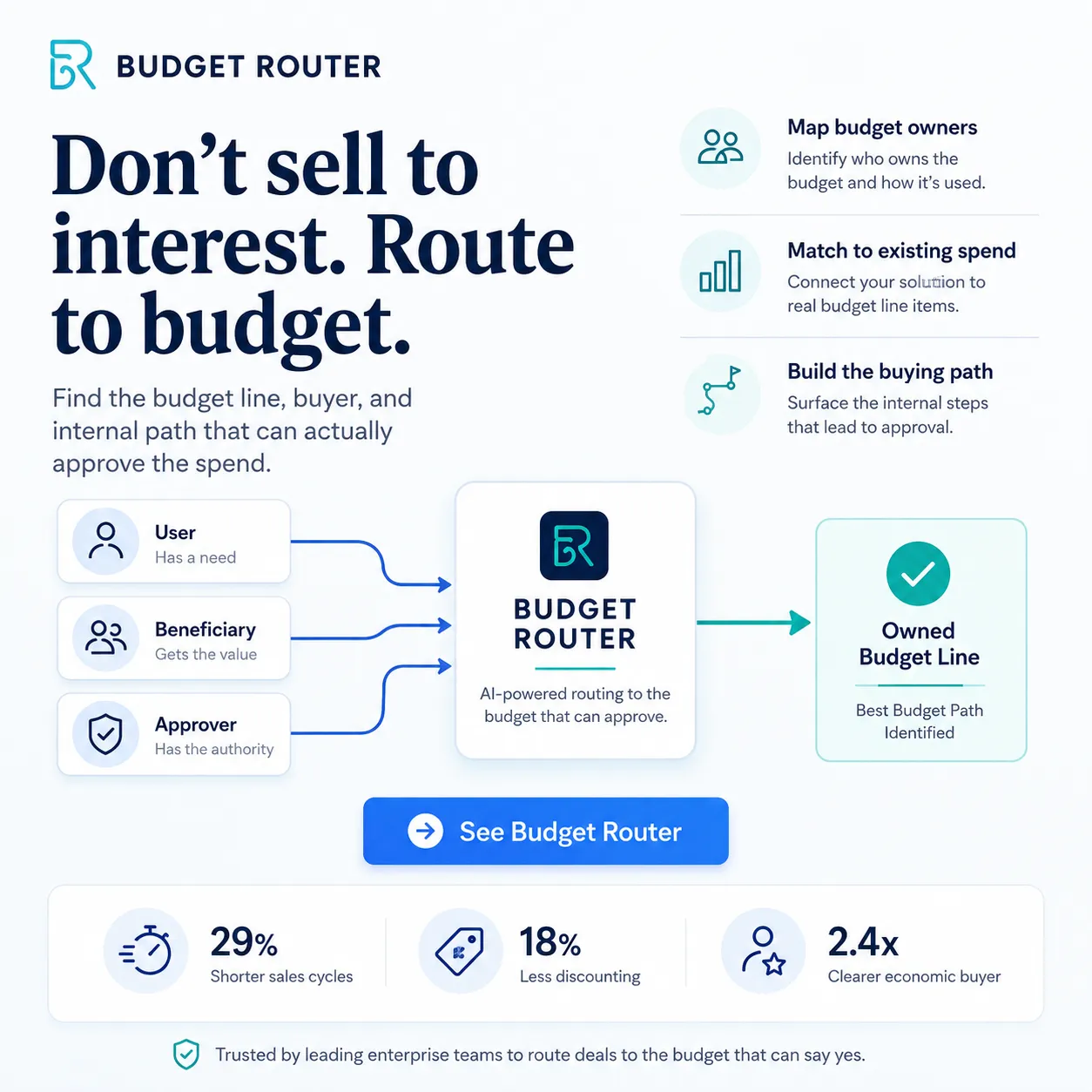
Description
No additional description provided.
The Pitch
Many B2B purchases fail not because the product is unwanted, but because it is financially homeless. The buyer may believe in the product, the end users may be enthusiastic, and the ROI may be real, yet the purchase stalls because nobody knows which line item should absorb it. A company that solves this would be addressing a hidden bottleneck in enterprise sales: not persuasion, but budget translation.
This is especially valuable because budgets are often more stable than org charts, priorities, or enthusiasm. Companies say they buy based on strategic need, but in practice they buy through pre-existing financial grooves. If a product can be described as “new software,” it competes for scarce innovation funds; if it can be framed as reducing contractor spend, protecting renewal revenue, consolidating tools, or replacing services, it suddenly becomes easier to approve. The same product can be either discretionary or inevitable depending on which budget it enters through.
The business would also benefit from sitting at an unusually valuable layer of commercial data. Sales tools know activities, CRMs know opportunities, procurement systems know vendors, and finance systems know spend categories, but the connective tissue between product value and budget authority is often tribal knowledge inside the best account executives. Turning that intuition into a repeatable system would make every seller better at navigating the customer’s internal economy. Over time, the product would accumulate a map of how organizations actually fund change, which is far more useful than how they describe decision-making on an org chart.
There is a strong asymmetry in the value created. A small improvement in routing can rescue large deals that would otherwise die slowly in indecision. The cost of a stalled enterprise sale is not just lost revenue; it is months of executive attention, solution engineering, legal work, and forecasting error. If this system helps a seller find the buyer who already has the problem and the money, it can change the shape of the sales cycle without changing the product being sold.
The most interesting version of this company would not merely help vendors sell more cleverly. It would make enterprise buying less wasteful by matching purchases to the budget where the value will actually show up. That is a subtle but important shift: instead of adding another layer of sales automation, it would formalize one of the least understood parts of business judgment—the art of knowing where an idea belongs financially.