Employee Community Engagement Platform
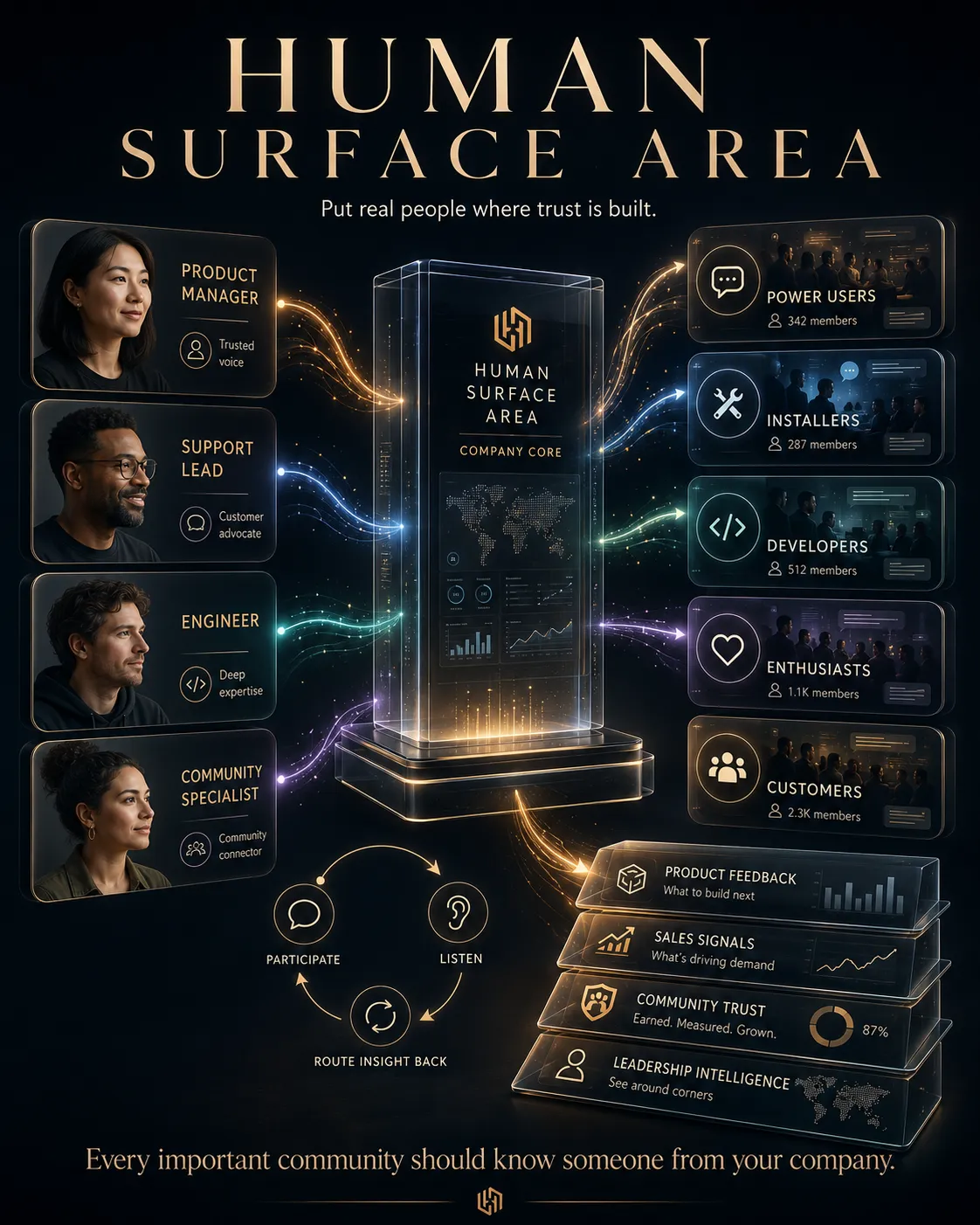
Every important customer community eventually develops a few people it trusts, but companies mostly leave it to chance whether one of those people works for them. Reddit threads, Discords, niche forums, LinkedIn conversations, developer communities, and industry groups contain product problems and buying signals that corporate social accounts rarely reach. Human Surface Area would map the communities that matter to a company, identify the employees best suited to participate in each one, surface conversations where their expertise would genuinely help, and route what they learn back into product, sales, and leadership. As algorithms suppress corporate content and AI makes polished marketing nearly free, recognizable humans become a scarce distribution advantage. Sonos wouldn't hope another Keith Nieves emerges; it could deliberately build twenty trusted employee-community relationships across home audio, accessibility, installers, developers, and power users.
Description
No additional description provided.
The Pitch
Trust is an operational asset rather than a happy accident. Most companies know their brand is discussed in places they do not control, but they still behave as if the only legitimate channels are the ones they own. The reality is stranger: the most commercially valuable conversations often happen in semi-public spaces where a helpful employee can be far more credible than an official spokesperson. A company that can systematically find those spaces, match them with the right internal people, and make participation useful rather than performative is turning an informal behavior into infrastructure.
The deeper shift is that distribution is moving from polished broadcasting to situated expertise. When anyone can generate acceptable marketing copy, the copy itself loses scarcity. What remains scarce is a real person with a name, a history, and the authority to say something specific. The most valuable employee in a community is not necessarily the most senior or charismatic; it may be the support engineer who has answered the same edge case fifty times, the product manager who understands a roadmap constraint, or the installer who knows what breaks in the field. This business works if it can reveal those latent public-facing assets inside a company before competitors do.
It also changes what “listening to customers” means. Traditional customer research is episodic and sanitized: surveys, panels, win-loss interviews, NPS comments. Communities are continuous and unvarnished, but most companies either ignore them or treat them as a reputational threat. The interesting opportunity is not merely detecting mentions; it is creating a living membrane between the company and the outside world. When employees participate credibly, they do not just collect feedback. They learn the language, anxieties, hacks, misconceptions, and buying triggers of a market in their native habitat.
The business becomes especially durable because the asset it helps create compounds socially. A trusted participant cannot be copied overnight by a competitor, because their value comes from accumulated context and repeated conduct. Each useful interaction makes the next one easier: people tag them, ask them, defend them, and bring them earlier into conversations. Over time, the company gains not just reach but permission—permission to hear the truth sooner, correct misunderstandings faster, and show up in moments where no ad or official channel would be welcome.