Employee Benefits Outcome Benchmarking Platform
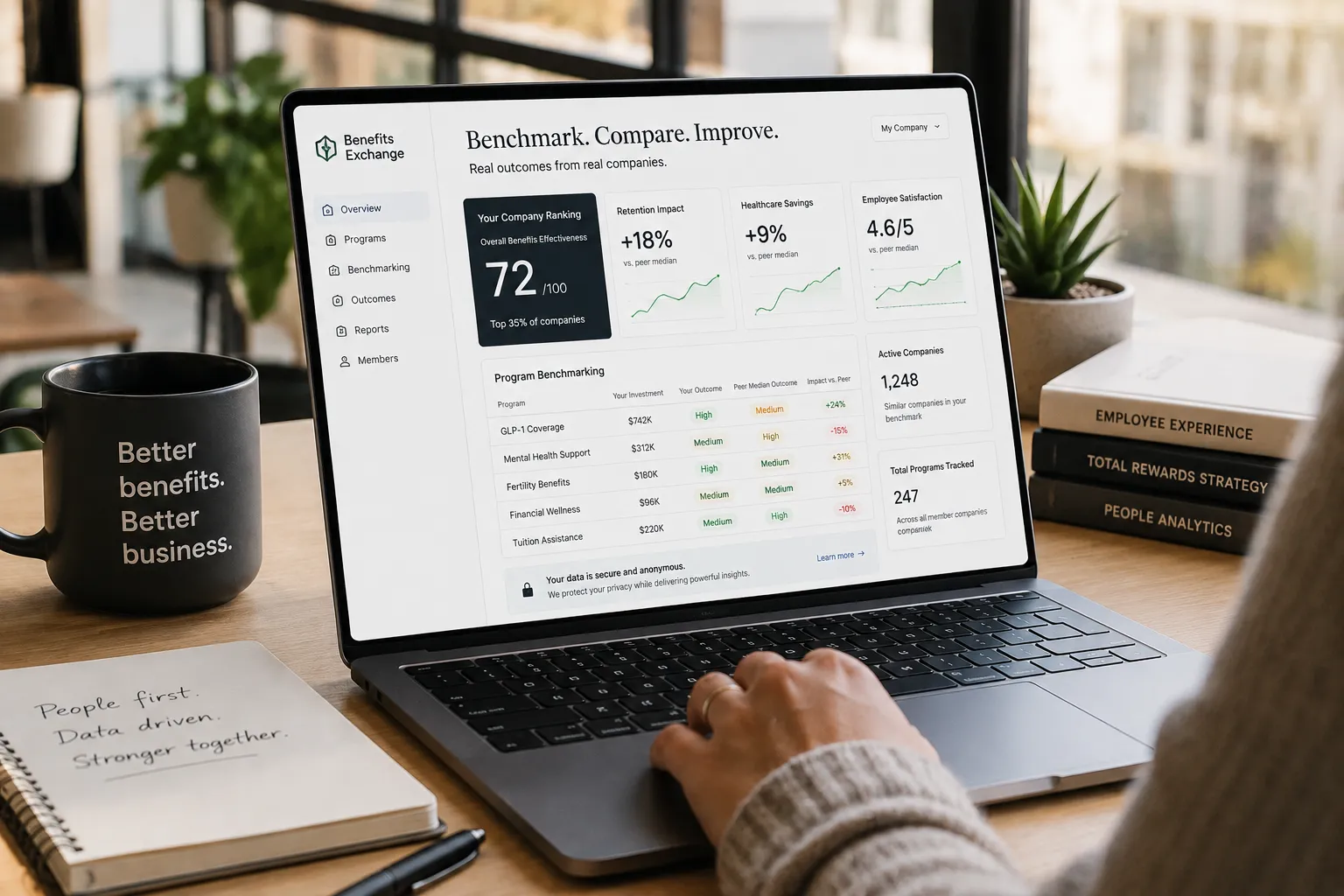
Employee benefits have become one of the largest operating expenses for many companies, yet almost every employer measures success in isolation. Organizations know what they spend but rarely understand whether a benefit improves retention, recruiting, productivity, or healthcare costs compared with similar businesses. A Benefits Exchange would anonymously benchmark outcomes across participating employers, allowing companies to compare the real business impact of every program rather than simply comparing costs. The recent surge in employer spending on GLP-1 medications highlights a future where benefits become strategic investments instead of administrative expenses. A technology company could discover that its expensive mental health program produces below-average outcomes while a lower-cost fertility benefit significantly improves retention among key employees.
Description
Employee benefits have become one of the largest operating expenses for many companies, yet almost every employer measures success in isolation. Organizations know what they spend but rarely understand whether a benefit improves retention, recruiting, productivity, or healthcare costs compared with similar businesses. A Benefits Exchange would anonymously benchmark outcomes across participating employers, allowing companies to compare the real business impact of every program rather than simply comparing costs. The recent surge in employer spending on GLP-1 medications highlights a future where benefits become strategic investments instead of administrative expenses. A technology company could discover that its expensive mental health program produces below-average outcomes while a lower-cost fertility benefit significantly improves retention among key employees.
The Pitch
Benefits are one of the few giant corporate spend categories where buyers still lack a feedback loop. Companies negotiate harder on premiums, add programs based on employee sentiment, and copy what peers seem to offer, but they rarely know which benefits actually change behavior. That creates an unusual market failure: enormous spending decisions are being made with better data on utilization than on consequence.
The most interesting part is that no single employer can solve this alone. A company can observe that retention improved after adding a benefit, but it cannot easily know whether that improvement was caused by the benefit, the labor market, compensation changes, manager quality, or industry-wide patterns. The value appears only when many employers contribute enough anonymized outcome data to reveal what “normal” looks like. This is a business where the product becomes more truthful as participation grows, because the benchmark is not a static report but a living comparison set.
The timing matters because benefits are shifting from uniform entitlements to expensive, targeted interventions. When a benefit costs little and signals goodwill, imprecision is tolerable. When a single drug category, caregiving program, or specialized clinical service can materially change per-employee spend, intuition becomes too expensive. Employers will need to distinguish between benefits that are merely popular, benefits that are morally attractive, and benefits that measurably affect business outcomes. Those categories overlap less often than most companies would like to admit.
There is also a deeper organizational tension this company could resolve. HR leaders are increasingly expected to defend benefits using financial language, but the available evidence is usually anecdotal, vendor-produced, or too generic to persuade finance teams. A neutral exchange could give HR a shared evidence base without turning every people decision into a sterile cost-cutting exercise. The best version would not simply say “spend less”; it would reveal where generosity is wasted and where underappreciated benefits quietly protect the most valuable parts of the workforce.
The defensibility comes from trust, not just software. Employers would contribute sensitive data only if the exchange were seen as independent, careful with anonymity, and rigorous about comparisons. If it achieved that position, it could become the closest thing the benefits industry has to a market index for human outcomes: not a vendor marketplace, not an annual survey, but a way for employers to see which promises actually survive contact with reality.