Emerging Infrastructure Project Intelligence Platform
Every trillion-dollar infrastructure shift creates the same problem: billions of dollars move before anyone has a complete picture of what’s being built. Governments, investors, suppliers, contractors, recruiters, and operators all hunt through fragmented filings, permits, funding announcements, regulatory approvals, and local news trying to identify opportunities before everyone else. This startup becomes the intelligence layer for emerging infrastructure industries, tracking every major project from announcement through operation while revealing who is involved, what stage it’s in, and where the next opportunities will emerge. The timing is right because AI, nuclear, transmission, water, semiconductors, and defense are all entering decades-long investment cycles with no unified source of truth. A supplier could receive an alert the moment a newly funded reactor, semiconductor fab, or desalination plant enters procurement, allowing them to pursue the opportunity months before competitors.
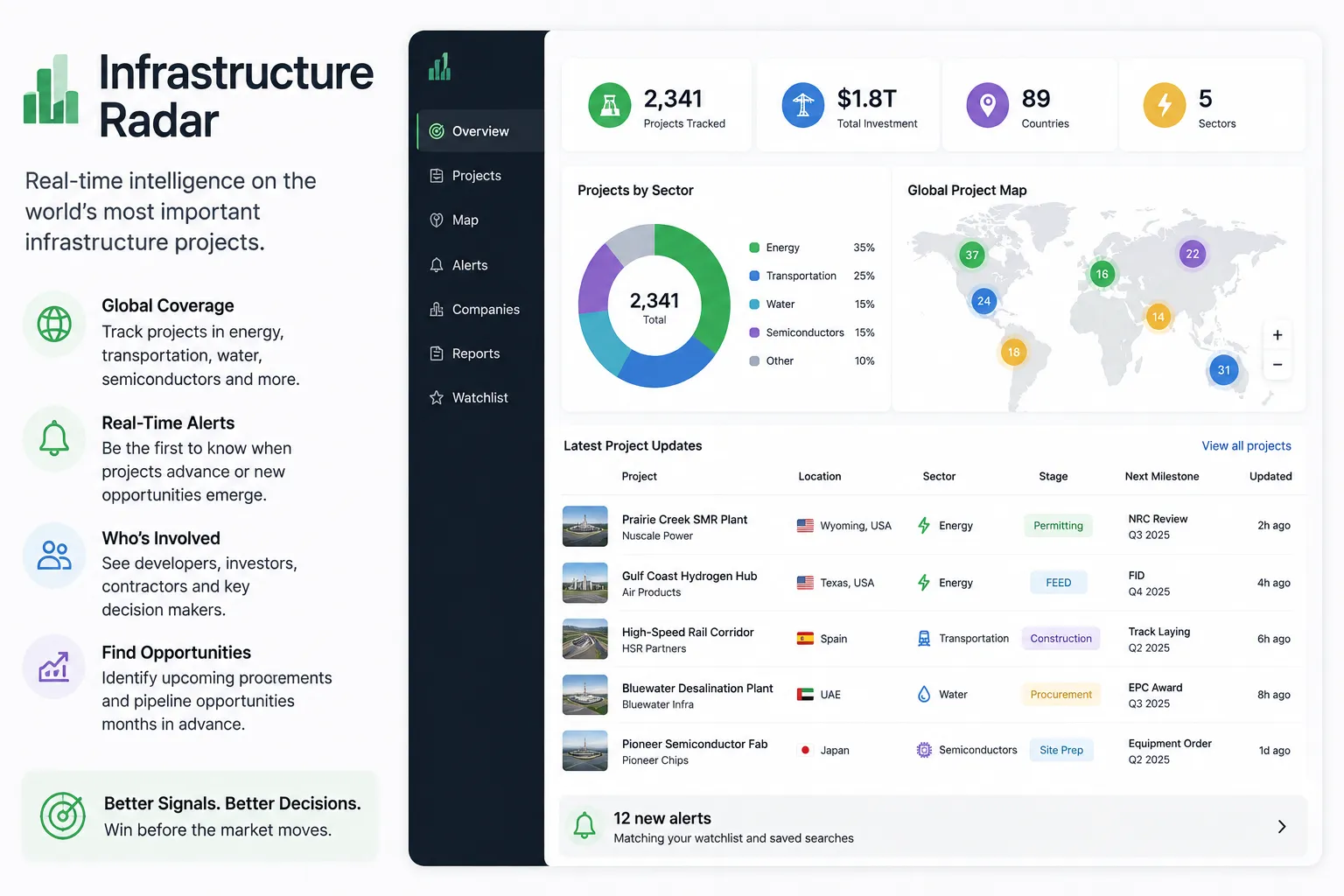
Description
No additional description provided.
The Pitch
The compelling part is that infrastructure markets are enormous but strangely pre-modern in how information moves. A single project can reshape demand for land, labor, equipment, grid capacity, water rights, logistics, and financing across an entire region, yet the earliest signals are scattered across obscure public documents and local breadcrumbs. Whoever organizes those signals first is not merely selling data; they are compressing the time between institutional intention and commercial action.
The best version of this company would become valuable because infrastructure decisions are path-dependent. By the time a project is officially visible, many of the most important choices have already been influenced: preferred vendors, site constraints, political risk, interconnection bottlenecks, labor availability, permitting objections. Early knowledge is not a convenience in these markets; it changes the surface area of what is still possible. A company that can reliably show “this is becoming real” before consensus forms gives customers a practical advantage that generic market research cannot.
There is also an unusual durability to the information asset. Unlike consumer trends or software accounts, major infrastructure projects unfold over years and leave long public trails. Each new document, hearing, contract, delay, lawsuit, incentive, and executive hire adds context to the same underlying asset. Over time, the company is not just collecting announcements; it is building a living memory of how large physical projects actually progress, stall, mutate, and connect to each other.
The non-obvious opportunity is that the customer does not only want to find projects. They want to understand adjacency. A transmission upgrade implies substation work, transformer demand, permitting fights, land deals, and new generation economics. A fab implies water treatment, specialty chemicals, workforce housing, security, logistics, and local political pressure. The value lies in turning one disclosed event into a map of second- and third-order commercial consequences.
If this existed at sufficient depth, it could become one of those quiet systems that makes an industry legible to itself. Infrastructure spending is too large, too slow, and too consequential to remain dependent on rumor, PDFs, and regional relationships. The business works because it sits at the intersection of urgency and opacity: when capital is committed but clarity is scarce, better visibility becomes a tool people pay for repeatedly.