Emergency Internal Network for Internet Blackouts
Businesses prepare for ransomware, cloud outages and destroyed data centers but rarely prepare for a scenario where connecting to the public internet itself becomes temporarily unsafe. Dead Internet Switch maps everything a company needs to operate, maintains local versions of critical services and provides an emergency internal network that can keep the organization running after external connectivity is deliberately shut down. AI-driven cyberattacks make this newly plausible because thousands of autonomous attackers could exploit a newly discovered vulnerability faster than organizations can patch it. A bank could run an annual 24-hour “internet blackout drill,” discover which operations unexpectedly depend on outside services, and build enough redundancy to continue processing critical transactions when it eventually needs to disconnect for real.
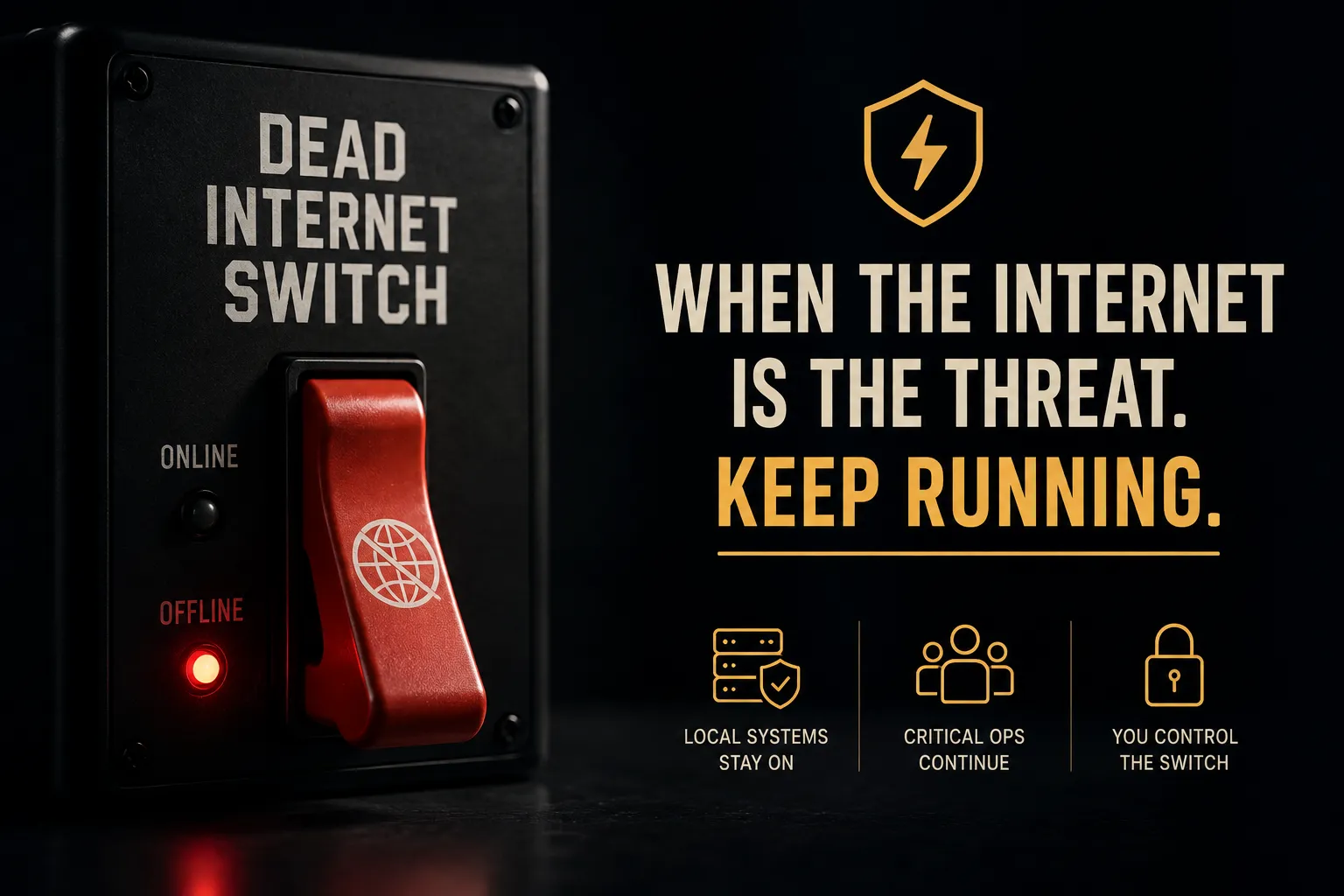
Description
No additional description provided.
The Pitch
Modern companies have become extremely good at backing up data while remaining strangely bad at backing up operational continuity. The internet is no longer just a channel; it is the control plane for identity, payments, logistics, support, security tools, documentation, software updates, and even the instructions for what to do when systems fail. A company may have pristine backups and still be unable to function because the thing that tells employees who they are, what they can access, and how to coordinate lives somewhere outside the walls.
What makes this especially interesting is that the product is not really “offline mode” for a single application. It is a map of hidden dependency. Most executives do not know which parts of their business would stop if external connectivity became a liability rather than an asset. The first valuable artifact is the discovery itself: the realization that a payroll approval, a warehouse door, a customer balance check, or a trading exception depends on a chain of services no one consciously designed. In that sense, the company would sell operational self-knowledge before it sells resilience.
The strongest customers would not buy this because they expect the internet to disappear often. They would buy it because the cost of not knowing whether they can disconnect is unacceptable. Banks, hospitals, utilities, manufacturers, and governments already spend heavily on unlikely-but-catastrophic scenarios because continuity is part of their social license to operate. The more regulated and trusted an institution is, the more embarrassing it becomes to admit that its emergency plan assumes the continued safety of the same network being attacked.
The business also benefits from a paradox: the more cloud-native and outsourced the world becomes, the more valuable a deliberately local fallback becomes. Not as nostalgia for on-prem software, but as a new form of insurance against systemic correlation. Cloud concentration, single sign-on monocultures, shared vendors, and automated attack tooling mean that failure can propagate across many organizations at once. A local operating layer becomes valuable precisely because it is boring, constrained, and disconnected.
The lasting opportunity is to turn internet disconnection from panic into procedure. Fire drills did not make buildings fireproof; they made people and systems legible under stress. A company that can make “we can safely go dark for 24 hours” a measurable capability would create a new category of resilience: not cybersecurity as defense, but organizational survivability when connection itself becomes the threat.