Embedded Demand Routing Marketplace
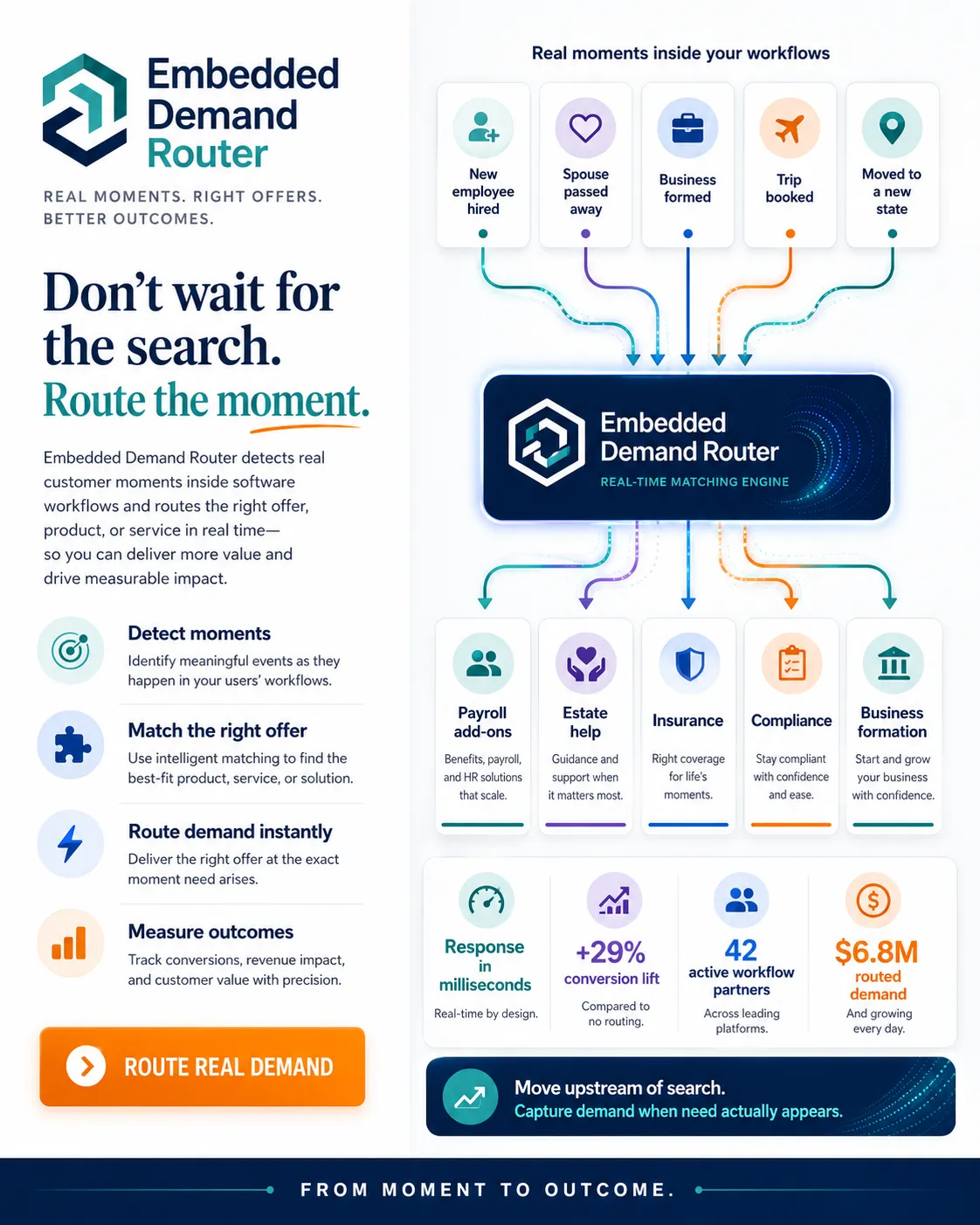
Companies currently think of distribution as channels: SEO, paid, partnerships, affiliates. But the future may be moments. Embedded Demand Router would identify commercial moments occurring across thousands of software products and route relevant products into them. A new employee hired. A home purchased. A company formed. A spouse dies. A business crosses a regulatory threshold. A traveler books an expensive trip. Those events create demand before anyone searches Google. The system would let vendors bid or qualify to be surfaced at those moments. That attacks rented-channel risk at its root because you stop competing for captured intent and move upstream to generated need. Example: LegalZoom currently fights for “start an LLC” searches. In this model, the service appears when someone opens a business bank account, registers a domain, buys payroll software or receives their first contractor payment.
Description
No additional description provided.
The Pitch
Most commerce is still organized around where attention is gathered, not where need is born. Search and ads are downstream artifacts: they are what happens after a person has translated a life event into a query. But many valuable purchases begin as administrative transitions, not conscious shopping journeys. The moment someone becomes eligible, liable, responsible, underinsured, overexposed, or newly obligated is often more commercially important than the moment they decide what to type into a search box.
The most interesting insight is that software has become the sensor layer for the economy. Payroll systems know when a company is hiring. Accounting tools know when revenue crosses a threshold. Travel platforms know when a trip has unusual risk. Banking, HR, compliance, real estate, and vertical SaaS products increasingly observe the small status changes that used to be invisible. If those signals can be interpreted safely and surfaced appropriately, they become a new kind of distribution inventory: not impressions, not audiences, but context with consequences.
This also changes the quality of the recommendation. A product introduced at the moment of need does not feel like an ad in the same way a retargeted banner does. It feels closer to a missing next step. That matters because trust is usually highest inside the workflow where the triggering event occurred. A founder opening a business account may be more receptive to formation, tax, insurance, or compliance help there than on a search results page crowded with anonymous providers fighting for the same keyword.
The business would also benefit from a structural frustration on both sides. Vendors are exhausted by bidding against each other in channels where intent has already been commoditized. Software platforms, meanwhile, often sit on commercially valuable moments but lack the breadth, neutrality, or operational machinery to monetize them without cluttering their product. A demand router could be valuable precisely because it is not another single marketplace; it is connective tissue between many narrow contexts and many specialized solutions.
The larger shift is from persuasion to timing. Many categories are not won by having the loudest message but by appearing at the point when inaction becomes costly. If a company could reliably understand those points across the software ecosystem, it would own something more durable than traffic: it would own the map of when demand becomes real.