Embedded Budget Bundling for Enterprise Software
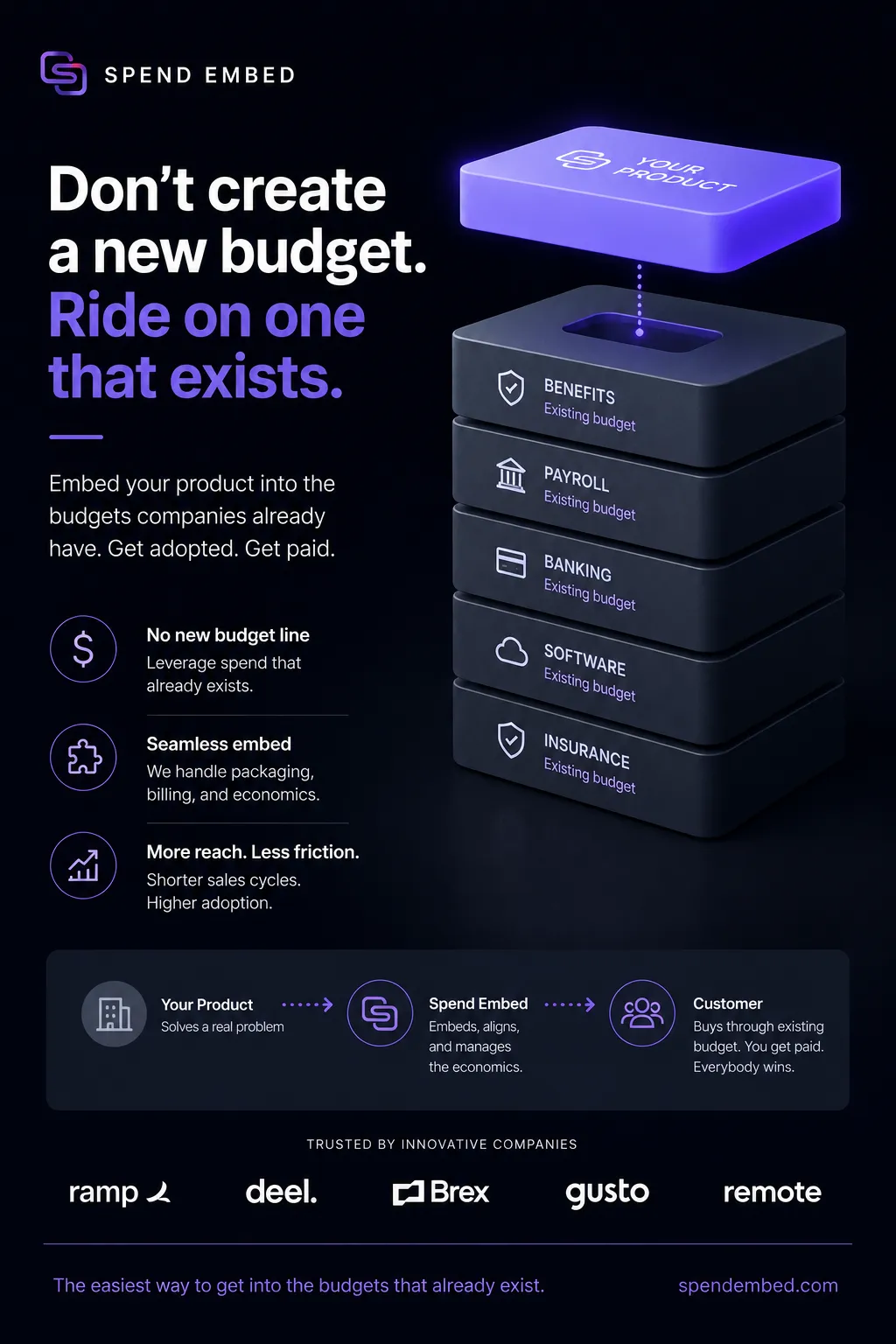
Some products will never deserve their own budget line. Spend Embed would let them ride inside something the company already buys. Instead of selling a standalone product to HR, finance or customer success, the vendor bundles into an existing payroll, benefits, insurance, banking, cloud or software contract and settles economics behind the scenes. Why now: more enterprise products are sold through platforms and embedded ecosystems, making it possible to shift from “convince someone to create a budget” to “take a percentage of an existing one.” Example: financial wellness is used by employees, valued by HR and funded unpredictably; Spend Embed packages it into the employer’s benefits spend and pays the vendor based on enrolled employees.
Description
No additional description provided.
The Pitch
Many useful products fail not because customers dislike them, but because companies have no clean place to buy them. Corporate budgets are maps of organizational history, not maps of current need. If a product sits between HR, finance, legal, IT, and operations, it can be loved in conversation and still die in procurement because no one owns the line item. A business that turns “budget ambiguity” into an integration problem would unlock a class of products that are chronically under-bought.
The most interesting wedge is that existing spend is often less rationally defended than new spend. A company may scrutinize a $30,000 new vendor while barely noticing a larger renewal that has become institutional furniture. Attaching a marginal service to a trusted recurring contract changes the psychology of the purchase: the question moves from “Should we buy another thing?” to “Should this thing be included in the thing we already buy?” That is not just easier administration; it is a different category of decision.
This would also create a new kind of distribution advantage. Platforms with large recurring contracts already have the customer relationship, the data context, and the billing rail, but they cannot build every adjacent product themselves. Smaller vendors often have sharper products but lack procurement gravity. A company that specializes in embedding, packaging, compliance, attribution, and settlement could become the connective tissue between these two worlds. The hard part is not adding another marketplace tile; it is making the economics and accountability feel native to the host contract.
The business becomes more durable if it focuses on products whose value is real but whose buyer is structurally weak. Benefits, employee support, compliance-adjacent tools, risk reduction, enablement, and financial health often create diffuse gains across the company while lacking a powerful internal champion. These are exactly the products that suffer in normal sales motions and benefit most from being tucked into a stronger purchasing stream.
The deeper thesis is that enterprise software has over-indexed on proving product value and under-indexed on fitting the shape of corporate money. Spend Embed would not merely help vendors sell; it would acknowledge that budgets are one of the primary interfaces through which companies understand what is legitimate. Whoever controls that interface can make previously optional products feel inevitable.