Elective Surgery for Human Biological Enhancements
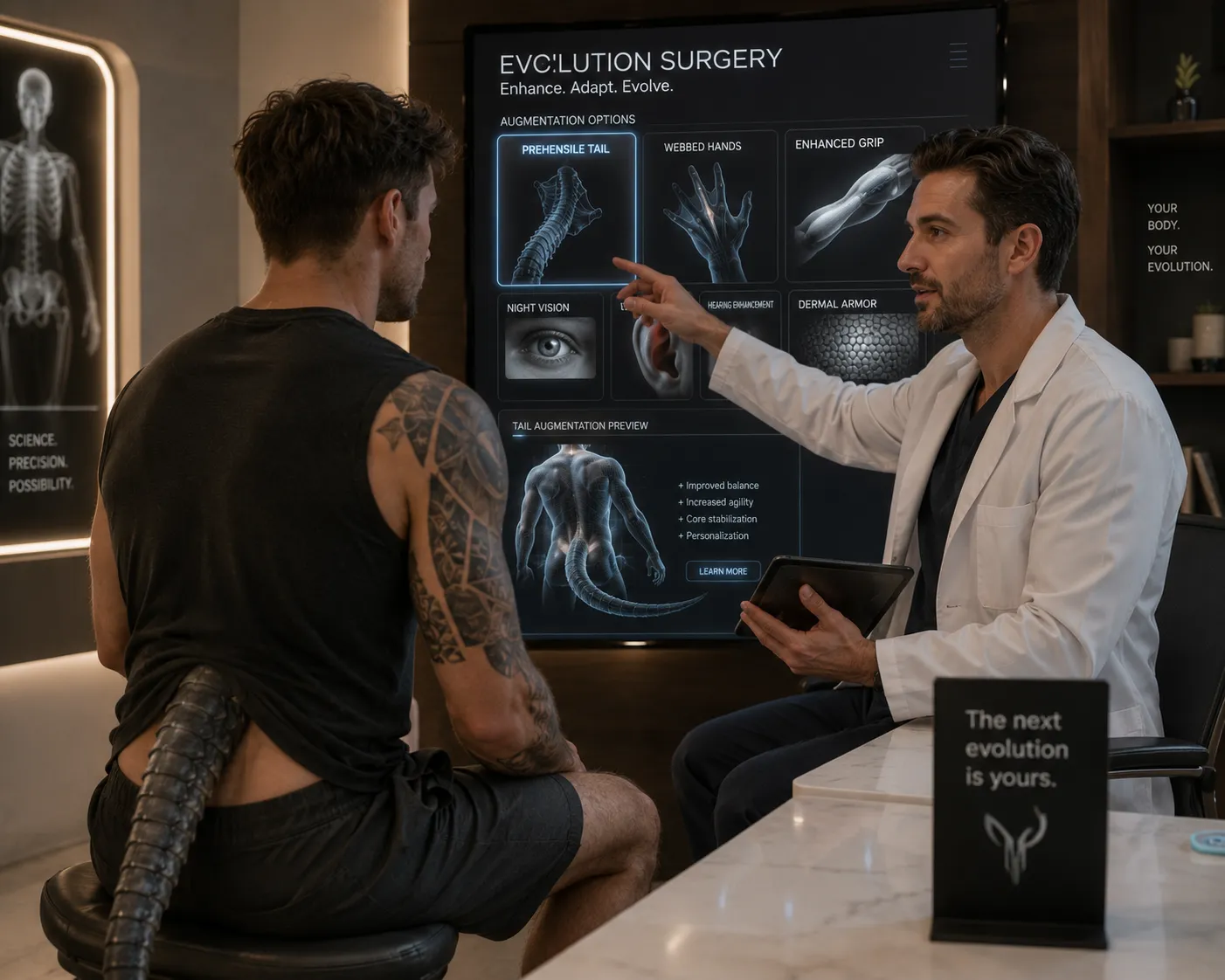
Body modification today is largely limited to cosmetic procedures that make people look younger or slightly different, while advances in biotechnology continue expanding what's medically possible. Evolution Surgery imagines a future where elective procedures add entirely new biological capabilities such as functional tails, enhanced grip, webbed hands, sensory implants, or other nontraditional human enhancements. Rather than simply changing appearance, these procedures allow people to customize how their bodies function based on hobbies, professions, or personal identity. As bioengineering, prosthetics, neural interfaces, and regenerative medicine continue advancing, consumers may increasingly seek enhancements rather than corrections. Imagine a rock climber electing to receive an engineered prehensile tail that provides additional balance and stability during climbs.
Description
No additional description provided.
The Pitch
People already spend heavily to change bodies for status, confidence, identity, sexuality, performance, and belonging. The non-obvious shift is that the next premium body market may not be about looking more natural, but about becoming deliberately less standard. Once safety crosses a threshold, unusual capability can become a luxury good, a subculture signal, and a tool all at once.
The strongest version of this business would not be selling procedures as isolated novelties. It would be creating a new category of embodied specialization. Modern life has made many people feel detached from their bodies: work is screen-based, fitness is abstracted into metrics, and identity is increasingly digital. A functional body modification reverses that trend. It makes identity physical again. For the right customer, an added capability is not merely useful; it is a way of making the body feel authored rather than inherited.
The market would likely begin where utility and self-expression overlap. That matters because purely cosmetic modifications depend on taste, while purely functional medical devices are constrained by clinical need. Capability-enhancing modifications sit in a rarer middle: they can be justified by performance, but desired for meaning. The same enhancement can be equipment, art, identity, and membership in a community. Businesses that own those layered meanings tend to be more durable than businesses that sell a single practical benefit.
Trust would be the real product. A company in this space would need to make the strange feel safe without making it feel ordinary. That is a difficult balance, and therefore a source of defensibility. The brand would have to borrow from surgery, luxury, tattoo culture, athletic equipment, and medical ethics without fully becoming any of them. If it succeeded, it would become the institution that legitimizes a taboo before the rest of society knows how to talk about it.
The deeper thesis is that human enhancement may not arrive first as a mass-market productivity upgrade. It may arrive as a set of intense, expensive, identity-rich choices made by people for whom the standard human form feels like a default setting rather than a destiny. A company that understands that psychology would not just sell altered bodies; it would sell permission to imagine the body as a platform for personal authorship.