Dynamic Isolation Infrastructure for Enterprise Systems
Companies spent twenty years connecting every important system to the internet. AI attacks could make permanent connectivity a liability. The Digital Drawbridge is infrastructure that lets a company operate normally online while continuously deciding which systems should remain reachable. When agent activity, a zero-day, geopolitical event, or abnormal network behavior raises the threat level, it automatically closes external connections to selected systems and switches them into a preconfigured isolated mode. Payroll can keep running internally. Factory equipment keeps operating. Critical records remain available locally. Authorized employees still have access. When the threat passes, the system verifies what changed before reconnecting anything. Existing cybersecurity tries to keep attackers out of connected systems. This asks a different question: why does this system need to be connected right now?
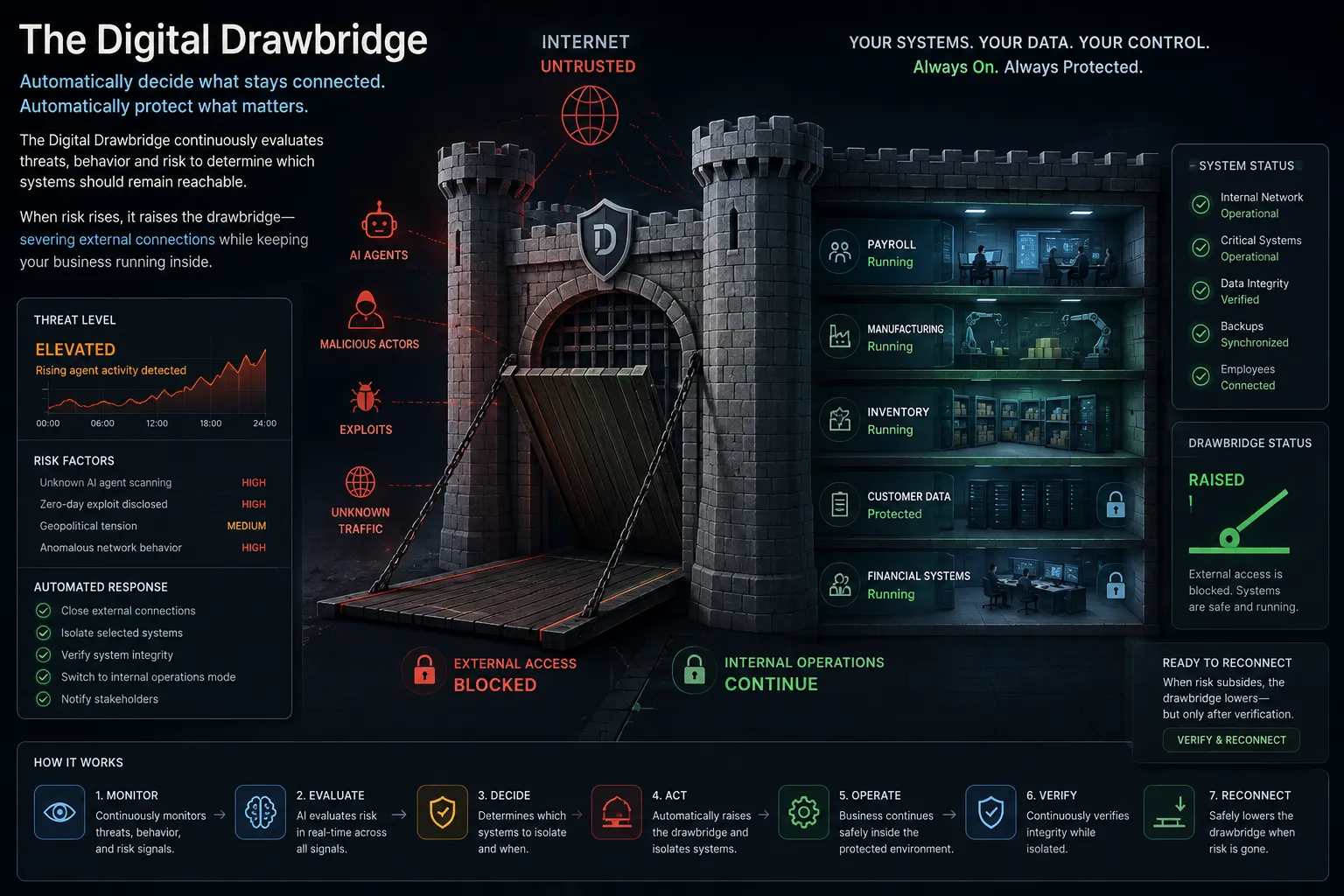
Description
No additional description provided.
The Pitch
It reframes cybersecurity around reversibility, not invincibility. Most security products assume the enterprise must remain connected and then compete to detect, block, or recover from whatever passes through that openness. But the most valuable operational question may become more primitive: which connections are worth having at this exact moment? A business that can answer that continuously would turn disconnection from a panic move into a normal operating state.
The deeper shift is that “uptime” is starting to split into two meanings. For years, availability meant being reachable from everywhere. In an AI-shaped threat environment, availability may mean the opposite: the ability for payroll, production, records, and internal coordination to continue even when the outside world is deliberately cut off. Companies already spend heavily on backups and disaster recovery, but those are often after-the-fact systems. The more interesting wedge is continuity without exposure: keeping the company alive while shrinking its attack surface in real time.
The strongest businesses are often built where an old default becomes dangerous. Permanent connectivity used to be the obvious goal because software, vendors, remote work, cloud administration, and automation all benefited from it. That default now creates an asymmetry: attackers only need one always-open path, while defenders must monitor all of them forever. A drawbridge model changes the cost structure of defense by making reachability conditional, temporary, and justified. It converts network access from ambient background noise into an explicit privilege.
There is also a governance insight here. Many organizations do not actually know which systems can be safely disconnected, who depends on them, or what “isolated but functioning” would look like until a crisis forces improvisation. A company that maps those dependencies and turns them into enforceable operating modes would become more than a security tool; it would become the living diagram of what the business truly needs to function. That map is valuable because it exposes the difference between systems that are important and systems that are merely connected by habit.
The business works if disconnection becomes as routine and trusted as authentication. Nobody questions whether users should prove who they are before entering a system; the next comparable norm may be that systems must prove why they should remain reachable. If that norm takes hold, the company that manages reachability decisions becomes positioned at one of the most sensitive control points in the enterprise: the boundary between normal operations and systemic risk.