Dynamic Data Isolation for Corporate Security
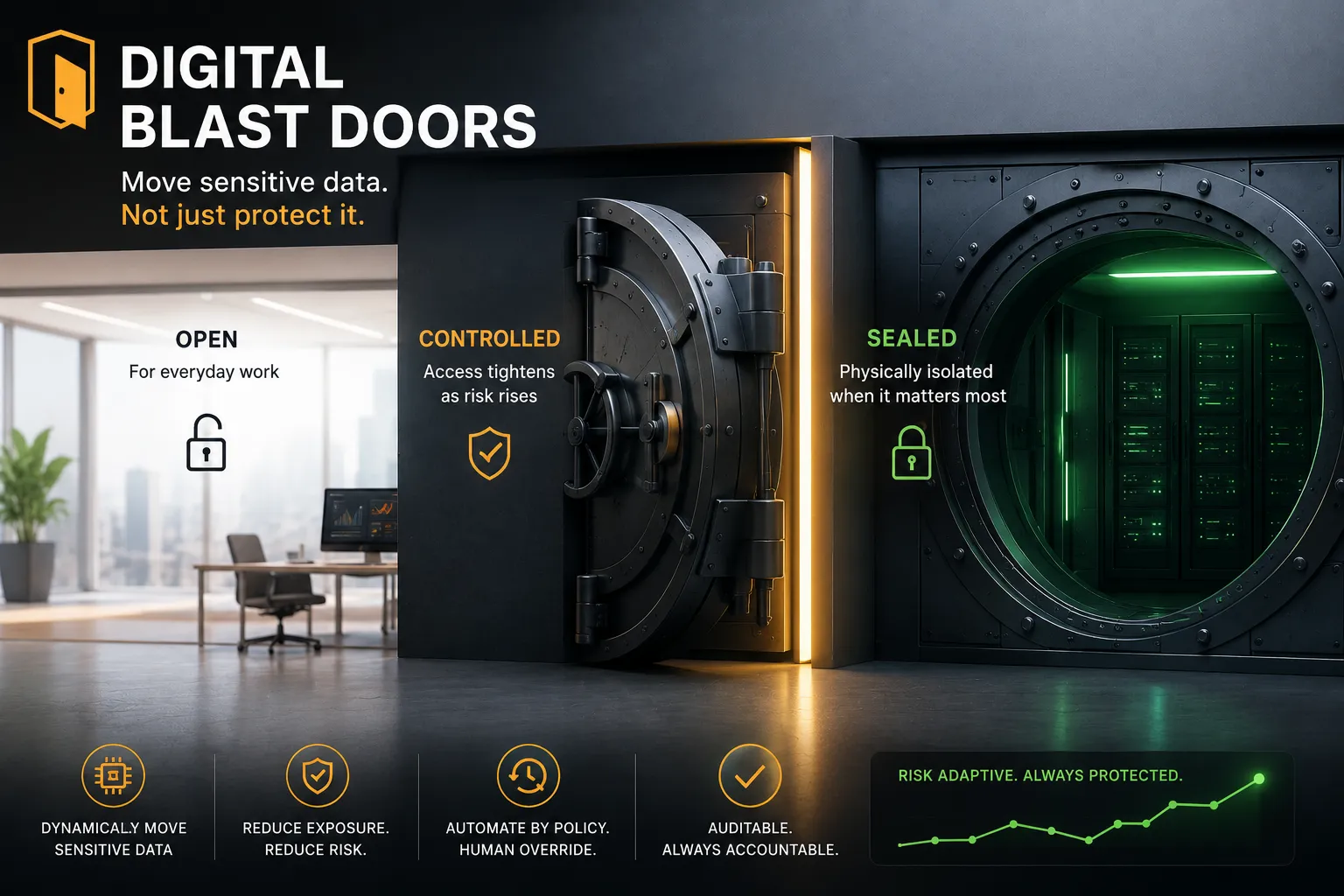
Sensitive information is usually protected by deciding who can access it, even though the information itself remains sitting on network-connected infrastructure that attackers can potentially reach. Digital Blast Doors makes the location of data dynamic, automatically moving information between connected, restricted and physically isolated environments based on its sensitivity and the current threat level. That becomes valuable as AI dramatically increases the number and sophistication of attempts against valuable corporate information, making permanent digital accessibility an unnecessary risk. When a company’s acquisition moves from preliminary discussions to a signed LOI, its deal room could automatically move onto physically isolated infrastructure that requires someone inside headquarters to open access.
Description
No additional description provided.
The Pitch
Treat data exposure as a temporary operating condition, not a permanent property of the enterprise. Most security assumes important information must remain continuously reachable because businesses are continuously digital. But many of the most valuable documents are not actually needed every second; they are needed in bursts, by specific people, during specific moments. A company that can make sensitive data disappear from the reachable internet when it is not actively required changes the attacker’s problem from “find a weakness eventually” to “be present at the exact moment the door is open.”
This is especially interesting because the value of isolation rises as attack automation improves. AI does not merely make phishing emails better; it makes persistence, reconnaissance, and timing cheaper. If attackers can probe every exposed system indefinitely, then defending all access paths all the time becomes structurally unfair. Moving data across levels of connectivity creates a scarcity attackers are not used to: opportunity. The best defense may not be a smarter lock, but fewer hours in which a lock exists.
The business also works because it aligns security with the real rhythm of corporate sensitivity. Information does not have one fixed risk level. A board deck, legal memo, source code branch, customer export, or M&A folder may become vastly more dangerous for a short period and then decline in urgency. Today, companies often respond to this with manual procedures, special permissions, or blanket restrictions that people work around. Dynamic location is a more native control: the infrastructure itself reflects the moment, rather than depending on every employee to behave as though every file is always radioactive.
The deepest appeal is psychological as much as technical. Executives understand physical separation. A safe, a clean room, a locked records archive, an air-gapped machine: these are intuitively different from another dashboard permission. Digital Blast Doors would give companies a way to say, with unusual concreteness, that certain information is not merely harder to access but not presently there to steal. In a world where breaches increasingly feel inevitable, that distinction is powerful.
If this existed, it could become a new default for high-consequence information: not because every file deserves isolation, but because the most dangerous assumption in enterprise security is that the crown jewels must always be online.