Distribution Risk Planning for Customer Acquisition
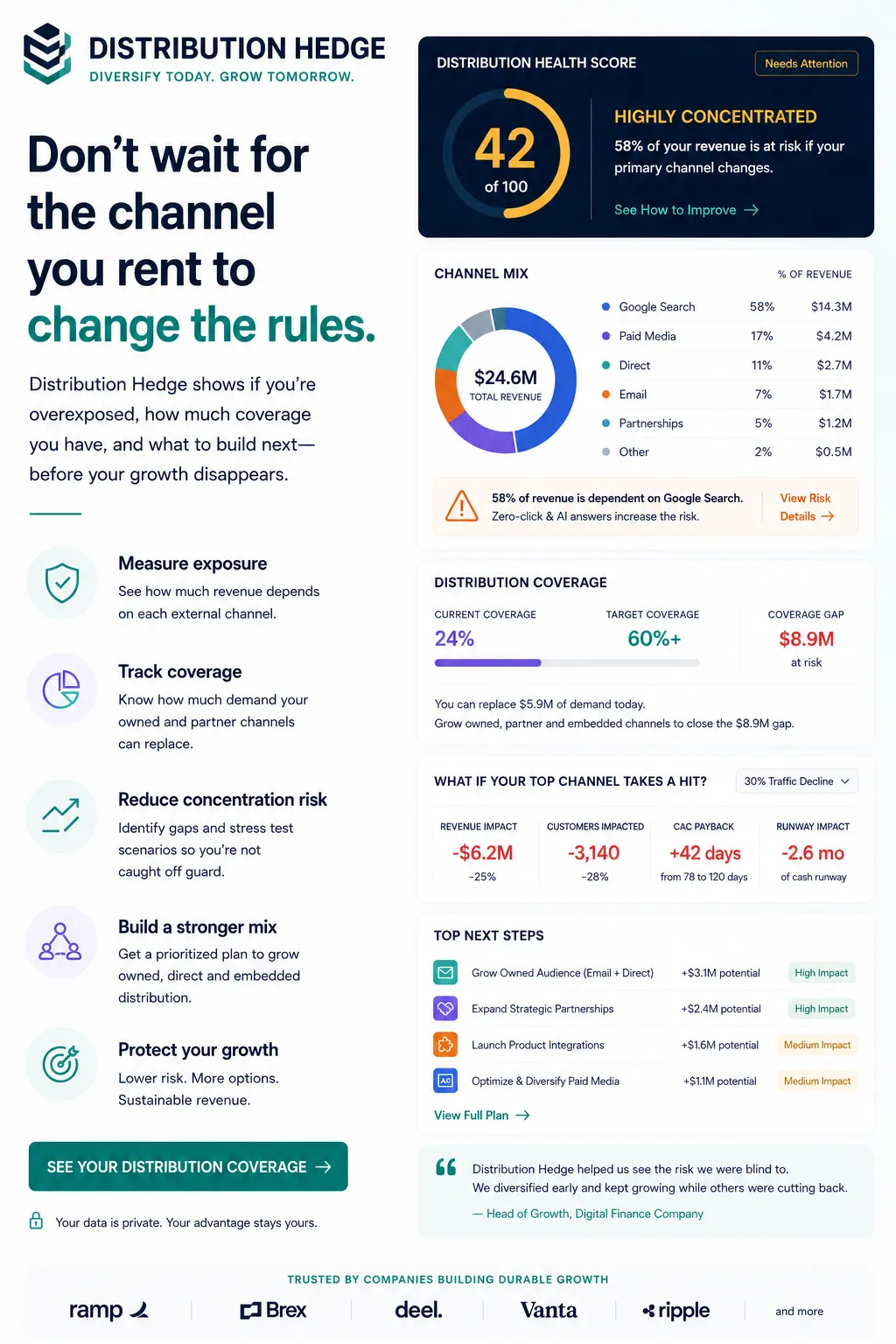
Companies diversify channels after the primary one breaks, when they have the least time and capital to do it. Distribution Hedge would continuously calculate how much replacement acquisition capacity a company has outside its dominant channel and prescribe how much owned, direct or embedded distribution needs to be built to reduce concentration risk. Why now: the economics of search are changing toward more zero-click and AI-mediated behavior, making historical traffic levels a weaker assumption for planning. Example: a publisher relies on search for 70% of monetizable visits. Distribution Hedge shows that email, direct traffic and partnerships could currently replace only 14% of that demand, creating a measurable “distribution coverage ratio” leadership can improve before traffic disappears.
Description
No additional description provided.
The Pitch
Distribution risk is one of the largest unpriced liabilities inside modern companies. Teams can tell you their cloud spend, churn, gross margin, and cash runway, but many cannot answer a more existential question: if the main source of customers weakened by half, how much demand could be replaced without panic? That blind spot persists because channel performance is measured as growth, not resilience. A company can look healthy right up to the moment its dependence becomes visible.
The important shift is that distribution has become less like a set of marketing tactics and more like balance-sheet exposure. A dominant channel can function like cheap debt: it funds growth beautifully until the terms change. Search, social platforms, app stores, marketplaces, and recommendation feeds all create the same hidden bargain: companies get efficient demand in exchange for accepting rules they do not control. The more successful the channel becomes, the harder it is politically to spend money on alternatives that look worse in the short term.
A business that quantified replacement capacity would change the internal conversation. “We should build audience” is easy to postpone; “we can currently replace only 14% of demand if our main channel deteriorates” is harder to ignore. The power is not in predicting which platform will break, but in making dependency legible before it does. Once concentration risk has a number, it can be tracked, assigned, budgeted, and compared across business units in a way vague anxiety never can.
The best customers would not be the companies already in crisis, but the ones whose success has made them fragile. Publishers, consumer brands, SaaS companies, marketplaces, and content-led businesses often mistake channel fit for durable advantage. The more efficient the acquisition engine, the more it suppresses investment in slower assets like direct relationships, partnerships, community, data, and brand recall. This creates a recurring need for a neutral instrument that says, in effect: your growth is real, but your access to demand is rented.
What makes the idea especially interesting is that it turns defensive work into an operating metric. Companies already know they should reduce dependence, but the work feels abstract until it is tied to a coverage ratio that can improve or deteriorate. The enduring company here would not merely warn that platforms are risky; it would create the language by which management decides how much independence is enough.