Distribution Asset Valuation Platform
a financial system of record for distribution assets and liabilities. Today a company can distinguish owned versus leased real estate, but not owned versus rented customer access. Distribution Balance Sheet would value search traffic, paid media, marketplaces, partnerships, direct audience, integrations and embedded placement based on durability, control, concentration and replacement cost. Example: two companies each generate $100M of revenue. One owns an audience and embedded distribution; the other depends on Google and Meta. Their revenue looks identical in the P&L but is not remotely the same asset.
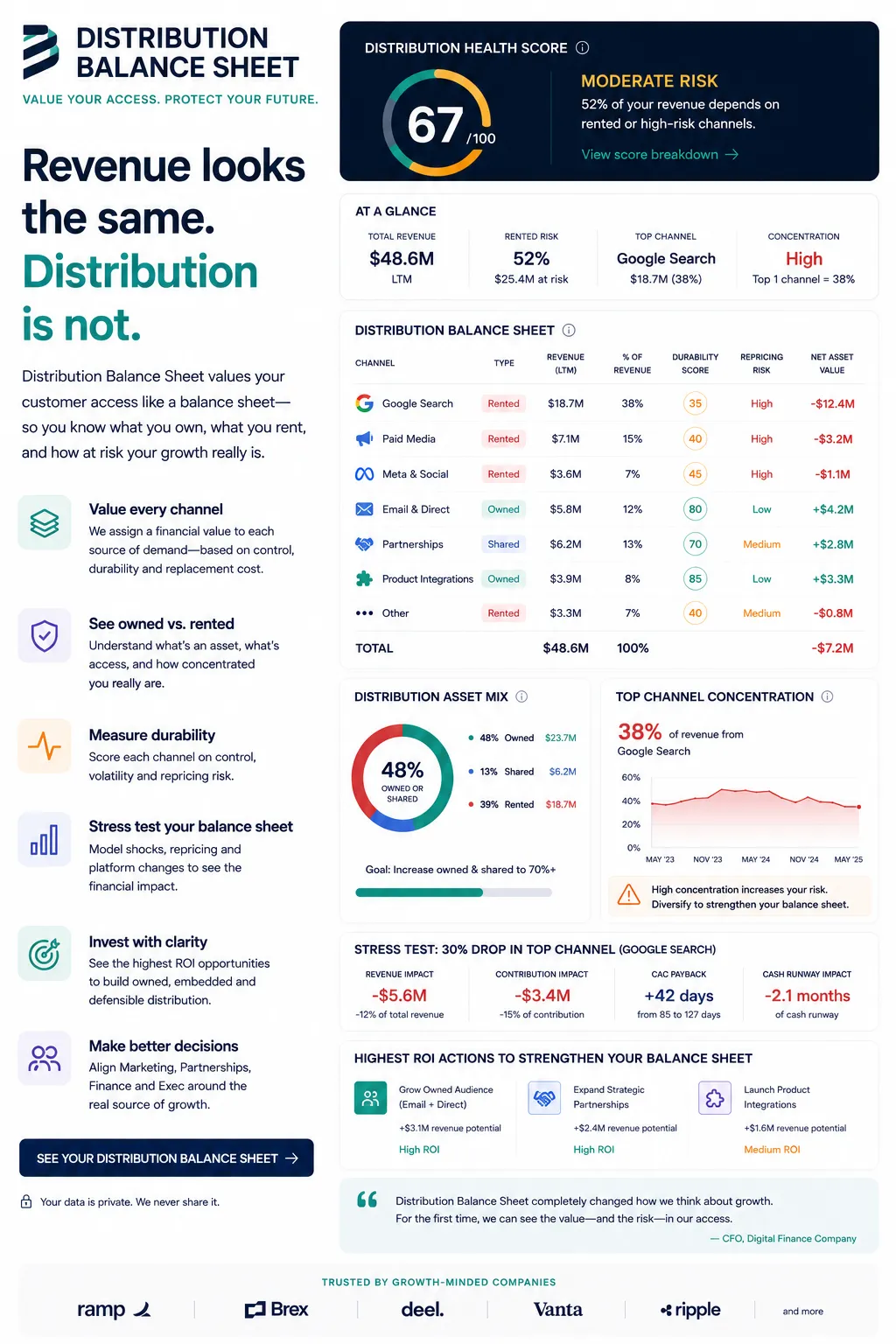
Description
No additional description provided.
The Pitch
Distribution has become one of the largest hidden balance sheet items in modern companies, while accounting still treats it mostly as a period expense. A business can spend years compounding an email list, app habit, partner channel, community, ranking position, API integration, or embedded workflow, yet those assets appear nowhere with the clarity given to a warehouse or software license. The result is that management teams often know their CAC but not whether they are building an asset or renting one month to month.
The most interesting wedge is that distribution risk is mispriced. Two companies with the same revenue, margin, and growth rate can have radically different fragility depending on whether demand is pulled from controlled channels or borrowed from auction-based platforms. That difference usually becomes visible only after an algorithm change, platform fee increase, channel saturation, or partner churn. A system that makes this legible before the shock would change how boards evaluate performance: growth bought through unstable access would no longer look equivalent to growth produced by durable reach.
The business also benefits from a broader shift in power from production to access. In many categories, making the product is no longer the scarce function; reaching the customer repeatedly without paying a toll each time is. This is why brands acquire media properties, software companies cultivate developer ecosystems, and marketplaces fight to prevent disintermediation. The company that can measure owned customer access gives executives a vocabulary for something they already feel but cannot quantify: the difference between having demand and merely purchasing demand.
There is also a natural buyer because the pain appears at consequential moments. Acquirers want to know whether revenue will survive outside the seller’s current channel mix. CFOs want to distinguish marketing spend that creates enduring access from spend that evaporates. Lenders and insurers care because distribution concentration can behave like credit risk. The product becomes more valuable precisely when the stakes are high, because it translates channel dependency into financial language.
The deeper opportunity is that once distribution is measured consistently, companies will manage it differently. They will compare the replacement cost of a partner channel against building direct audience, treat marketplace dependency as a liability, and value embedded integrations as strategic infrastructure rather than vague “traction.” The system would not just describe where revenue comes from; it would reveal how much of that revenue the company truly controls.