Distributed Brand Merchandising Story Network
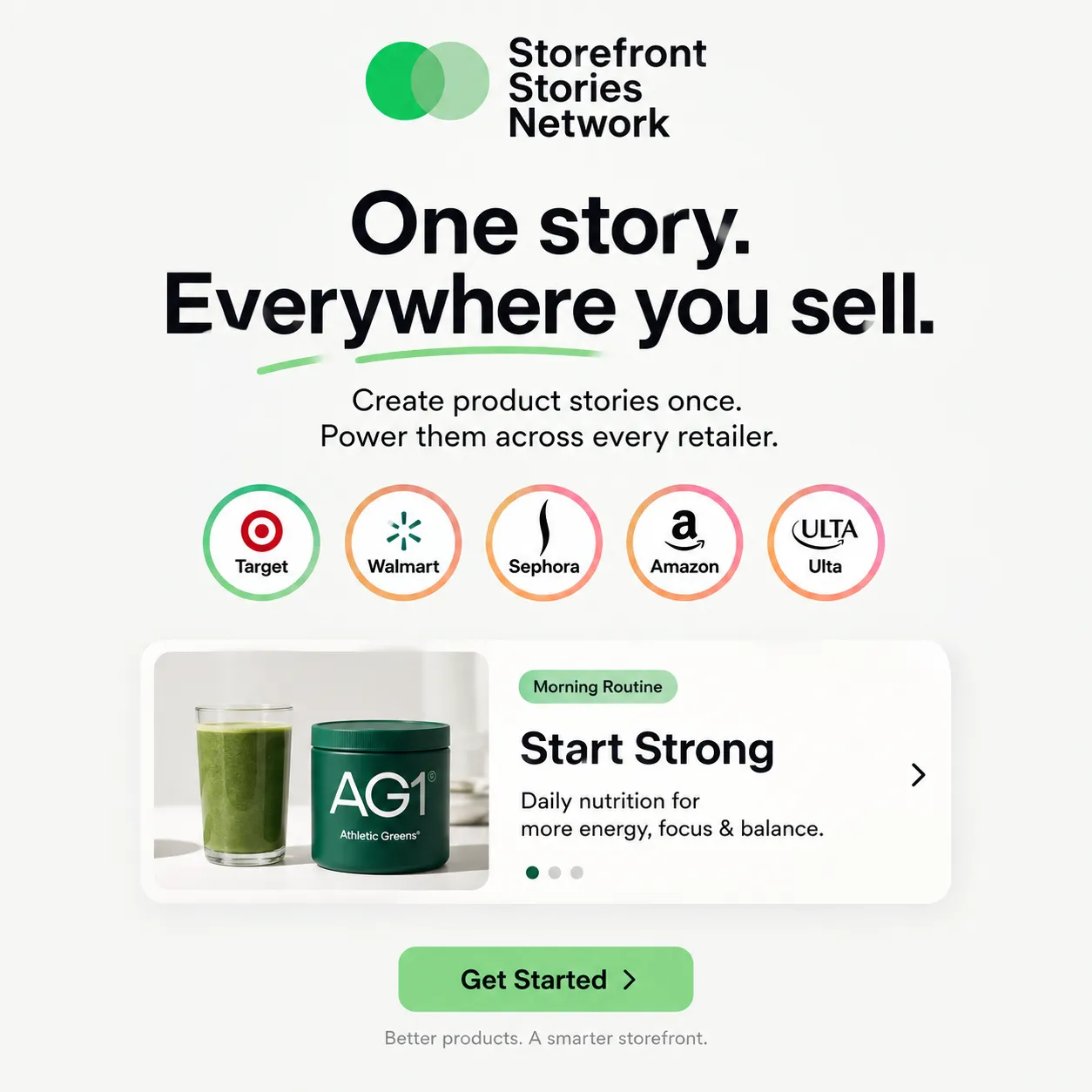
Brands spend enormous amounts creating merchandising for their own sites, then lose control of the story when the same product appears at Target, Walmart, Sephora or hundreds of smaller retailers. Storefront Stories Network would let a brand create tiny, standardized merchandising units that travel with the product everywhere it is sold. Athletic Greens could publish “Morning Routine,” “Travel” and “Energy” stories once, then retailers carrying AG1 could automatically surface those stories alongside the product and see which ones convert. Retailers get continuously updated merchandising without creating it themselves, brands get a new distribution surface, and the humble product feed evolves from price, image and description into actual persuasion.
Description
No additional description provided.
The Pitch
Product information has become strangely underdeveloped compared with the rest of commerce. A brand can spend millions refining the story on its own site, but the moment the product enters retail distribution, the story collapses into a title, a thumbnail, a bullet list and a review average. The most persuasive part of the product is treated as non-portable. Turning merchandising into a reusable layer recognizes that, for many products, the reason to buy is not contained in the SKU data at all.
The deeper opportunity is that retailers and brands both suffer from the same asymmetry, but from opposite sides. Retailers have the traffic and purchase intent, but not enough context to merchandise every item well. Brands have the context, but not the shelf where many customers make the decision. Today that gap is filled manually, inconsistently and expensively. A shared story format would let each side contribute what it is naturally best at: retailers provide distribution and conversion data; brands provide meaning, use cases and education.
The non-obvious power is standardization. If every retailer asks for a different content package, the system becomes another production chore. But if “product stories” become a recognizable commerce primitive, they start to behave more like a richer product feed than a campaign asset. That makes the content cheap to update, easy to syndicate and measurable across channels. The winning format would not be the most beautiful one; it would be the one trusted enough that retailers are willing to render it automatically.
This could also change how brands learn. Today, brands often know which ads produce clicks and which retailers produce sales, but they have far less visibility into which pieces of merchandising actually move a shopper from interest to purchase across the retail web. A portable story layer creates a feedback loop around the middle of the funnel, where positioning, occasions and objections are tested in the places people already buy. Over time, the network becomes not just a distribution system for content, but a map of why people buy the same product in different contexts.
The reason this feels like a company rather than a feature is that no single retailer or brand can solve it alone. The value appears when the format travels. Once enough retailers accept the units and enough brands maintain them, the network becomes a new piece of commerce infrastructure: invisible when it works, but quietly responsible for making online shelves less dumb.