Deployment Learning Software for Enterprise Implementations
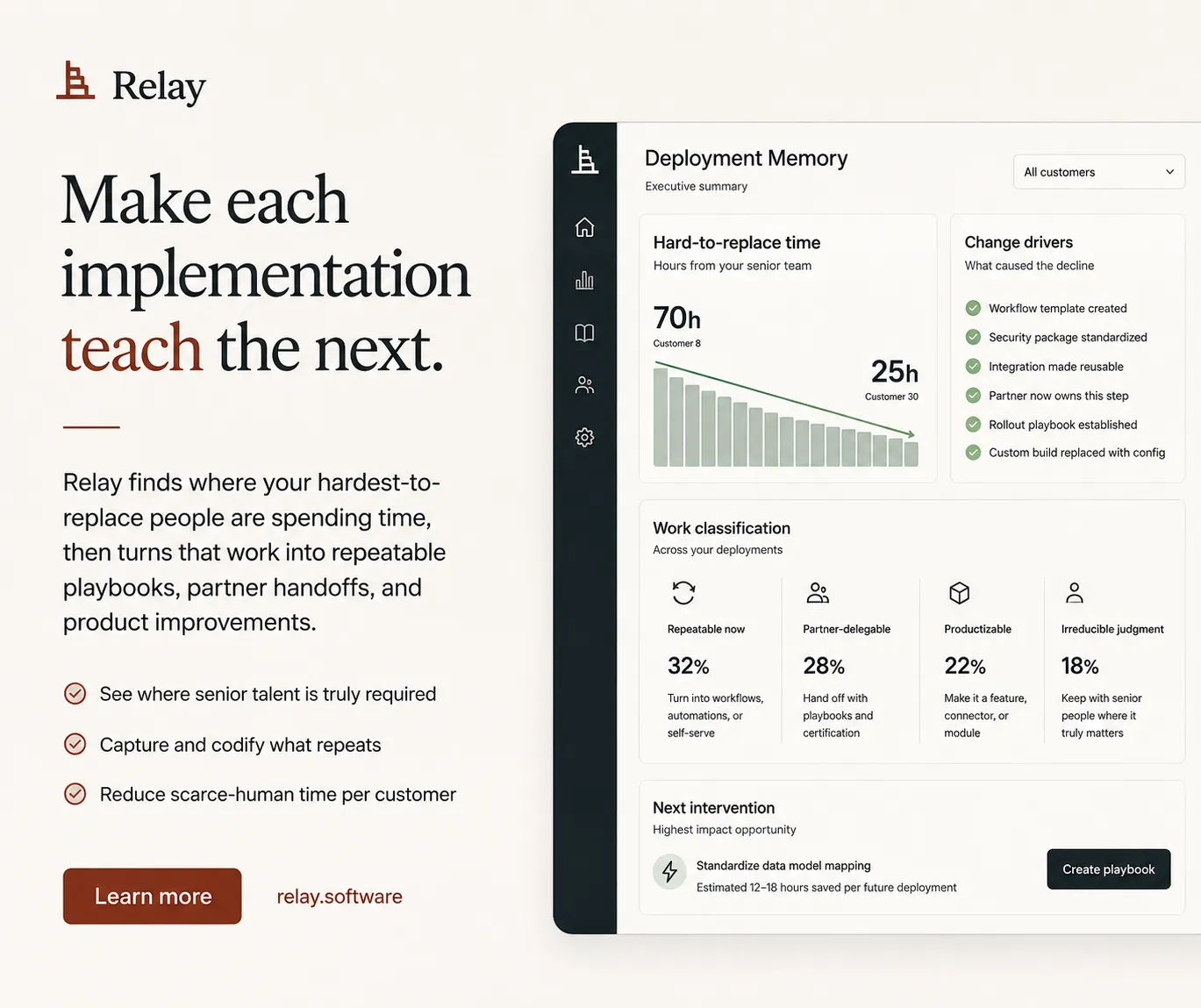
Enterprise software companies keep trying to make implementation standard, even though the hardest part usually cannot be standardized. The thing that should exist is software that watches every customer deployment and figures out where the company is repeatedly spending its hardest-to-replace human judgment. It connects to calls, Slack, Jira, Salesforce, implementation docs and support, then separates the work into what can become a workflow, what can be handed to a partner, what should become product, and what still genuinely needs a senior person. The goal is not to automate the implementation. It is to make each implementation teach the company how to need less scarce talent on the next one. A dashboard might show that customer eight required 70 hours from the CTO, principal engineer and head of product, while customer thirty required 25, then show exactly what changed. This matters because the companies that have successfully scaled implementation-heavy software did not eliminate the human layer. They made the proof, capacity, economics or path to adoption more repeatable while the difficult customer-specific decisions remained bespoke. The product becomes more valuable with every deployment because it builds a private map of what the company has learned how to generalize. Eventually it should be able to tell a team, before the next customer starts, which parts are about to consume senior people again and what needs to exist so they do not. The category is not professional-services automation. It is software that makes bespoke work compound.
Description
No additional description provided.
The Pitch
The most expensive constraint inside many enterprise software companies is not engineering capacity or sales capacity, but interpretive capacity. A handful of senior people know how to translate messy customer reality into something the company can actually deliver. They sit in the gap between product, services, support, and customer politics. Their time is treated as heroic assistance, but it is really the company’s most important unpriced production input.
The interesting insight is that implementations are one of the few places where a software company repeatedly encounters the same ambiguity under slightly different disguises. Each deployment contains clues about what the product does not yet understand, what the sales motion has overpromised, what documentation cannot explain, and what customers consistently need translated. Today those clues mostly evaporate into meetings, Slack threads, and postmortems. Capturing them turns implementation from a cost center into a learning system.
The value is not in replacing expert judgment, but in locating it precisely. Companies often try to automate the visible tasks while leaving the real bottleneck intact: the moment when an experienced person says, “This customer’s request is actually the same as those other five, but framed differently.” If software can identify those recurring judgment calls, it gives the company a way to decide what should become product, process, partner work, or preserved expertise. That distinction is where the leverage lives.
This also creates a rare internal system of record for organizational maturity. Most metrics show whether deployments are late, costly, or painful; they do not show whether the company is becoming better at absorbing customer complexity. A tool that can reveal declining dependency on specific scarce people gives leadership a much more honest measure of scalability than headcount ratios or onboarding timelines. It would show whether the business is compounding knowledge or merely surviving each customer.
The durable appeal is that every serious enterprise software company eventually has to choose what kind of complexity it wants to own. Some complexity belongs in the product, some in partner ecosystems, some in repeatable playbooks, and some remains a reason customers pay a premium. A company that helps make those boundaries visible would sit close to the operating truth of the business. It would not just help software companies deliver faster; it would help them understand what they are actually learning as they grow.