Dependent Retirement Benefit Administration Platform
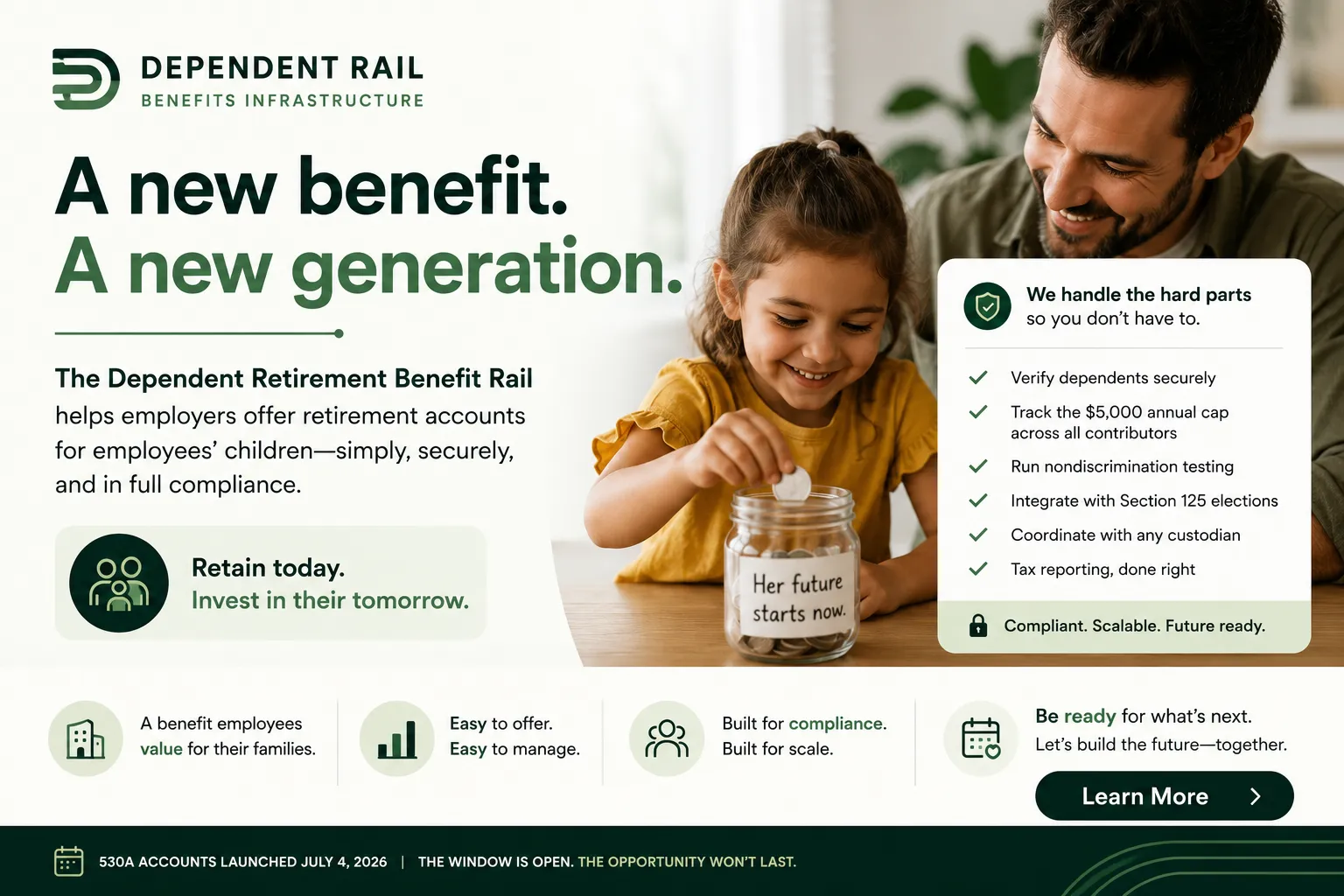
A new retirement benefit exists with no infrastructure to run it. Section 530A lets employers contribute to retirement accounts for employees’ children, but administering it means verifying dependents, coordinating a $5,000 annual cap across parents, grandparents, and employers, handling Section 125 elections, running nondiscrimination testing, and routing money to different custodians. **The Dependent Retirement Benefit Rail** would become the administration layer between employers, payroll systems, and custodians. A manufacturer could offer every employee $500 a year toward each child’s account; the platform handles eligibility, contribution limits, compliance, payments, and reporting. The accounts only launched in July 2026, giving a startup a narrow window before major benefits administrators and recordkeepers build their own rails. Employers pay per enrolled dependent, with brokers and payroll platforms providing distribution. The bigger opportunity sits underneath the software: whoever controls these contribution flows gains a relationship with families and visibility into retirement assets years before those children become adult investors.
Description
No additional description provided.
The Pitch
A benefit aimed at children changes the emotional geometry of workplace compensation. Adults routinely ignore marginal retirement benefits for themselves, but a contribution in a child’s name feels concrete, generous, and unusually durable. It lets an employer say something more distinctive than “we increased the match,” while still spending money inside a tax-advantaged, benefits-shaped container. The same dollar can carry more perceived value because it attaches to a parent’s identity rather than only to an employee’s paycheck.
The administrative difficulty is not incidental; it is the moat. This is the kind of benefit that sounds simple in a policy memo and becomes messy the moment it touches real families: blended households, divorced parents, multiple employers, grandparents who want to contribute, custodians with different formats, payroll systems that were not designed around minors. A company that normalizes those edge cases into a reliable rail would not merely be selling software. It would be converting legal permission into an actual market.
The most interesting feature of the category is that the account owner is a child, but the buyer, contributor, decision-maker, and future customer are all different people at different times. That creates an unusually long-lived financial relationship. A platform that begins as a compliance utility for employers could become the first financial institution attached to a child’s working-life capital before the child has wages, a credit file, or a bank preference. Most financial companies acquire customers after habits have formed; this one would be present before the habits exist.
It also sits at the intersection of two budgets that rarely meet cleanly: employee benefits and family wealth formation. Affluent families already build quiet financial advantages for children through custodial accounts, 529s, and trust structures. A workplace version makes the same instinct more accessible and more visible, especially for workers who may not have advisors or spare cash to start. If adoption spreads, “does this employer help me fund my kid’s future?” could become a small but real part of how parents judge jobs.
The business is compelling because the first trusted administrator could become the default translator for a new category. When rules are unfamiliar and mistakes are expensive, employers and payroll platforms tend to converge on whoever makes the benefit feel boring. In benefits infrastructure, boring is powerful: it means the company has embedded itself into flows that, once established, are rarely re-plumbed without a very good reason.