Demand Portability Layer for First-Party Customer Intent
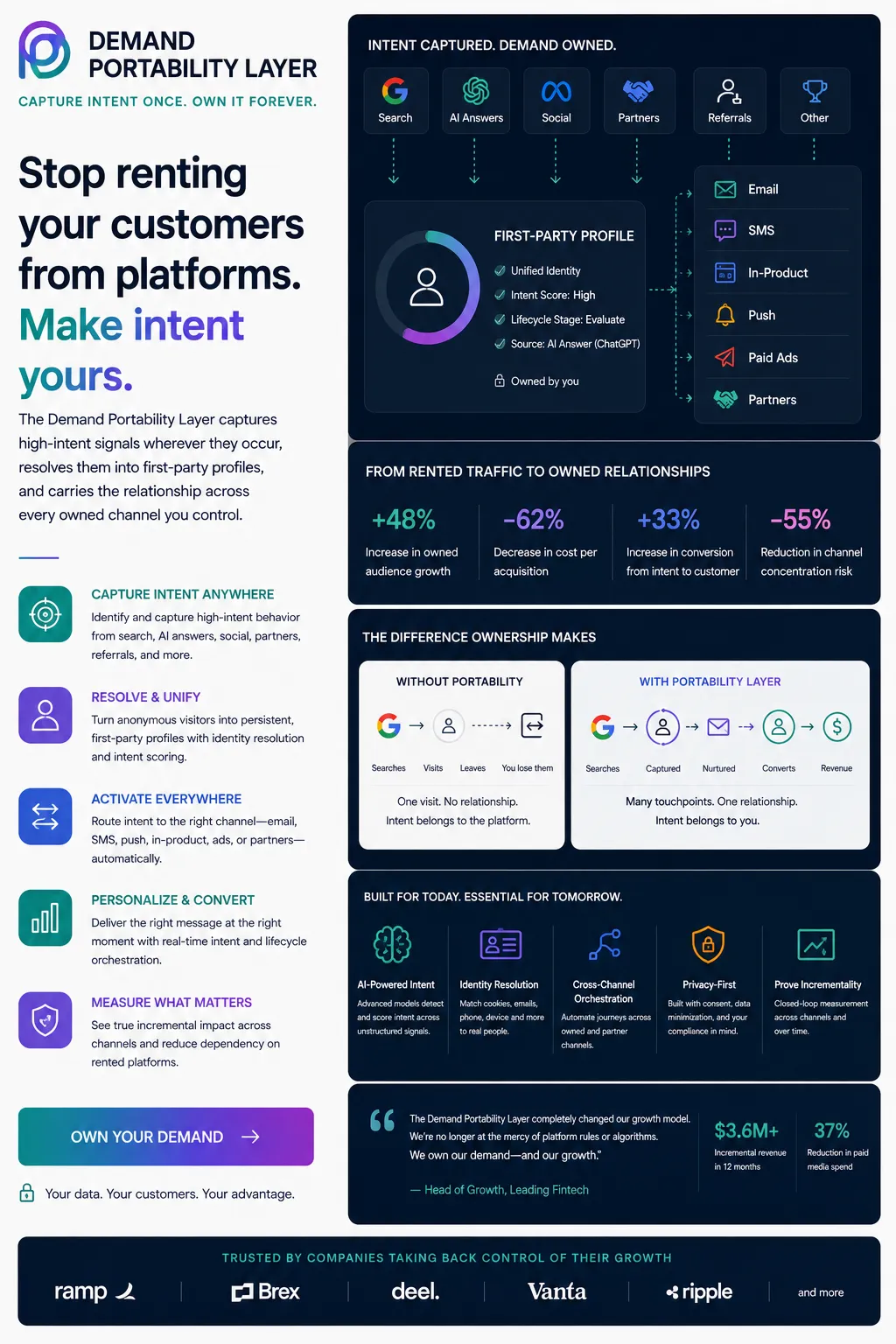
A hidden problem with rented channels is that customer demand belongs to the platform. Google knows the query. Meta knows the intent. Amazon knows the purchase. The company sees the customer only after the platform decides to send them. The product opportunity is to help companies capture intent once and make it portable across channels. A Demand Portability Layer would identify high-intent behavior wherever it appears, resolve it into a first-party identity or audience, and let the company continue the relationship through email, SMS, direct, product, partners or other owned surfaces. Why now: third-party distribution is becoming less predictable while first-party identity, event streams and AI personalization make it increasingly possible to carry intent from one environment into another. Example: someone lands from Google looking for “best student checking account.” Instead of treating that visit as one search session, the system converts the intent into a persistent first-party profile and continues the journey through owned channels until purchase. The big idea is: do not replace Google traffic. Make Google traffic less necessary every time you receive it.
Description
No additional description provided.
The Pitch
The most expensive part of modern customer acquisition is not the click itself, but the amnesia that follows it. Companies repeatedly pay to rediscover the same demand because intent usually evaporates at the edge of a session. A person who compares checking accounts, abandons a cart, reads a pricing page, or watches a product demo is not a vague “visitor”; they are an asset in motion. The company that can preserve that motion turns transient attention into compounding memory.
The deeper shift is that distribution channels are becoming less like roads and more like toll booths with changing rules. Search results get reorganized, social feeds become more algorithmic, marketplaces privilege their own inventory, and AI interfaces may answer questions before a brand is ever visited. In that world, owning a customer record is not enough. The more valuable asset is an owned understanding of what the customer is trying to do right now. Identity without intent is a mailing list. Intent without portability is rented demand.
This business would matter because most companies have fragmented signals but no shared nervous system. The search team sees queries, the website sees sessions, sales sees leads, lifecycle sees opens, product sees usage, and support sees friction. Each system treats these as separate facts, even when they are chapters in the same buying process. A company that can connect those moments creates a practical advantage: it can respond to demand while it is still warm, instead of waiting for the customer to re-announce themselves through another paid channel.
The economic appeal is unusually clear because the product improves the yield of money companies already spend. It does not require a new belief in advertising, content, CRM, or personalization; it makes all of them less wasteful. A single acquired visitor becomes more valuable if their intent can be carried into cheaper, more direct, and more relevant follow-up. Over time, this changes the shape of growth: paid channels remain useful, but they become sources of learning and relationship creation rather than recurring tolls.
The most interesting version of this company would become a kind of customer-demand ledger. Not merely a database of who people are, but a living record of what they have revealed they want, how strongly they want it, and where the relationship should continue next. That is a powerful position because every company says it wants to be customer-centric, but most still organize around channel ownership. Demand portability would reorganize the business around the customer’s momentum.