Demand Creation Attribution Platform
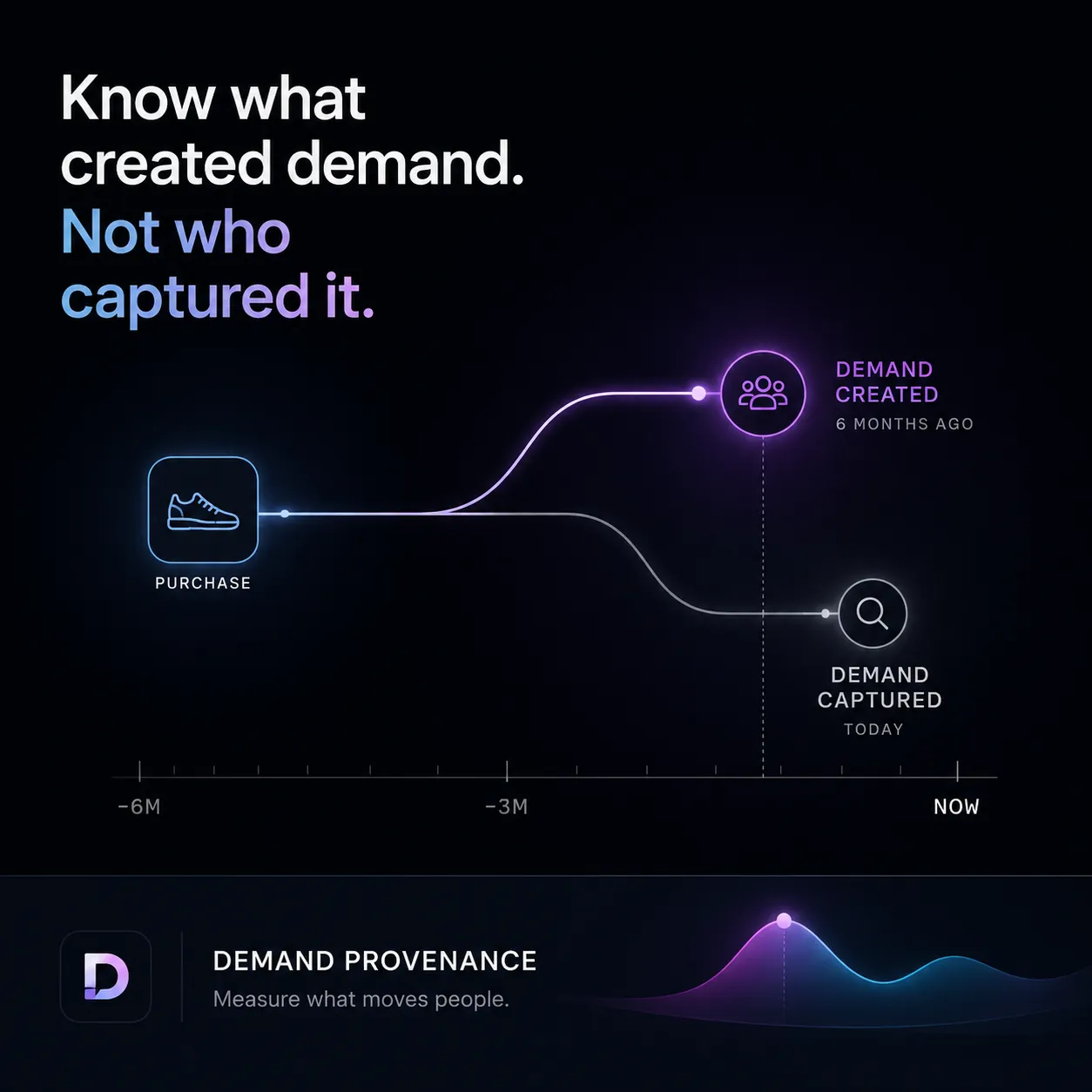
Marketing attribution tells companies which channel captured a customer, not which experience created the demand in the first place. Demand Provenance would separate demand creation from demand capture by tracing when a consumer's preference first measurably changed and what caused it. As discovery fragments across creators, communities, podcasts, AI answers, search and offline experiences, the last click becomes increasingly meaningless. Someone might discover On through a running club, hear about it repeatedly on podcasts, ask ChatGPT which shoe to buy six months later and finally purchase through Google. Google captured the demand; the running club created it. Companies should be able to measure both.
Description
No additional description provided.
The Pitch
A business like this would be compelling because modern marketing has a hidden accounting problem: the activities that create belief are often treated as costs, while the activities that harvest belief are treated as profit centers. That distorts budgets toward whatever is easiest to count, not whatever actually moves people. If a company could credibly show that a community, creator, podcast, event, or AI answer changed future buying behavior before a transaction happened, it would give management permission to fund the parts of marketing that compound but rarely get credit.
The most interesting shift is that demand is becoming more ambient. People no longer move cleanly from ad to website to purchase; they accumulate impressions, recommendations, stories, and social proof over months. The valuable signal is not merely “where did they click?” but “when did this become the kind of thing they were likely to buy?” A company that can identify that moment would turn brand marketing from a faith-based discipline into something closer to behavioral finance: measuring changes in propensity rather than waiting for the register to ring.
This also matters because the internet is filling with intermediaries that collapse the path to purchase. AI assistants, marketplaces, search engines, and retail media networks will increasingly sit at the point of capture and claim disproportionate credit. The stronger those capture layers become, the more brands need an independent memory of how demand was formed before the customer arrived there. Otherwise, the tollbooth starts to look like the road.
The defensibility of such a company would come from building a new kind of longitudinal demand graph: not just clicks and conversions, but repeated exposure, language adoption, search behavior, community participation, content resonance, and eventual purchase. The hard part is not collecting more data; it is distinguishing correlation from preference change well enough that companies trust the result. If done well, the product becomes less like another dashboard and more like a source of truth for how markets are actually shaped.
The deeper business insight is that every brand is surrounded by unpaid or under-credited demand creators. Enthusiasts, niche experts, local communities, reviewers, athletes, stylists, and obsessive hobbyists often do more to form preference than the official campaign. A system that reveals these origins would not just reallocate budgets; it would change how companies understand their own markets. It would show that demand is often born at the edges, long before it becomes visible in the metrics that currently decide what gets funded.