Delivery Capacity Planning for Enterprise Software Sales
Companies forecast bookings without modeling whether they can actually implement what sales is closing. Delivery Capacity OS would connect pipeline, signed contracts, implementation complexity and team throughput to show the real revenue capacity of the company before deals close. Why now: enterprise software is becoming easier to sell and customize with AI, but deployment still depends on scarce human capacity, making implementation the hidden constraint on growth. Example: sales expects $14M of enterprise ARR next quarter, but the system shows current delivery capacity can only absorb $8.5M without pushing time-to-live past 120 days, then identifies the exact hires or process improvements needed to close the gap.
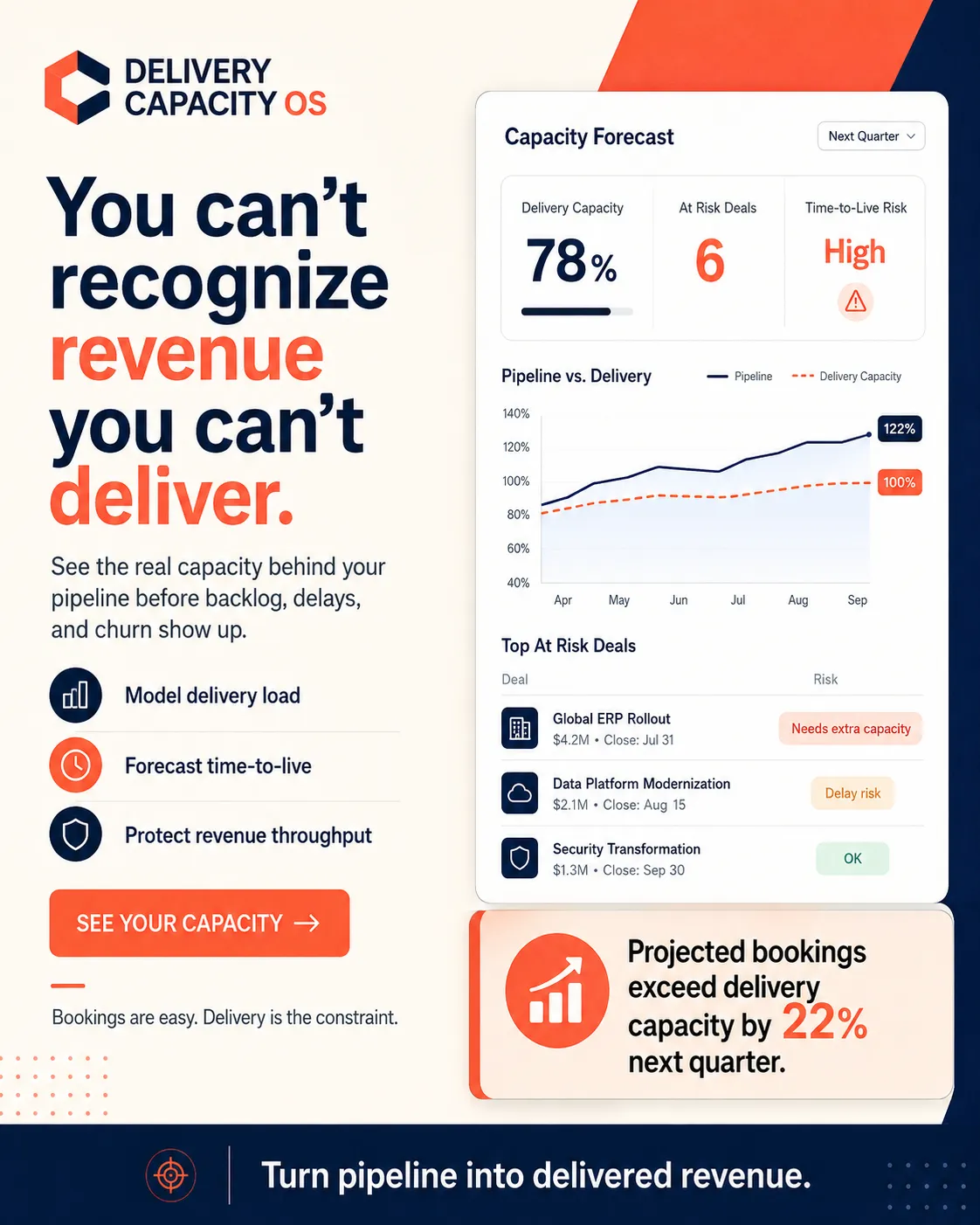
Description
No additional description provided.
The Pitch
Reframe revenue as something constrained by operational physics, not just market demand. Most companies treat a signed contract as the end of the revenue story, when for complex software it is often only the beginning of a second sale: the customer must be activated, integrated, trained, and made successful enough not to regret buying. A business that measures this gap would expose a category of risk that currently hides in spreadsheets, optimism, and heroic delivery teams.
The non-obvious insight is that implementation capacity is not merely a services problem; it is a revenue quality problem. Two companies with the same bookings number can be in radically different positions if one can convert those bookings into live customers in 30 days and the other needs 180. The first has cleaner cash conversion, lower churn risk, happier customers, and more credible forecasts. The second may look healthy in the CRM while quietly accumulating future disappointment. A system that makes this visible would become important because it turns “can we sell it?” into “can we absorb it?” before the damage is done.
This becomes more valuable as AI increases the surface area of what can be sold. If sales teams can promise more personalization, more integrations, and more bespoke workflows, then the bottleneck shifts from product capability to organizational throughput. The irony of AI-enabled software is that it can make the demo feel infinitely flexible while making the post-sale burden harder to reason about. The company that quantifies that burden becomes the counterweight to increasingly fluid selling.
The durable business is in becoming the shared truth between sales, finance, customer success, and delivery. Today each function has its own version of reality: pipeline probabilities, revenue forecasts, staffing plans, utilization reports, onboarding queues. None of them fully answers the question executives actually care about: how much revenue can we take on without degrading the customer experience? Once a company trusts one system to answer that, it would sit close to planning, forecasting, hiring, and deal approval.
The most interesting consequence is cultural. It would make operational capacity a first-class commercial constraint, the way inventory is in retail or seats are in airlines. Software companies like to imagine they have near-infinite marginal scalability, but enterprise software often scales through people long after the code is written. A business that names and measures that hidden limit would give companies a more honest way to grow.