Decisioning Layer for Embedded Commerce Workflows
Companies increasingly sell through someone else’s workflow, but the decision about what product to surface, when to surface it, and to whom is still mostly hard-coded or left to human memory. The opportunity is a decisioning layer for indirect commerce that evaluates each transaction in real time and returns the best partner product, referral, benefit or action to show next. Why now: more commerce is embedded inside software, APIs make these moments accessible, and AI can optimize across context, timing and conversion instead of relying on static rules. Example: a bank sees a customer report a death, the system recognizes the moment, evaluates available estate, insurance and financial products, and inserts the highest-value next action directly into the banker’s workflow.
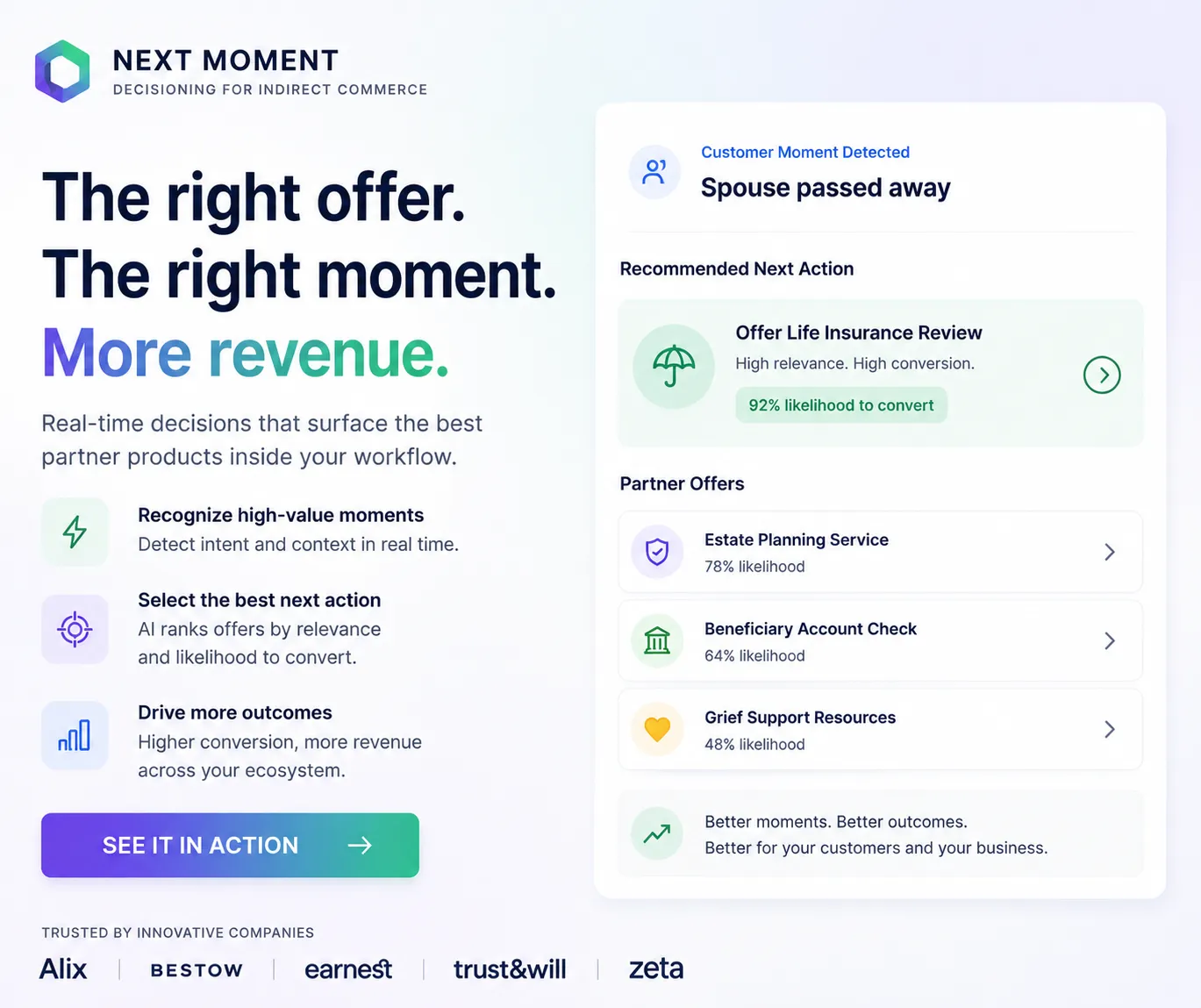
Description
No additional description provided.
The Pitch
The interesting business here is not “more recommendations.” It is that distribution is moving into places where the seller does not control the front door. Banks, payroll platforms, vertical SaaS tools, marketplaces, insurers, and healthcare systems all sit inside high-intent moments, but most of those moments are commercially underused because no one wants to turn trusted workflows into messy ad inventory. A neutral decisioning layer could make indirect selling feel less like promotion and more like operational relevance.
The durable insight is that the most valuable commercial signal is often not identity, but circumstance. A customer changing jobs, filing a claim, forming a company, missing a payment, inheriting assets, buying equipment, or adding an employee is revealing a need before they search for a solution. Today those signals are trapped inside systems that were built to complete tasks, not interpret opportunity. A business that can read those transitions and translate them into the right next action would sit close to demand at the moment it becomes legible.
This could also solve a trust problem that affiliate and referral models never fully solved. Most partner commerce is optimized by whoever pays the most or whoever negotiated the placement, which slowly teaches users to ignore it. But in regulated or relationship-heavy environments, the host company cannot afford irrelevant offers. The winning system would have to optimize for long-term fit, compliance, timing, and customer outcome, not just conversion. That makes the product harder to build, but also harder to replace with a generic ad network.
The business becomes especially compelling because it creates a shared intelligence layer across many narrow contexts. One company may only see a few estate events, business formations, relocations, or benefit changes each month, but a networked decisioning system can learn across thousands of such moments. The advantage compounds not from owning consumer attention, but from understanding which life or business events reliably imply which next needs.
If it worked, it would quietly reprice a large category of distribution. Many companies spend heavily trying to reach customers after intent has already become competitive and expensive. This model reaches the need while it is still embedded in an existing relationship and before the customer has turned it into a shopping exercise. That is why the business is compelling: it treats workflows not as software screens, but as the new shelf space for consequential commerce.