Decision Routing Layer for AI Agents
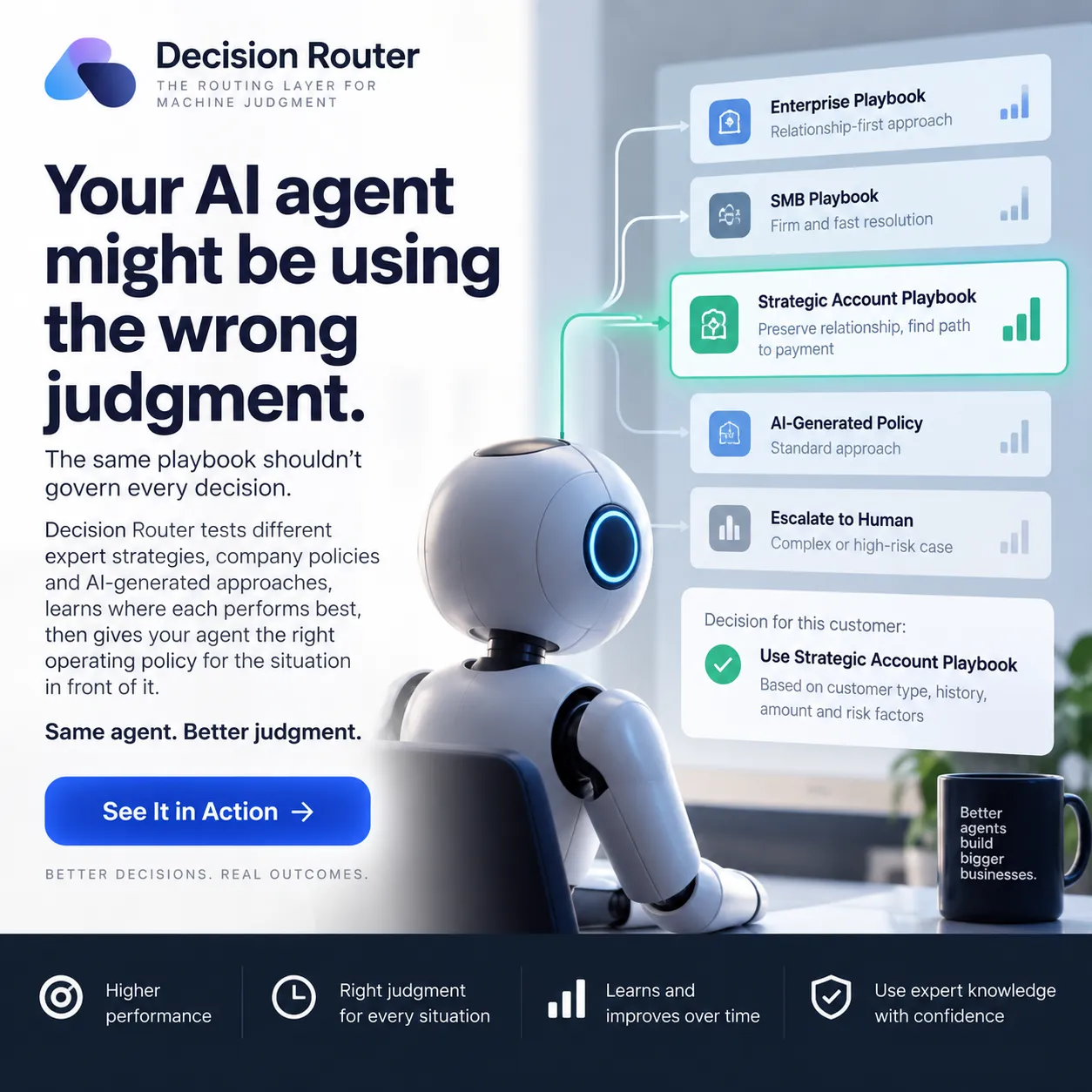
AI agents are getting access to the same models, tools, data and software, but they still need to decide how to act. The problem is that there may not be one best set of instructions for every situation. A great collections strategy for a strategic enterprise customer may be wrong for a chronically late SMB. Decision Router would test different expert playbooks, company policies and AI-generated strategies, measure where each performs best, and dynamically give an agent the right operating policy for the decision in front of it. Every decision and outcome would make the routing smarter over time. Think of it less like an Agent Skills marketplace and more like a routing layer for judgment: before an AI agent acts, Decision Router determines which proven way of thinking it should use.
Description
No additional description provided.
The Pitch
AI agents will not fail mainly because they lack access to actions; they will fail because they apply the wrong judgment at the wrong moment. Most software assumes consistency is a virtue: one workflow, one policy, one “best practice.” But many business decisions are conditional. The same customer behavior can mean loyalty risk, fraud risk, price sensitivity, confusion, or bad timing depending on the context. A company that learns which judgment works in which situation becomes valuable because it turns ambiguity into an asset rather than a source of brittle automation.
This would also create a new kind of institutional memory. Today, much of a company’s operational intelligence lives in scattered playbooks, manager preferences, exception handling, and employee instinct. When people leave, that judgment leaks out. When teams scale, it becomes inconsistent. If every agent decision is tied to a strategy and an outcome, the organization gradually builds a map of its own decision ecology: not just what it does, but when each way of thinking performs well. That is more durable than a prompt library because it compounds around evidence, not authorship.
The business becomes more interesting as AI agents proliferate inside companies. A single agent can be tuned manually. Hundreds of agents making thousands of semi-autonomous decisions cannot be governed by hand-written instructions alone. The more agents touch customers, money, compliance, inventory, or employees, the more valuable it becomes to separate “what the agent can do” from “how the agent should decide.” That routing layer could become the control plane for judgment across many systems, especially in messy domains where the cost of being confidently wrong is high.
There is also a subtle alignment advantage. Companies will not fully trust autonomous agents if improvement means letting them freely improvise. But they may trust a system that tests bounded strategies, compares outcomes, and shifts behavior toward approaches that demonstrably work. It gives organizations a middle path between rigid automation and opaque autonomy. The agent can adapt without becoming ungovernable, because the unit being optimized is an explicit operating policy rather than an unknowable internal impulse.
If this existed, its power would come from making expertise measurable at the level where businesses actually operate: individual decisions under changing conditions. The prize is not better prompts. It is a living market of judgment inside the company, where different ways of acting compete, specialize, and improve.