Decentralizing AI Power: The Global AI Grid
Every country is racing to build datacenters — but the future of AI power shouldn’t be owned by a few hyperscalers. The Global AI Grid would decentralize compute at planetary scale, turning idle hardware, underused solar farms, and even private GPUs into a globally orchestrated AI utility. Picture a new kind of public infrastructure — half hardware, half protocol — that intelligently routes workloads across millions of nodes for the lowest cost, carbon, and latency. It would make AI power as accessible as water or electricity, letting any school, startup, or small lab plug in and train. Instead of five companies owning intelligence, the world would.
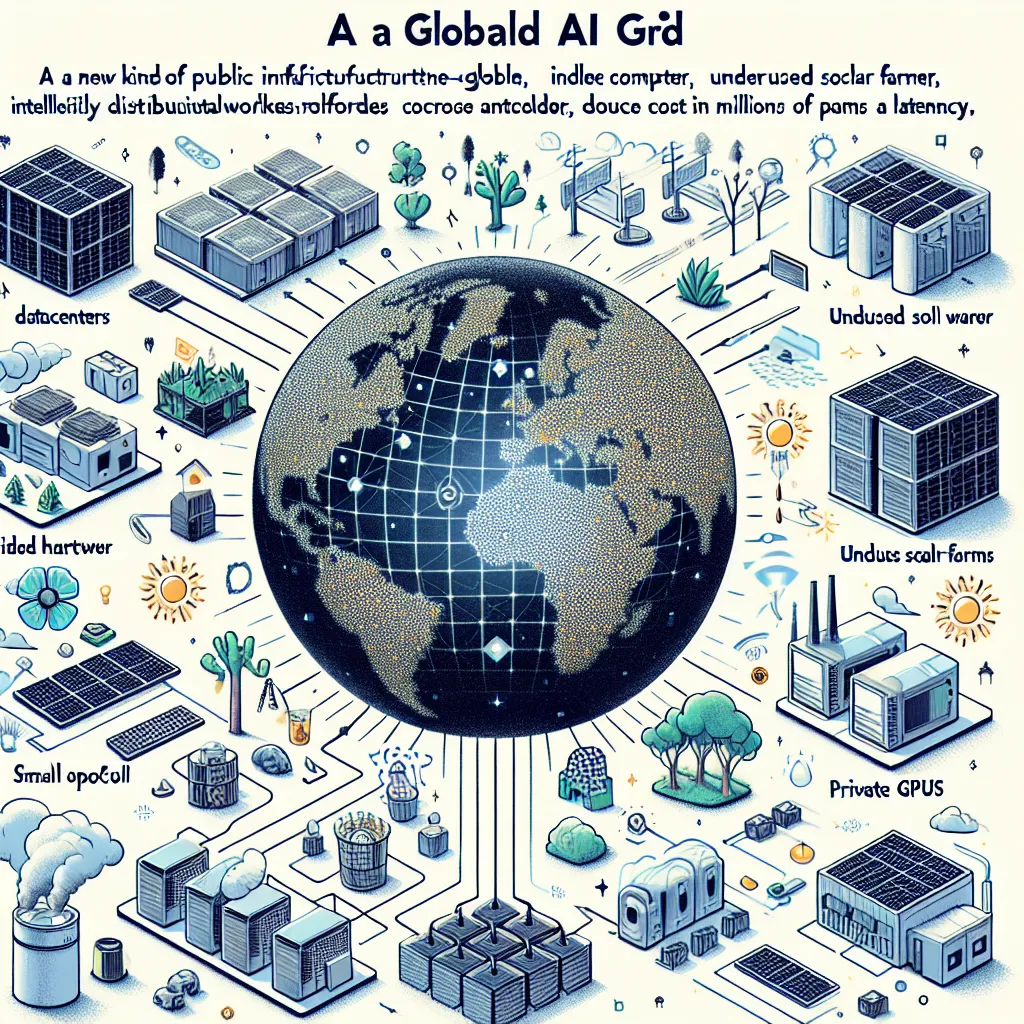
Description
No additional description provided.
The Pitch
Building a planetary-scale AI infrastructure presents an exciting opportunity to democratize access to computational power, ensuring that advanced AI capabilities are not limited to a few major corporations. Instead, this vision aims to create a decentralized compute network known as the Global AI Grid, which would integrate idle hardware, underused renewable energy sources, and distributed personal computing devices into a unified AI utility.
**Backstory**
The explosive growth of artificial intelligence has seen significant investments in data centers across various countries. The demand for computational power continues to surge, driven by more complex AI models and applications. However, this has resulted in a concentration of resources among a handful of hyperscale cloud providers, leading to concerns about accessibility, equity, and sustainability.
**Problem**
The current centralization of compute resources entails several drawbacks:
1. **Limited Access**: Smaller entities such as startups, educational institutions, and independent researchers often face high barriers to accessing advanced computational resources.
2. **Environmental Concerns**: Building and maintaining massive data centers consume significant energy, contributing to carbon emissions and environmental impact.
3. **Monopolization Risks**: The concentration of AI capabilities in a few companies threatens innovation and competitive balance, potentially stifling smaller players and varying perspectives.
**Solution**
The Global AI Grid proposes a solution by creating a distributed network to decentralize AI compute power. This would leverage:
- **Idle Hardware**: Utilize existing computational resources that are underused or idle, such as personal computers, mobile devices, and gaming consoles.
- **Renewable Energy Sources**: Integrate underutilized solar farms and other renewable energy assets to provide sustainable power for AI workloads.
- **Decentralized Protocols**: Implement intelligent routing protocols that optimize task allocation based on cost, carbon offset, and latency considerations.
**Product Details**
The Global AI Grid would function as a hybrid infrastructure combining physical hardware and software protocols. Its key features include:
- **Node Integration**: Seamlessly connect a wide range of devices and infrastructures to the network.
- **Workload Orchestration**: Automatically distribute AI tasks to optimal nodes, ensuring efficiency and reliability.
- **User Interface and API**: Provide a user-friendly interface and robust APIs to allow easy access and integration with existing AI solutions.
**Tools for MVP Launch**
1. **Cloud Computing Platforms**: Use cloud services for initial development and testing.
2. **Blockchain Technology**: Leverage blockchain for secure and transparent management of decentralized resources.
3. **AI Frameworks**: Utilize existing AI frameworks to test the orchestration of distributed training and inference tasks.
4. **DevOps Tools**: Implement DevOps practices for continuous integration and deployment, ensuring iterative improvement.
**Go-to-Market Strategy**
- **Pilot Projects**: Collaborate with educational institutions and startups to test the MVP and gather feedback.
- **Partnerships**: Form alliances with hardware manufacturers and renewable energy providers to expand the network.
- **Community Engagement**: Build a community of developers and early adopters to drive interest and contributions.
**Business Model**
- **Subscription Services**: Offer tiered subscription plans based on usage, catering to different organizational sizes and needs.
- **Profit Sharing**: Create a revenue-sharing model with node providers, incentivizing participation.
- **Freemium Model**: Provide basic access for free, with premium features available at a cost.
The Global AI Grid envisions a future where AI power is a universally accessible resource, fostering innovation and equitable progress. By shifting towards a decentralized model, it aims to create a more sustainable, inclusive, and balanced AI ecosystem.