DebateMapper: Visualizing the Evolution and Patterns of Online Discussions
Description
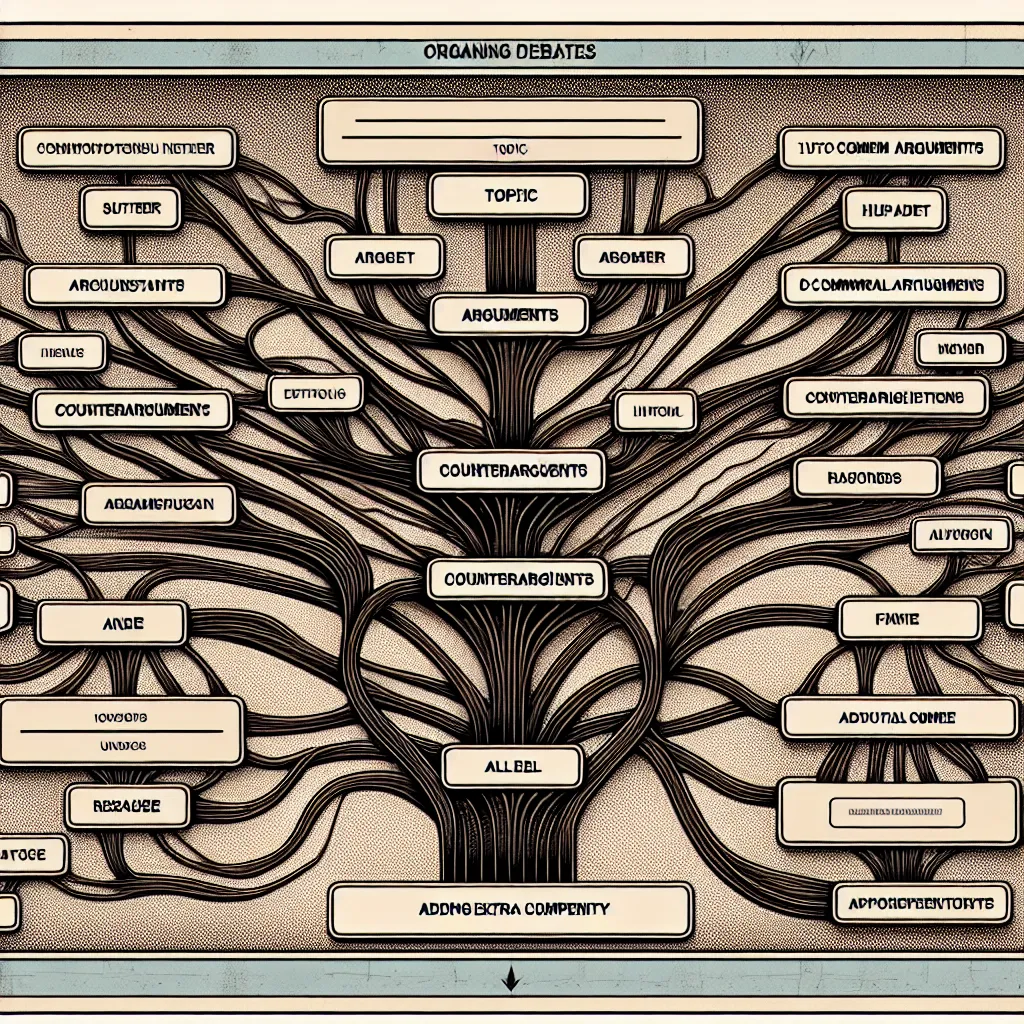
The concept is to create a website with a flowchart for mapping discussions. It begins with a main topic, branching into common arguments, counterarguments, and further responses. This visual layout aims to streamline debates by showcasing how arguments evolve and identifying repetitive patterns. It helps users see where their points stand in a discussion and when a point has been countered. Inspired by the irony in xkcd's "Competing Standards" comic, this tool intends to simplify discussions but risks adding another layer to the debate ecosystem it aims to organize. If well-implemented, it could make discussions more efficient and understandable.
The Pitch
In both academic and casual settings, discussions can quickly become complex and hard to follow, with arguments and counterarguments piling up, leading to confusion and inefficiency in reaching conclusions or understanding. This problem also extends into the digital realm where online forums and discussion platforms often see repetitive and sprawling conversations without clear resolutions.
Solution Overview: We propose to develop a web-based tool that dynamically creates flowcharts for any given discussion topic. Starting with a primary issue, the platform will map out subsequent arguments, counterarguments, and further responses, all organized in a visually intuitive format. This will allow users to track the evolution of a discussion and clearly identify which arguments have been addressed and which remain open.
Target Audience: Our core target audience includes educational institutions, debate clubs, online forum moderators and contributors, as well as businesses that rely on structured discussions for decision-making. Additionally, this service will be highly beneficial to anyone involved in policy-making, legal arguments, or any field where structured arguments are pivotal.
Value Proposition: Our tool promises to bring unprecedented clarity to discussions by visually mapping out dialogue. This will help in recognizing redundant arguments, understanding the flow of debate, and quickly identifying the critical points that have or have not been addressed. It will serve as a vital tool for educators, students, professionals, and casual users, making their discussions more productive and insightful.
Market Analysis: The demand for effective communication tools is ever-present in educational technology, business solutions, and online community platforms. With the increasing complexity of online interactions and the constant search for innovations that enhance clarity and efficiency in communication, our solution will be well-positioned. Competitors might include traditional forum and thread platforms, but none currently offer a dynamically evolving visual map of discussions.
Implementation Plan: 1. Prototype Development: Building a basic version of the platform capable of handling simple discussions. 2. Testing & Feedback: Deploy the prototype in controlled environments such as local debate clubs and online forums to gather comprehensive feedback. 3. Feature Expansion: Develop additional features like AI-driven suggestions for likely arguments and integration with popular online discussion platforms. 4. Launch: Release the fully-featured product to our primary markets, accompanied by a marketing campaign targeted at academic institutions and online platforms. 5. Scale: Expand server capabilities and refine the UX to handle larger user bases as the tool gains traction.
Monetization Strategy: Initially, the platform will be offered for free to build a user base and collect valuable data. Monetization will be introduced through: - Subscription models for advanced features (e.g., integration with other platforms, enhanced analytics). - Licensing deals with educational institutions and corporations. - Ad-supported revenue for the free version of the tool.
Impact Assessment: The tool’s success will be measured by its adoption rate in identified markets and the reduction in time and complexity of discussions observed by users. User feedback will be continually analyzed to refine the tool, and several key metrics, such as user engagement rates and the frequency of resolved discussions, will be tracked. Success in these areas will indicate a significant positive impact on the efficiency of discussions and debates across various fields.
This tool will not only ease the process of understanding complex discussion flows but also foster more focused and meaningful academic and professional dialogues. As discussions become more transparent and less repetitive, the overall quality of communication within critical fields such as education, law, and policy-making could see considerable improvements.