Customer Portability Platform for Embedded Products
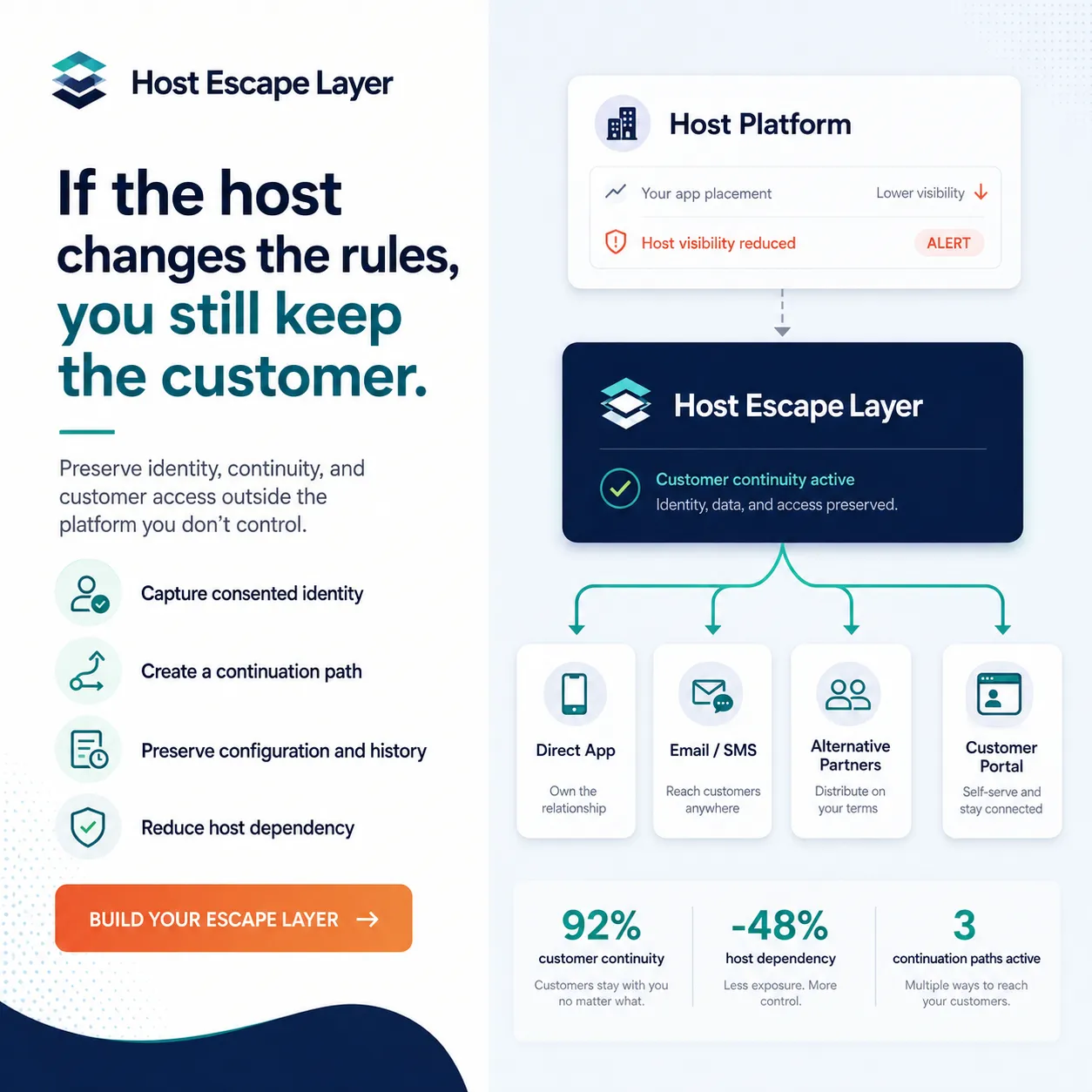
Some companies cannot diversify because their product lives deeply inside one dominant host. For them, the product should make the customer relationship portable. Host Escape Layer would sit between the vendor and host, capture consented identity, product configuration, history and entitlement data, and create an independent continuation path if the host changes placement, removes the product or decides to build it internally. Why now: embedded products are increasingly valuable precisely because they live inside someone else's workflow, while APIs and identity infrastructure make it possible to preserve more of the customer relationship outside that host. Example: a financial feature lives inside a bank app. If the bank stops merchandising it, eligible customers can still continue through a direct or alternative-partner experience rather than disappearing overnight.
Description
No additional description provided.
The Pitch
Platform dependency as a balance-sheet risk, not merely a distribution risk. Many embedded products appear healthy while they are actually renting the most important asset they have: the customer relationship. Revenue, usage and trust may all be flowing through someone else’s interface, which means the business can lose not because customers stopped wanting the product, but because the host changed its priorities. A company that makes those relationships portable would turn a fragile embedded business into something closer to an owned franchise.
The subtle insight is that the best time to preserve customer continuity is before anything goes wrong. Once a host demotes, replaces or removes a product, the vendor often discovers that it does not know enough, cannot contact enough people, or lacks the permissions to serve them elsewhere. The value is not in emergency migration alone; it is in quietly accumulating the consent, context and entitlements that make an emergency survivable. This is insurance against platform power, but with operating value every day because the same data improves service, support and personalization.
It also changes the negotiation between hosts and vendors. Today, dominant hosts can behave as though replacement is clean: remove the embedded product, swap in an internal version, and assume the vendor’s customers are effectively captive. If the vendor has a credible continuation path, the host no longer controls the full downside. That does not eliminate dependency, but it makes the dependency less one-sided. A portable relationship layer becomes a kind of bargaining power that is hard to see from the outside but very real when contracts are renewed.
The business works best where the embedded product is important enough for the end customer to miss, but invisible enough that the host has historically owned the relationship by default. That tension creates the opening. If customers do not care, portability is worthless. If customers already have a direct relationship, the layer is unnecessary. The valuable middle is large: products that are trusted, regulated, configured, personalized, or financially meaningful, yet still hidden inside a larger channel.
The larger shift is that distribution and ownership are becoming separable. The host may remain the best place to acquire and serve customers, but it should not be the only place the customer can exist. A company built around that premise would be selling continuity in a world where the most attractive distribution channels are also the most dangerous.