Customer Outcome Measurement Planning Tool
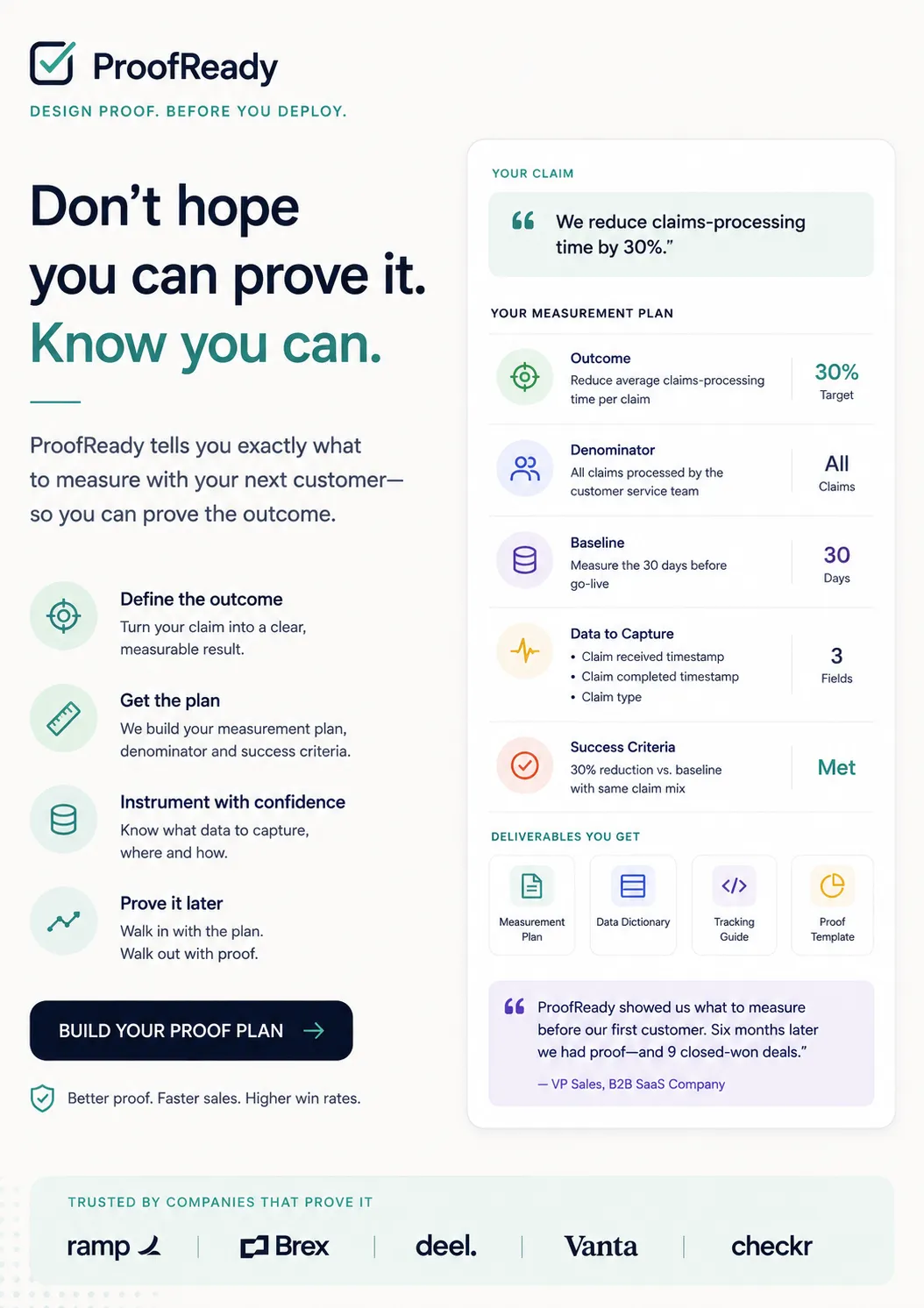
A company enters what it sells and the outcome it claims, and ProofReady tells it exactly what must be measured from the next customer to prove it. It generates the baseline, denominator, instrumentation plan, customer questions and proof template before deployment starts. Why now: AI makes it possible to translate messy product claims into structured measurement plans instantly, while companies routinely discover too late that the data needed for a case study was never collected. Example: “We reduce claims-processing time by 30%” becomes a six-field measurement specification that can be installed with the next customer. The product starts as a $500-$1,500/month proof-design tool and can grow into the actual measurement infrastructure.
Description
No additional description provided.
The Pitch
Proof is usually treated as a marketing artifact, but it is really a data supply chain problem. By the time a customer is happy enough to be a case study, the counterfactual is gone, the baseline is fuzzy, and the strongest claim has to be softened into something anecdotal. A business that moves proof design to the moment before deployment would sit at a strangely valuable choke point: it determines whether a future success story will be measurable at all.
The non-obvious wedge is that most companies do not fail to prove value because they lack dashboards. They fail because nobody translated the commercial promise into measurable units early enough. “Save time,” “reduce risk,” and “improve quality” sound concrete in a sales deck but dissolve when a customer success manager has to ask what counted, who counted it, and compared to what. A tool that forces this translation before the product goes live turns claims into assets that can be reused across sales, onboarding, customer success, and marketing.
The business is compelling because it converts a painful, recurring embarrassment into a routine operating habit. Every company that sells outcomes eventually needs evidence, and the cost of missing evidence compounds: weaker case studies, slower enterprise sales, skeptical buyers, and internal confusion about whether the product actually worked. The value is not in producing prettier testimonials; it is in making sure the company does not accidentally waste its best customer outcomes by failing to capture them.
There is also a powerful alignment hidden inside the product. Buyers increasingly distrust broad performance claims, while vendors increasingly need sharper proof to stand out. ProofReady would make both sides more honest without requiring either side to become more sophisticated about measurement. The customer gets a cleaner definition of success, and the vendor gets evidence that can survive scrutiny. That makes the product less like a marketing tool and more like a trust protocol for commercial relationships.
If it expands into measurement infrastructure, the company could own the connective tissue between promise and realized value. Many systems record activity after the fact, but few begin with the claim itself as the organizing object. A company that knows what every customer was supposed to prove, what baseline was captured, and which outcomes were actually observed would accumulate a rare dataset: not just how products are used, but which business promises reliably become true.