Customer Acquisition Channel Risk Analysis Platform
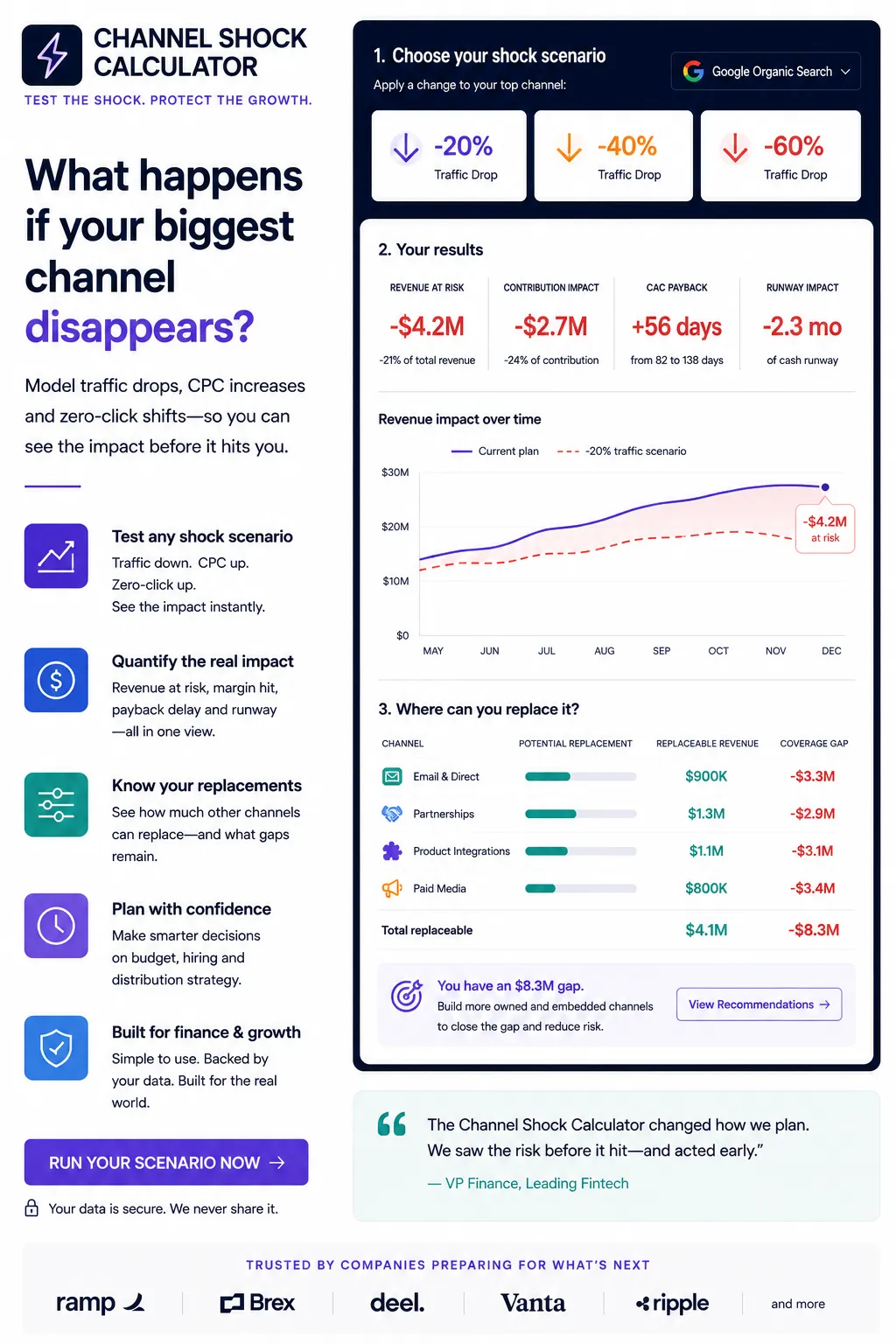
A company connects or uploads traffic, revenue and CAC by source. The product asks: what happens if your biggest acquisition channel gets 20%, 40% or 60% worse? It calculates revenue exposure, payback impact, runway effects and how much replacement volume each alternative channel would need to create. Why now: the underlying data already exists in analytics and finance systems, while companies increasingly need to scenario-plan for platform changes rather than assume yesterday’s traffic continues. Example: a business learns that a 30% reduction in organic-search traffic removes $4.2M of annual contribution margin and that its current owned channels would replace only $600K.
Description
No additional description provided.
The Pitch
Most companies do not know they are dependent until the dependency is repriced. A channel can look healthy for years because it is cheap, familiar, and embedded in every forecast. Then an algorithm change, auction shift, privacy rule, marketplace policy, or AI interface quietly turns yesterday’s distribution advantage into an uninsured liability. The product’s value is not better attribution; it is making distribution fragility visible in financial terms before the shock arrives.
What makes this especially interesting is that channel concentration is usually discussed in marketing language, while the consequences land in boardroom language. A 30% traffic decline is easy to debate; a six-month payback extension, margin compression, or shortened runway is harder to ignore. The business works because it translates a messy operating risk into the unit that executives already use to make tradeoffs: cash. That translation changes the buyer from someone optimizing campaigns to someone protecting the company’s future shape.
The non-obvious insight is that replacement volume is often far more revealing than loss size. Knowing that one channel could lose $4 million is alarming, but knowing that every other channel combined could replace only a fraction of it is clarifying. It exposes whether diversification is real or cosmetic. Many companies believe they have multiple acquisition channels because reports contain multiple rows; in reality, they may have one engine and several ornaments.
There is also a durable behavioral advantage here: fear becomes useful when it is specific. Generic warnings about platform risk are easy to dismiss, because they sound like strategy theater. But a model that says, “If this channel worsens by 40%, these three assumptions in next year’s plan break” creates a recurring planning habit. It can sit between finance and growth teams as a shared truth machine, not another dashboard competing for attention.
If this company existed, its best customers would not use it only when something goes wrong. They would use it whenever they commit to a forecast, approve a marketing budget, enter a new channel, or explain resilience to a board. The enduring business is not in predicting which platform breaks next. It is in becoming the system that shows how breakable the company is.