Curated Business Event Audience Service
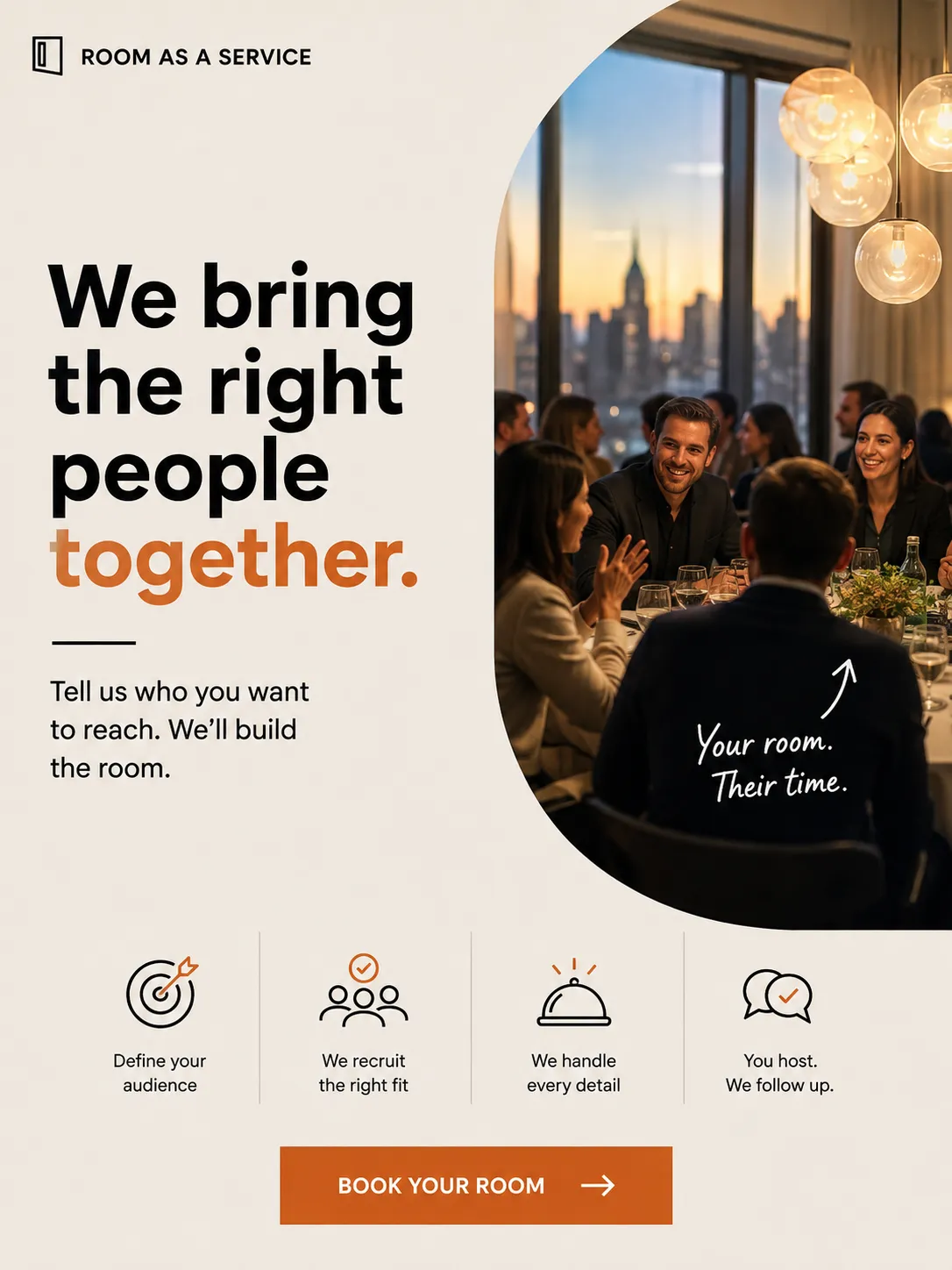
Companies are rediscovering small breakfasts, dinners, salons, and workshops as powerful distribution, but assembling a genuinely valuable room is still mostly manual: spreadsheets, personal networks, cold invitations, venues, speakers, and crossed fingers. Room-as-a-Service would let a company request an audience — “30 fintech executives in New York interested in AI” — and have the entire room assembled for them, including attendees, complementary brands, hosts, venue, programming, and follow-up. As digital customer acquisition becomes saturated with AI-generated content and outbound, companies will increasingly pay to get the right 30 people physically together. Instead of spending $40,000 sponsoring a conference hoping the right buyers walk past your booth, buy the room.
Description
No additional description provided.
The Pitch
Turns distribution from a media problem back into a social architecture problem. Most companies do not need more impressions; they need a specific set of people to trust them, remember them, and associate them with a topic. A well-composed room does that in a way no ad unit can: it borrows status from the host, relevance from the guest list, and urgency from the fact that everyone is briefly in the same place.
The scarce asset is not event planning, but curation. Anyone can rent a private room and order wine; very few can reliably know which thirty people should be there, who should not be there, what pretext makes attendance feel worthwhile, and how to avoid the room becoming a disguised sales call. If this company worked, its real product would be judgment encoded into a repeatable system: the ability to make attendance feel like an opportunity rather than an obligation.
There is also a subtle shift in how business relationships are formed. As inboxes fill with automated personalization and feeds fill with synthetic expertise, physical presence becomes a stronger signal. Showing up to a small dinner costs time, attention, and social risk; that cost is precisely what makes it meaningful. The room becomes a filter. People who would ignore ten emails may attend one intimate gathering because the guest list itself is information.
This business would improve with use because every room creates proprietary social data that is hard to scrape: who actually shows up, who brings energy, who influences whom, which combinations produce follow-up, which topics are becoming commercially alive before they are obvious online. LinkedIn knows the public graph; a company like this would learn the private graph of professional curiosity and trust.
The most interesting version is not an events agency with software, but a market maker for high-context business attention. Conferences sell access to crowds, and ads sell access to audiences. This would sell access to a moment when the right people are unusually open to each other. If it can consistently manufacture that moment without making it feel manufactured, it sits on a rare kind of demand: companies will always pay to be in the room where their future customers, partners, and category-definers are forming opinions before the market has named them.