CRM for In-Person Event Attendance
Companies track every digital signal imaginable — opens, clicks, pageviews, downloads — but barely capture one of the strongest signals of intent: who keeps showing up in person. The Room Graph would be a CRM layer for physical gatherings, tracking who attended, returned, brought someone, met whom, and what topic or product got them there. As AI makes digital engagement increasingly cheap and automated, spending 90 minutes in a room becomes unusually expensive and meaningful behavior. A company like Gamma could discover that 12 heads of growth attended multiple events, five brought colleagues, and three work at target accounts, then automatically invite that cluster to a private dinner or route them to sales. HubSpot tells you who clicked. The Room Graph tells you who showed up.
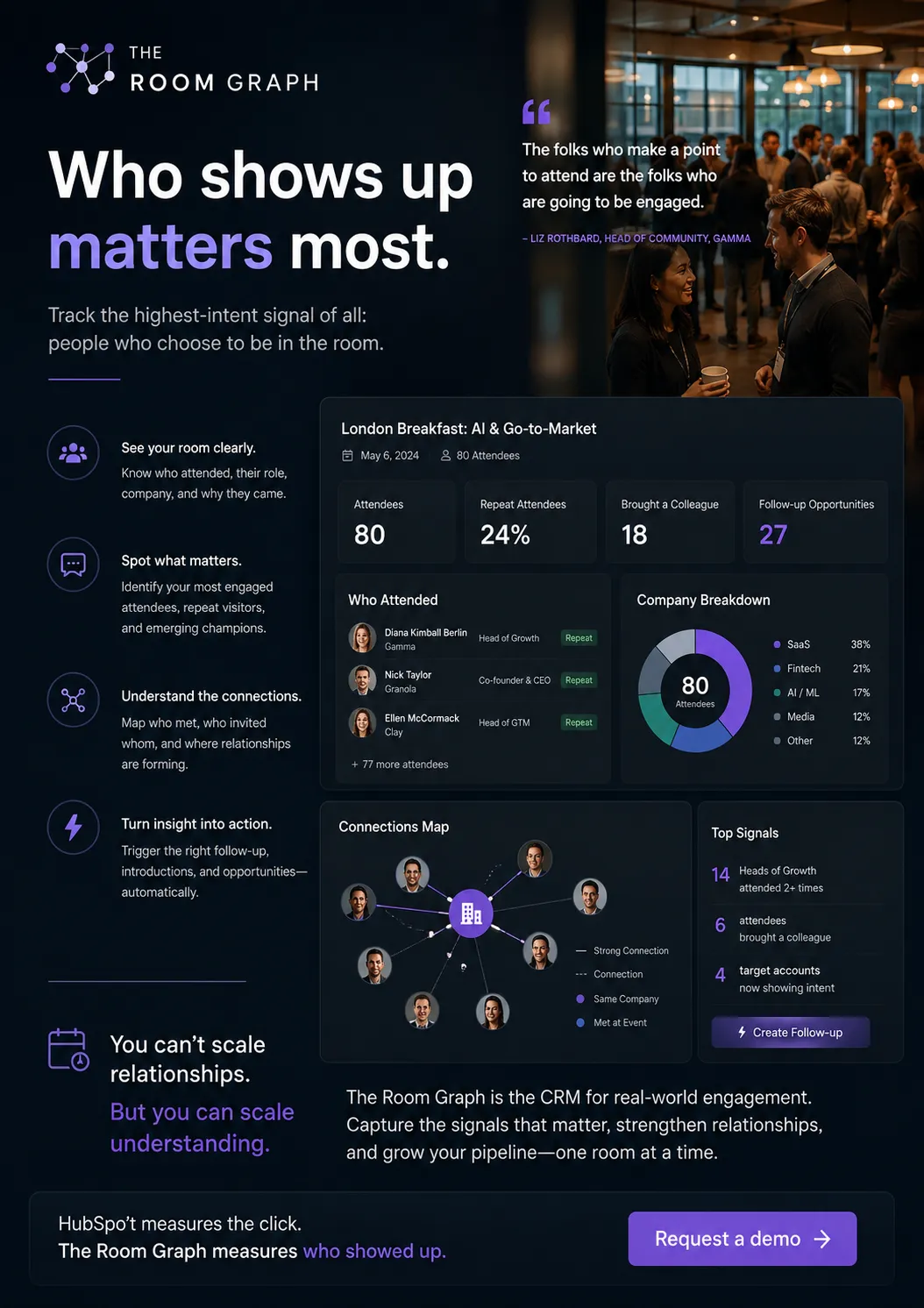
Description
No additional description provided.
The Pitch
Physical attendance is becoming one of the few remaining signals that cannot be cheaply faked. A click can be bought, automated, delegated, or generated by accident. Showing up somewhere requires calendar space, travel time, social risk, and attention. As digital behavior gets noisier, the relative value of embodied behavior rises. The room becomes a filter.
The deeper opportunity is that most companies already spend money creating these signals, then let them disappear. Every conference, dinner, workshop, customer meetup, launch party, and community event produces a dense map of intent and affinity, but the data is usually trapped in spreadsheets, badge scans, memory, and follow-up emails. The business is not about inventing a new behavior. It is about preserving a high-value behavioral trace that companies are already paying to generate.
What makes this especially interesting is that attendance alone is less valuable than recurrence and co-attendance. The person who comes once may be curious; the person who comes three times is declaring a pattern. The two people who keep appearing in the same rooms may reveal an internal buying committee, an emerging peer group, or a community forming before it has a name. Most CRMs understand individuals and accounts, but rooms reveal clusters. That is often where the real commercial meaning sits.
There is also a subtle shift in status happening. For years, software companies treated events as brand activity: hard to measure, emotionally important, operationally messy. But in a world where every company can personalize email and generate infinite content, convening the right people becomes a scarce capability. The company that knows which rooms produce relationships, champions, referrals, and eventual revenue can treat in-person gathering less like marketing theater and more like relationship infrastructure.
The strongest version of this business would become valuable because it changes what companies remember. Organizations are full of people who “know” that someone important came to a dinner, brought a colleague, asked a sharp question, or kept returning to a niche topic. But that knowledge usually lives in human recollection until the employee leaves or the moment passes. A Room Graph would turn the social memory of a company into durable institutional intelligence. That is a rare kind of data: created offline, rich with context, and hard for competitors to reconstruct after the fact.