CRM Capacity Scoring for Sales Opportunities
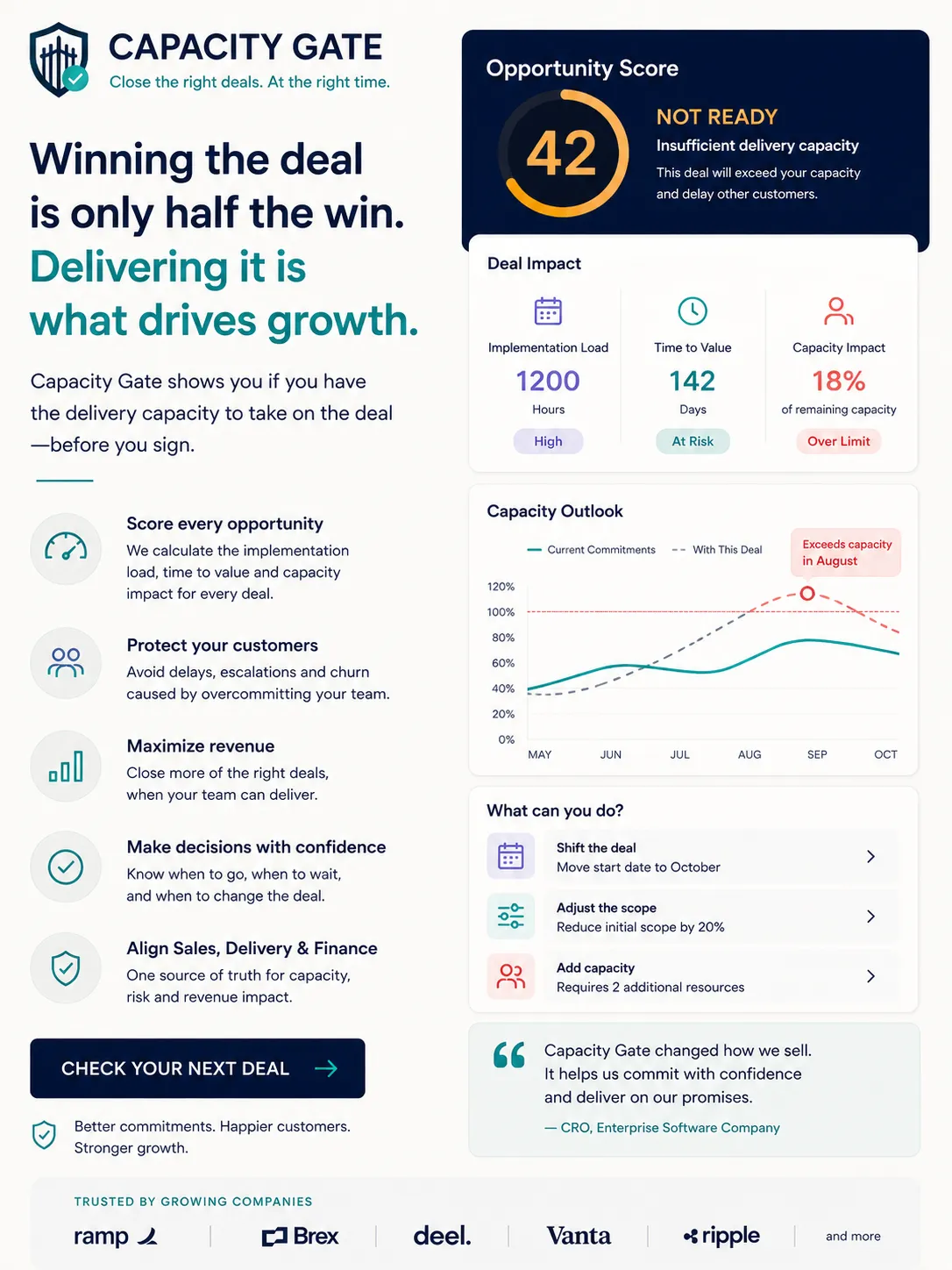
Companies approve deals based on ACV, probability and strategic value, while almost never asking whether the organization can actually deliver them on time. Capacity Gate would sit inside CRM and score every opportunity based on the implementation load it creates, available delivery capacity and expected time to revenue. Why now: companies already score whether a deal will close; the missing layer is whether it should close right now. Example: a $900K enterprise deal looks attractive in Salesforce, but Capacity Gate shows it would consume 18% of remaining deployment capacity and delay four existing customers, giving leadership the choice to change scope, timing or price before signing.
Description
No additional description provided.
The Pitch
The interesting thing about this business is that it reframes sales from a revenue-maximization function into a sequencing problem. Many companies do not lose money because they fail to sell; they lose money because they sell the wrong things in the wrong order. A deal can be economically attractive in isolation and destructive in context. The company that can make that context visible at the moment of approval would influence one of the few places where operational truth can still change the outcome.
The hidden profit pool is not in forecasting bookings more accurately, but in preventing revenue from becoming operational debt. Every custom commitment, integration requirement, security review, migration, training burden, or launch dependency is a claim on scarce organizational capacity. Today those claims are often discovered after the contract is signed, when the only available options are heroics, delays, margin erosion, or customer disappointment. A system that translates deal shape into delivery load would make capacity feel as real to sales leadership as quota does.
This would be compelling because the buyer is not merely avoiding bad deals; they are learning the true cost of their growth model. Two companies with the same ARR can be radically different businesses if one has sold clean, repeatable deployments and the other has sold a pile of exceptions. Over time, the data would reveal which products, segments, contract terms, and customer promises quietly consume the company. That makes the product less like a workflow tool and more like an economic instrument for distinguishing good revenue from expensive revenue.
It also has the advantage of sitting at a high-leverage point in the organization. By the time a customer is angry, the damage is already expensive. By the time professional services is overwhelmed, the queue is already full. But before signature, small changes still matter: phasing scope, moving a start date, charging for complexity, swapping terms, or deciding that a logo is not worth the congestion it creates. The same deal can become healthy or unhealthy depending on how it enters the system.
The deeper appeal is cultural. Most companies treat delivery capacity as a constraint to be managed after ambition has spoken. A business like this would make capacity part of the commercial conversation without asking the company to become less ambitious. It would help organizations grow with a more honest sense of what their promises cost, and in software especially, that honesty may be one of the rare remaining advantages.