Countertop Soda Recarbonation Appliance
Carbonated drinks begin losing their fizz almost immediately after they're opened, forcing people to either finish them quickly or throw away flat soda. While home carbonation machines create sparkling water from scratch, there's no simple way to restore carbonation to an existing drink. A Soda Recharge Station is a countertop appliance that reseals an opened beverage and injects the precise amount of CO₂ needed to restore it to nearly its original carbonation level. Rather than wasting half-finished drinks, consumers simply place the bottle or cup into the machine and enjoy it as if it had just been opened. As home beverage systems continue growing in popularity and consumers increasingly look to reduce waste, there is an opportunity to extend the life of millions of beverages that would otherwise be discarded. Imagine opening a Coke at lunch, forgetting about it all afternoon, then placing it into the machine before dinner and enjoying it fully carbonated again.
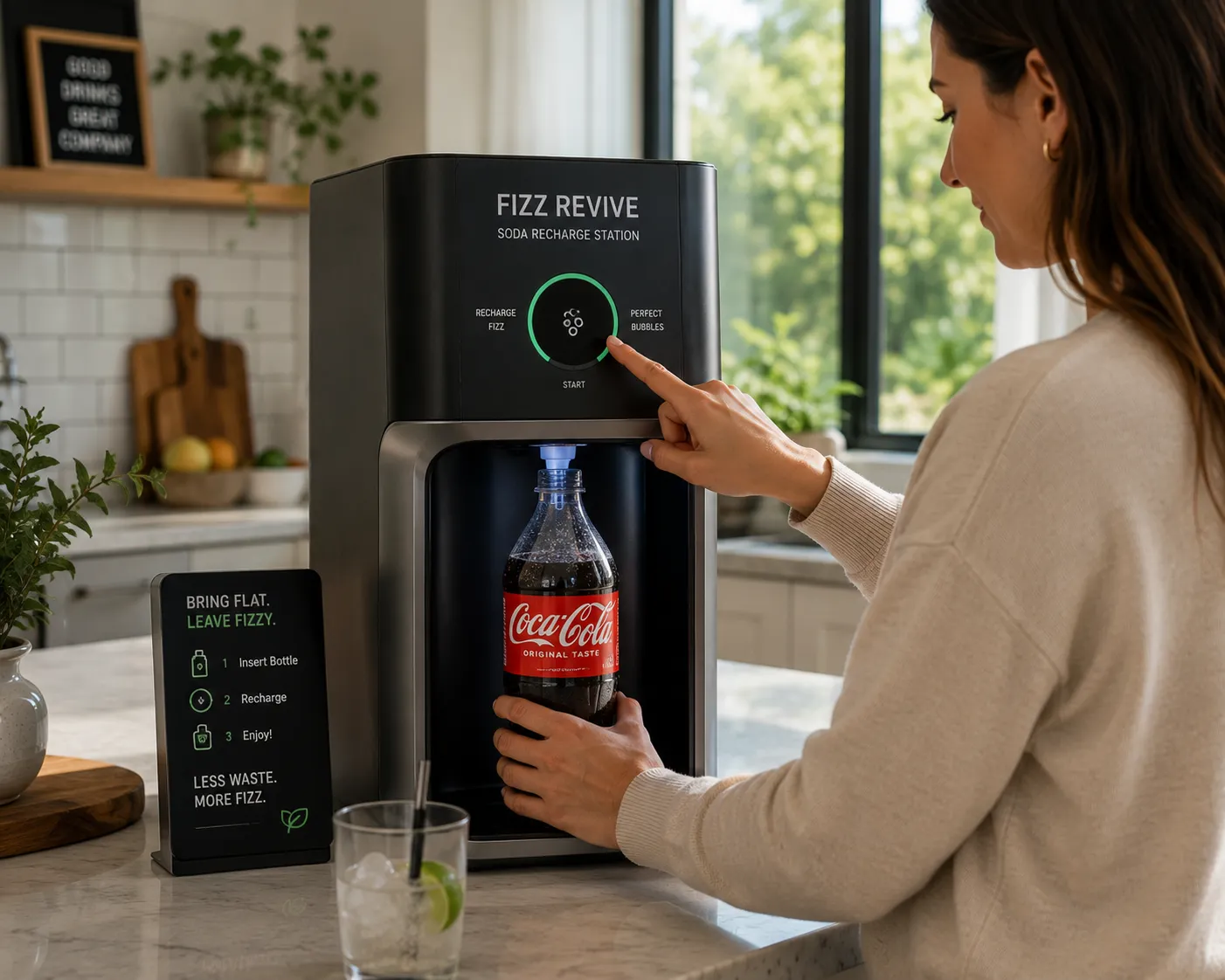
Description
No additional description provided.
The Pitch
The interesting thing about this business is that it treats carbonation as a quality that can be maintained, not a one-time attribute that disappears after opening. Most beverage appliances ask the consumer to become a drink maker. This would instead preserve the drink they already chose, which is a much easier behavior change. People do not have to learn recipes, buy syrups, or switch brands; they are simply rescuing something that has visibly degraded.
The waste case is unusually tangible. Many household waste problems are abstract, but flat soda is emotionally obvious: the bottle is still there, the flavor is still there, and yet the experience is ruined. That makes the appliance less like a novelty gadget and more like a small act of domestic recovery. It gives people permission to buy larger formats, open drinks casually, and stop treating carbonation as a countdown timer.
It also sits in a neglected gap between beverage brands and home carbonation machines. Soda companies are optimized around sealed containers, while carbonation systems are optimized around plain water. Neither has much incentive to solve the half-finished drink problem, because it lives after purchase and outside the original packaging experience. A company built specifically around “after-opening beverage quality” could own a category that is currently no one’s responsibility.
The most compelling version would not be about making flat drinks “acceptable.” It would be about restoring the ritual of a fresh opening. Carbonation is disproportionately tied to perceived freshness, temperature, and indulgence; when it disappears, the drink feels old even if it is perfectly safe. If the machine can reliably recreate that first-sip sensation, it is selling more than CO₂. It is selling back the part of the beverage people actually paid for.
There is also a quiet household economics to it. The appliance would be most valuable in homes where consumption is irregular: families with kids, people who drink soda occasionally, hosts, offices, and anyone who opens more than they finish. In those settings, waste is not caused by lack of interest but by bad timing. A recharge station turns beverages from perishable moments into inventory, which is a surprisingly powerful shift for something as ordinary as soda.